Tag Archives: aftermath

The Making of the Squid, Part 4

The Making of the Squid, Part 1     Part 2     Part 3

You can read the rest of the Aftermath stories here or here.
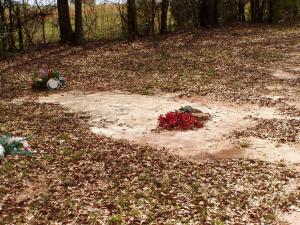
unmarked grave

Edward buried Ramya in the backyard of the house, between two beech trees. There was no funeral, but a few of the residents came to give their condolences. The children clumped together around the edges of the yard, looking lost.

“What are we going to do now?” Hazel asked when they had all gone back inside the house and were sitting despondently in the living room.

“What are we going to do?” Edward repeated, forcing a smile onto his face. “We just gonna—we’re gonna keep going, right? I’m Uncle Octopus, remember? I got this.”

A few of the younger ones smiled at this. Then Meredith came over and climbed onto his lap. Cala and Lalasa followed, with Ernesto toddling behind and after a moment, all the kids—even Hazel and Portia, the older ones—were around him, crying and hugging him. Part of him wanted to fling them off and go get blackout drunk somewhere, but he restrained himself and soon he felt the tears trickling down his own cheeks.

The rest of the community responded to his plight and for a while once again, women came in from time to time to help him cook and clean. Portia, Hazel, and Sean helped as well, although never as much as Edward wanted. He had to remind himself that they were children, and children who had just lost their families and the only life they had ever known. Sometimes they would break down in tears out of nowhere, and go off by themselves for hours at a time.

As for Edward, he threw himself into work, drugging himself with exhaustion. Life soon fell into a routine: up at sunrise to make breakfast for the children, then out collecting food and supplies from abandoned houses. Back to make lunch and clean the house around noon, and then do it all again in the afternoon and evening. He fell into bed soon after sunset, too tired to even think.

The electricity had died soon after August 4, the day the missiles fell, but the water kept running in the taps. Kaine Bowlery told him that the water system was all automated and should go for months by itself. But of course at some point it would break and the water would stop. So, with the help of some of the other men in the town, they were building huge cisterns to catch rain water. It was slow, frustrating work and none of them had had experience building anything before.

Eight days after Ramya died, Edward was resting outside after lunch. The calendar said it was September 1 and the weather remained warm and deceptively cheerful. Sean came over and sat by him. They sat together in silence for a moment.

“You don’t go back to check our houses anymore,” Sean said.

“The note’s still there,” Edward said. “Your parents can find their way here. I just don’t want to waste power, now that we can’t charge the cars anymore.”

There was a moment of silence. “They’re not coming back, are they?”

“We don’t know that,” Edward said. “Roads are a mess. It could have taken weeks for your mother to find your father and it could take longer to get back here. They could be on their way back now, especially if they have to walk.”

“I just wish I knew,” Sean said.

“I wish I did too,” Edward said. The fact was that he truly did not know. None of them did. The Internet was still working somewhere, presumably, but with the electricity out in Harlow, all battery-powered devices had died within a few weeks. Two weeks before, just before his device battery had given out, England was still in chaos. It was reported that on August 4th, there had been 96 nuclear strikes on twelve different countries. The most reliable estimates were of 150 million casualties on that day alone, not to mention the hundreds of millions who would probably die in the next year or two.

There was a scream from across the yard and Edward jumped up. It was Hugo, running towards him crying, with Kaveh and Meredith running behind. Hugo stopped in front of him, holding out his arms. Edward saw they were covered with tiny blisters, as if the boy’s skin had bubbled.

sunburn 2nd degree

“Get in the house, everyone!” he shouted. All he could think about was fallout, and cancer bombs, and Ramya throwing up her lifeblood on the upstairs carpet.

Edward examined them all and found that others kids had similar blisters and severe sunburns, although none as bad as Hugo. Meredith, Hazel, Kaveh and Lalasa were all dark-skinned, but even their skin was tender to the touch in places. Still, he felt better about fallout. “It’s just a bad sunburn,” he said. “I don’t know why, but stay out of the sun for now.”

They stayed inside for the rest of the day. Edward stayed with them, until he had to go out in the afternoon to get tampons for Portia. She had locked herself in the bathroom in embarrassment and it had taken her an hour to admit the reason. Edward was embarrassed as well, and was glad they had the talk through the bathroom door.

I can’t do this, he thought. It seemed to be a thought that came to his mind every day now. It wasn’t just buying tampons for teenage girls, it was everything. This isn’t me. I’m not Uncle Octopus, I’m Eddie Morrison, a 25-year-old illustrator. He felt like he was pretending to be something he wasn’t and that it was only a matter of time before everything came crashing down. Either he would make a mistake and one of the kids would die or he would just snap and take off, leaving them to their fate. Did he even want to? He wasn’t sure.

That night, he left the kids in the care of Portia and Hazel and went to the committee meeting. Others there had bad burns and blisters from the sun and they debated it at length.

“It can’t be radiation because we’ve been taking six pills a day and I still got it,” Gray Hassick said. “And this guy over here doesn’t have a bit.” He pointed to a black man who only went by the name Abdul.

“I think I know what it is,” Heston Bowlery said. “I think the Ra-Shield has gone down. That would explain everything.”

“That’s impossible,” someone else said. “What about the triple redundancy they went on about? They said the facilities were even hardened against nuclear attack.”

Edward had almost forgotten about the Ra-Shield. It was just a background part of normal life, like running water and electricity. 40-odd years before, the UN had built a huge, globe-spanning system of machines that helped protect against ultraviolet radiation, after the ozone layer had been dangerously depleted. He didn’t know how it worked, but if it was gone . . .

“So, if that’s the case, what do we do?” he asked. “Stay inside except at night? Bring an umbrella?”

“On top of cancer bombs and fallout, we have to worry about skin cancer too?” someone said. “Humanity is screwed.”

The committee looked around at each other dismally and Edward could feel the weight of depression settle over them all.

(to be continued)

The Making of the Squid, Part 3

The Making of the Squid, Part 1     Part 2

You can read the rest of the Aftermath stories here or here.


“Do it, Eddie. Don’t be a mouse.” Ramya stared at him, her mouth set resolutely. “Do it, or I’m walking out on you.”

“You’ve said that before. You wouldn’t dare,” he said.

“You wanna bet?” She thrust a large bowl of oatmeal into his hands. “Now get out there. And try learning their names for once.”

Edward pushed through the door into the dining room. “Good morning,” he said, flashing the assembled children a wide smile through gritted teeth.

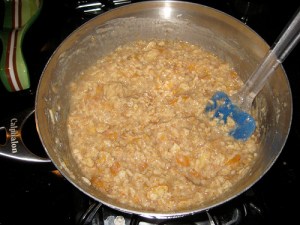
oatmeal

“Good morning, Uncle Octopus,” a girl said and giggled. Most were still yawning. There were nine children there, ranging in age from three to fourteen. Besides Sean, he knew that one of the girls was named Meredith and there was a boy named Hugo there somewhere. The three-year-old was named Ernesto, but he only knew that because the phrase “Ernesto wet himself again” was heard so frequently in the house.

“Before you get any breakfast, you have to tell me your name,” he said, plunking the bowl on the table.

“We told you yesterday,” the oldest girl (Portia?) said.

“Well, tell me again, dammit,” he said. “Sorry, just—tell me as I come around.” He tried to remember them in the order they were sitting: Sean, Hugo, Meredith, Kaveh, Hazel, Portia, Ernesto, Cala, and Lalasa. The names were muddled and gone from his head almost as soon as they told him.

“I want raisins in mine,” Cala, the four-year-old, said.

“There weren’t any raisins yesterday and there sure aren’t any today,” he said, remembering not to swear. Cala looked mournful, but picked up her spoon and started poking around the edges of her bowl.

“We’re going to need more food soon,” Ramya said when he was finished doling out the breakfast. “We have enough oatmeal for maybe another day and the rice is almost gone too.”

“Yeah, I know,” he said. “They’re little eating machines. The argument that they don’t eat much doesn’t work when there are nine of them.” He regretted it when he saw her face. He had promised not to keep bringing it up, subtly blaming her for their shortages.

It had been two weeks since they had moved into the house in Harlow and although the other residents had been generous at first, donations had dropped off quickly as stores of supplies shrank.

“I need to get everyone united somehow,” Edward said. “Other people may be able to get by on their own, but we can’t, not if you’re gonna—if we are going to have these kids here.”

She put her arms around him wordlessly and he hugged her, glad of her warm presence. He wondered what he would be doing if she hadn’t been with him. He wouldn’t be in Harlow, that was for sure. Most likely hoofing it along the coast or up to Cambridge like everyone else. He squeezed her harder and she grunted.

“You okay?” he asked.

“I got a bad stomach. Just tired, I think.”

He looked at her closely, then gave her a quick kiss. “Taking care of nine kids makes you tired? That’s crazy talk. Get some of the older ones to help and take the day off. I’m off to get some unity around here.”

Edward skipped breakfast and walked downtown. Now that the residents of Harlow numbered only a few hundred, they had drawn closer together, most living within a kilometre of each other in the town center. Edward got some spray paint and a ladder from a hardware store and went to the main roundabout in town, where there was a large blank wall of an electronics store. Carefully, he wrote with the spray paint, trying not to smudge the letters. Then he sat down underneath it and waited. Twenty minutes later, people began to gather around him, reading the message in huge, red letters:

It isn’t about survival

It’s about redemption.

It isn’t about existing

It’s about living.

It isn’t about me

It’s about us. [*]

“What does that mean, exactly?” asked Noah Crawford, a lawyer who had just arrived from a neighboring town with his family.

“It means we need to cooperate,” Edward said. “Each of us can get all the things we need, for a while maybe and while the weather is good, but what about later? What happens when it’s stormy or people starting getting sick and each of us runs out of food or medicine or drinking water? We need organization. We need to work together. We can’t do it on our own, but together, we have a chance.”

“And with you as the leader, I suppose?” Crawford asked.

“No leader,” Edward said. “Just a committee. It’s not about me, or you, it’s about us.” He could see that the idea appealed to them and he saw also that even with his proposal of a round table committee, he would be the natural leader, if only because he had come up with the idea. People look for a strong leader in times of uncertainty, he thought.

“We’ll meet tonight, in the Food Collective. Anyone who wants to be a part of it is free to come,” he said. There were many nods of agreement. No one argued. He was practically their leader already. Once he headed the committee, he and Ramya would never lack food again. He gave a warm, reassuring smile.

Thirty-six people attended the meeting, just over a quarter of the town’s current population by their best estimates. Jacine Ramm volunteered to be in charge of the census, to make sure no one was overlooked for food or necessities. The Crawfords—Noah and his wife Nikola—offered to be in charge of medicine distribution since Nikola was a nurse practitioner. Edward, Kaine Bowlery, and his son Heston were in charge of food collection and distribution. The evening went perfectly and Edward walked home feeling the happiest he had since the world Before had ended. Already they were referring to that time simply as Before and it was starting to seem like a dream.

“Eddie, is that you?” a voice called from the darkness in front of his house. It was Portia, standing on the porch. “Come quick, Eddie. Ramya’s sick.”

Fear struck Edward in the chest. He rushed into the house and upstairs. Children seemed to be crying all around him. He reached the top and recoiled at the pool of bloody vomit just outside the bathroom door, spatters flecking the door and walls nearby. Ramya was inside, her head resting on the toilet seat and Hazel, in tears, holding back her hair.

“Ramya, what the hell! What’s wrong?” No. No, it couldn’t be. No. Suddenly, he was terrified.

“I’m sorry, Eddie,” she said in a weak voice. “I didn’t feel well after dinner. I’ll clean it up, don’t worry.”

“Forget that. I need to get a doctor. I’ll be right back.”

It took thirty minutes for Edward to find Nikola Crawford and return with her in tow, almost dragging her along. Ramya had cleaned up a little and was in bed.

“Have you been taking your medicine, the Abadocil?” Nikola asked her, after examining her.

“Yes, every day,” Ramya said.

“How many times a day? The directions say three a day, but I would suggest up to five or six a day for adults in this situation. It won’t hurt you as long as you take it with food.”

“I’ve been giving the children one with every meal, but—I was afraid it would run out, so I’ve only taken one a day. Is that the problem?”

“You’re suffering from a type of acute radiation poisoning,” Nikola said. “It’s killing you.”

Edward felt his heart suddenly squeezed with fear so intense that he felt light-headed. “What’s the most she can take in a day?” he asked. “If she took eight or ten, would it make her better quicker?”

“It’s preventative medicine, Eddie,” Nikola said, looking sympathetic. “It won’t help to take more now. The damage is done.”

“Then what can we do? Surely the hospital has something that can treat her. Machines or medicine or something.”

“There’s no power, Eddie. As for medicine, I can go look around tomorrow.”

“You go tonight,” he said. She shot him a look of anger at his tone, but then nodded quickly and left.

Ramya reached up and took his hand. “I don’t want to die, Eddie.”

“You’re not going to die,” he said. He couldn’t even conceive of the possibility; no images came to his mind. He was going to marry her. They had made plans. Then again, the whole world had had its plans.

Nikola returned three hours later, exhausted but carrying a needle and an IV bag of green liquid. After it was started, Nikola went home and Ramya drifted off to sleep, looking peaceful.

Ramya sleeping

Edward woke up on the window seat next to the bed and saw the morning rays slipping through the curtains. Ramya looked as peaceful as she had the night before. He put his hand on her cheek and felt with a shock that it was cold. He checked her pulse. Nothing. He checked it again and again, unwilling to accept it.

It took only a moment before he was trembling so hard that he had to sit down. The terrifying black abyss of What if? had arrived and he was powerless against it. He wanted to scream, and then find a gun and blow his brains out.

I can’t, he thought, and the image of the nine sleeping children came into his mind. I’m Uncle Octopus. He had never felt so alone in all his life.

(to be continued)


The Making of the Squid, Part 2

The Making of the Squid, Part 1.

You can read the rest of the Aftermath stories here or here.


Fear. It was roiled in the air as thick as the smoke from the destruction in the south. It seemed permanently etched in the faces of everyone that Edward saw.

He had gone to Harlow center to get food and to find out how things stood there. He went to the National Food Collective building and was about to enter when he saw a portly man hunkered down on a low stool just inside the door, a shotgun by his side.

“And what do you want?” the man asked, picking up the shotgun.

“I’m Edward Morrison,” Edward said. “I live out of town a ways, in Leister Cottage. Got any food to spare?”

The man deflated a bit. “Take what you want,” he said. “Whatever’s left, that is. It doesn’t matter anyway, you know. What are we supposed to do when this is gone? There’s no more food coming and money’s no good now anyway. Anyway, did you hear?” He stopped as if he expected Edward to answer. “They dropped a few cancer bombs along with the nukes. We’re all walking dead anyway.” He turned his palms up, helplessly, then sat back heavily onto his stool.

Edward opened his mouth, but what could he say? They had all heard about the Central Bloc’s new weapons. Officially, they were known as radio-mutagenic ordinance—colloquially as cancer bombs. No one knew exactly what they did, but they were supposed to be able to change cells quickly. Some said they caused mutants, most said they just caused huge tumors to grow.

“Where did you hear that?”

“The net. Where else? It could be a rumor, but—” Palms up in the same helpless gesture.

“What’s your name, sir?” Edward asked.

“Kaine Bowlery, at your service. My daughter-in-law is manager of the Food Collective, but she didn’t want to come in. I offered to come stop looters, but—”

“Yeah, I understand. I’m going to go get some things, Mr. Bowlery. It was good to talk to you.”

empty shelves

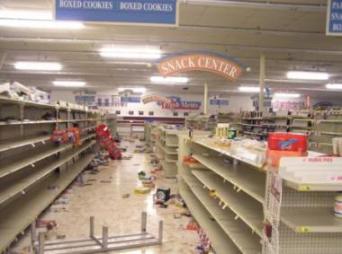
Edward loaded up a cart with what he could find, which wasn’t much. Even the pet food aisle was almost depleted. He threw the stuff in the car, then drove to Harlow National Hospital. Along the way, he saw a press of cars, loaded with possessions and driving north. The main road was so packed, he parked his car and walked the last half kilometre. The overheard snatches of conversation on the road all formed a common theme. Get away while you can. The fallout’s on it’s way. What’s the point? Cancer bombs. But the kids… What are we going to do now? Dear God, why?

The hospital was understaffed, but still manned by a few brave volunteers. One harried nurse gave Edward a once-over visual triage and seeing no obvious wounds, hurried away.

“Excuse me, I was wondering if you had any anti-radiation medication,” Edward asked, hurrying after her.

She gave him a tired glance, then pointed to the stairs. “Room 309. Join the line.”

She hadn’t been kidding about the line. It stretched all the way down the hall, but it moved fast.

“One box per person,” Edward heard as he got closer. “One box per person, no exceptions! Keep the line moving, please.”

Edward got up to Room 309 and saw an exhausted doctor sitting by the door handing out boxes of pills. A sheet of names with checks by it lay abandoned on the floor. He handed Edward a box with the word Abadocil on it and waved him on.

“I’ve got a woman and a kid at home. They’re sick. I’ll need one for each of them,” Edward said.

“One box per person, no exceptions,” the doctor said wearily.

Edward glanced behind him into the room. It was stacked floor to ceiling with cardboard boxes, all of which were printed Abadocil. “You’ve got loads of this stuff,” he said. “Spare me a few more boxes, please.”

“Look,” the doctor said, “you can’t take all this in one day anyway. Come back to tomorrow and we’ll give you another one. You want three boxes, and the next guy will want 12 and the people after that will want 100. This is all we have, do you understand? We have to make it last as long as possible. Okay?”

Edward balled up his fist, but swallowed his rage and nodded. He left and went home.

Ramya was waiting for him on the porch, looking pale, but slightly better. “I’m so glad you’re back,” she said, giving him a hug and a kiss. “I heard news of looters driving around killing and stealing things. I want to get away from here.”

“And go where, Ramya?” Edward asked. “We can’t go anywhere, especially not with Sean. Rosie could be back at any time, so until then, I’m not taking off to Edinburgh or the Orkneys or wherever people are going to. No hoarders are going to come.”

“Can we at least go into town?” she asked. “I’d feel safer being around other people, instead of out here by ourselves.”

In the end, he agreed. Kaine Bowlery was a good man and he had a gun. Edward did not have a gun, nor had he ever fired one before. He packed up what supplies he could and then the three of them drove into town.

“Where will we stay?” Ramya asked, as they drove down route B180 towards the town. “Do you think there will be any hotels open?”

“Everyone is leaving for the north,” Edward said. “We can probably pick out any house we want.”

“Will Mom and Dad be able to find us there?” Sean asked.

“I left a note on the door to check at the National Food Collective for us.” Edward said. “Don’t worry; they’ll be able to find us.”

Edward picked out a large house on a street just behind the giant National Food Collective. There was a fully-loaded car in the driveway and a man was cramming suitcases into the back. A woman and two children waited inside.

“Where you taking yourself to?” Edward asked, getting out. The man looked up in annoyance.

“Away from here. Scotland if we can make it. What do you care?”

“Can I live in your house?”

“Hell, no!” the man said. “Get back to your own house, you beggar.”

“So, when are you coming back?” Edward asked. The look on the man’s face confirmed what he thought. “You know, I can just break the window as soon as you leave. Plus, if we’re staying here, it’ll keep it safe from looters. You know, if you ever do want to come back.”

“Suit yourself,” the man muttered. He threw Edward the keys and jumped into the car, driving off quickly.

deserted town

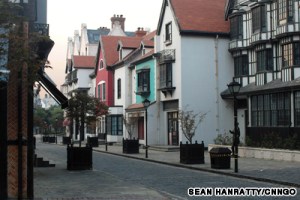
Over the next week, as most people left, the life drained slowly out of the town, like a leaf withering in the autumn chill.  Edward drove out to his house every day to see if Rosie or Mason Dodd had returned. The fifth day, when he returned, there were three more children in the house.

“What the—” he started as Ramya hurried over to him.

“They were alone outside, Eddie. The littlest is only three. I don’t know where their parents are, but I think they’re lost. They were hungry and crying. I couldn’t just leave them there.”

“We don’t have food for them all,” he whispered fiercely. “I didn’t even want to take Sean, and now we’re running an orphanage?”

“They don’t eat much, Eddie. Do you want to kick them out, let them starve?”

He turned away with a growl. “No more, okay? I’m not kidding.” He knew as he said it that they were empty words. She would bring more back if she found them and he would let her. What else was there to do?

The next day they got rid of one of the kids, a girl, when her parents came looking for her. Edward was encouraged until a woman showed up with two more children. “I hear you’re taking in children,” she said. “These two were staying with me; their parents were in London. I’d be obliged.”

“We are not taking in children!” Edward shouted at her.

“That’s fine by me,” the woman said, “but they’re not staying with me no more.” She walked away. Ramya looked at him and he swore and kicked the wall. The kids stayed.

Somehow the word spread and more children arrived. A week later, there were nine children at the house, including Sean. Edward made a sign: We are NOT taking in children!! It did no good. Ramya was too soft-hearted and Edward couldn’t say no to her. It was not all bad though. The remaining citizens heard of the impromptu orphanage and helped as they could. The Bowlery family brought them food and one of the doctors brought over a case of Abadocil. A few of the women in the neighborhood came over during the day to help out with the children. Edward tried to give them children to bring home but they said no and he saw fear behind their smiling refusals. No one wanted to be stuck with more liabilities than they already had.

Edward tried to mask his resentment and discomfort. He threw his energy into finding food, getting supplies necessary for the upcoming winter, even cutting wood and stacking it in the backyard. One day he was piling wood when one of the little girls called to him.

“Uncle Octopus! Uncle Octopus, come play with us!” she said.

“Too busy,” he said, then looked questioningly at Ramya.

“It’s the name they’ve given you,” she said, with a smile. “You’re so busy, they say it’s like you have eight arms. Like an octopus.”

“Bah!” he said, but mentally, he smiled. Uncle Octopus. How about that.

(to be continued)


The Making of the Squid, Part 1

The beginning of the Aftermath series of stories. You can read the rest here or here.

The last thought that Edward Morrison had before the world ended was plastic. He was sitting on his kitchen floor, his girlfriend Ramya muttering and rocking back and forth next to him. He looked up at the ceiling, where the wooden beams had been covered with molded plastic that made it look like the ceiling was melting and dripping down.

They had been warned, of course. Tensions had skyrocketed over the last month and that day, with word of fighting breaking out all over the world, people had stayed home, cowering with loved ones and glued to their devices. The final message of the National Feed, minutes before, was frighteningly brief: Missiles inbound for all major cities. Seek shelter. Now Edward sat, looking up at his ceiling with an arm around Ramya, offering perfunctory comfort and waiting for the end.

“They say it’s nothing, just like flipping a switch,” Ramya said, rocking back and forth. “It’s quick, there’s no pain. They say.”

Edward knew this wasn’t the case. Maybe, if they were at the epicenter, but it was very unlikely that anyone in the Central Bloc had programmed a missile to land directly on Harlow. What was more likely was death by radiation, but he didn’t want to disabuse her of the hope. He looked up at the ceiling again. Why had he covered up the wooden beams? It was too shiny, too artificial, too plastic.

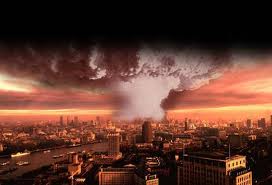
They heard a distant boom that grew louder and louder and continued to grow impossibly loud, as if a titanic lion was roaring to shake the stars. The house creaked and groaned and the windows shattered. Ramya screamed and threw herself against Edward. Even as he was covering her, stuffing his fingers ineffectually into his ears, all Edward could think was: It actually happened. My God, after years and decades of saber rattling and threats, it’s finally happened. This is the end. There was a slow cracking sound and the ceiling collapsed on them as outside, the fever-pitch scream of the apocalypse increased.

But then it stopped. Like a one-note hurricane that came, saw, and conquered, the roaring eventually died away into silence. Edward looked up, brushing plaster and shards of plastic off them both. The house was still standing, windowless and shaken, but sound. He looked up at the ceiling. The plastic molding had all fallen away, and the rough-hewn wooden beams stood out starkly. The original farmhouse kitchen ceiling. He almost smiled.

“Are we alive?” Ramya asked, raising her head from his chest. She reached up to her head, probing for wounds, and brushed plaster dust from her dark hair. “Is it over?”

“I don’t know if any more missiles are on the way,” he said, struggling to his feet, “but it’s not over.”

It was strange—it was almost as if he could see the clocks resetting—a long line of zeros. The first second ticked over, then the next. From now on, they lived in a new world, a world where England had been attacked with nuclear weapons. And not just England. America must have been hit as well, and France, and Germany, and Italy. And no one could attack unilaterally, so that meant that the Central Bloc was gone too, wiped clean by nuclear arsenals that men had probably been itching to fire off for over a hundred years.

“Stay here,” he said, “I’m going outside to look around.”

“Eddie, get back here!” Ramya said, grabbing his hand. “What if there are more? Don’t be an idiot.”

“I’ll be right back,” he said. He shook her off and went towards the door. She was right, of course. It wasn’t safe, but he had just survived a nuclear attack, dammit, and he thought he had earned the right to take a little risk.

The southern horizon was filled with roiling clouds and smoke and an ominous wind was blowing. Fallout, he thought, trying not to think about it. But still, above him the sky remained blue and clear. The world was a strange place sometimes.

london nuclear attack

He went back in and waited with Ramya in a silent, uncertain vigil. Twenty minutes later, there was a knock on the door. It was Rosie Dodd, who lived next door in Essex Cottage. She had her son Sean with her, bundled up in his winter coat, as if that could stop radiation.

“Thank God you’re alive, Eddie,” she said. She was sobbing but her wide doe eyes were dry, tapped out from grief. “Can you take care of Sean for a bit? I gotta go find Mason. He was in London last night, for work, you know, but—he had to have gotten out in time.”

“Where are you going to go?” Edward asked. “London is gone, Rosie, gone! Look south: everything on fire. You couldn’t get ten K before everything is blown to hell.” He saw the last tottering walls of her spirit crumbling and he kicked himself mentally. “Look, just stay here. I’m sure he got out. He’ll be back.”

Rosie nodded, but then kissed Sean on the head and propelled him towards Edward. “I gotta go, Eddie. I gotta find Mason. I know I can.”

“What are you doing? You can’t leave him here with me,” he called. She just shook her head and kept walking.

Ramya took Sean in—shooting Edward a sympathetic look over the kid’s head—and got him some food. Then the three of them sat in the living room and waited. Sean was nine and small for his age, with long hair tied back in a ponytail. He was not normally quiet, but now he barely said a word, only a nod or a grunt if a question was asked. Traumatized, Edward thought.

With nothing else to do, Edward pulled out his e-Device. It cycled for a moment, but then the page opened and Edward gave a small laugh. It was like a black joke: not even a nuclear holocaust could destroy the Internet.

The net was in chaos but Edward quickly learned that all the big cities had been hit. They were all gone, just like that: London, Birmingham, Manchester, Leeds . . . the horrifying list went on and on. At least twelve confirmed nuclear hits. There were reports streaming in from all over the world of more strikes but Edward soon had to turn it off—the sheer amount of destruction sickened him.

“What should we do now?” Ramya asked.

“Just wait, I guess.”

“Until what?” she asked. He didn’t have an answer. All plans were put on hold until Rosie got back and took Sean off their hands. Then they could brush the dust off, assess the situation, plan for the future.

They waited all day and then the next. Edward went to a local store and brought back a trunk-full of groceries, the last there would be. (“Just take it,” the clerk had said. “Money’s no good now.”)

They waited five days. Ramya started throwing up. Sean got diarrhea and lost his appetite. He would lie on the couch for hours, staring off into space. Edward felt fine physically, but mentally he was getting frantic from waiting and worry about Ramya.

Rosie never came back.

(Continued in The Making of the Squid, Part 2)


The Elephant's Trunk

🐘 Nancy is a storyteller, music blogger, humorist, poet, curveballer, noir dreamer 🐘

Thru Violet's Lentz

My view, tho' somewhat askew...

The New, Unofficial, On-line Writer's Guild

Aooga, Aooga - here there be prompts, so dive right in

Just Joyfulness

Celebrating joy

Tao Talk

You have reached a quiet bamboo grove, where you will find an eclectic mix of nature, music, writing, and other creative arts. Tao-Talk is curated by a philosophical daoist who has thrown the net away.

H J Musk

On reading, writing and everything in between ...

Clare Graith

Author, Near Future Sci-Fi

Dirty Sci-Fi Buddha

Musings and books from a grunty overthinker

Rolling Boxcars

Where Gaming Comes at you like a Freight Train

Lady Jabberwocky

Write with Heart

Fatima Fakier

Wayward Thoughts of a Relentless Morning Person

Life in Japan and Beyond

stories and insights from Japan

The Green-Walled Treehouse

Explore . Imagine . Create

One Minute Office Magic

Learning new Microsoft Office tricks in "just a minute"

lightsleeperbutheavydreamer

Just grin and bear it awhile

Linda's Bible Study

Come study God's Word with me!

Haden Clark

Philosophy. Theology. Everything else.

Citizen Tom

Welcome to Conservative commentary and Christian prayers from Mount Vernon, Ohio.

The Green-Walled Chapel

Writings on Faith, Religion and Philosophy

To Be A Magician

Creative writing and short stories

My music canvas

you + me + music

Eve In Korea

My Adventures As An ESL Teacher In South Korea

Luna's Writing Journal

A Place for my Fiction

Upper Iowa University

Center for International Education

Here's To Being Human

Living life as a human

jenacidebybibliophile

Book Reviewer and Blogger

yuxianadventure

kitten loves the world

Strolling South America

10 countries, 675 days, 38,540km

It's All in Finding the Right Words

The Eternal Search to Find One's Self: Flash Fiction and Beyond

Reflections Of Life's Journey

Lessons, Joys, Blessings, Friendships, Heartaches, Hardships , Special Moments

Ryan Lanz

Fantasy Author

Chris Green Stories

Original Short Fiction

Finding Myself Through Writing

Writing Habits of Elle Knowles - Author

BEAUTIFUL WORDS

Inspiring mental health through creative arts and friendly interactions. (Award free blog)

TALES FROM THE MOTHERLAND

Straight up with a twist– Because life is too short to be subtle!

Unmapped Country within Us

Emily Livingstone, Author

Silkpurseproductions's Blog

The art of making a silk purse out of a sow's ear.