Tag Archives: fantasy

The Recruitment of Bruce Riansson

The leaves were what first spoke to Bruce Riansson and told him that maybe there was still some hope in life.

He sat on the damp, pungent leaf mould of the clearing just where the squad of soldiers had left him, with all that he now owned in the world: a satchel with enough food for two meals, a small knife and three copper coins. He had been exiled to the wilderness and they had left him three copper coins. It was a mockery of charity.

He wished they had just killed him. He had been sentenced to death, but the king, with a wicked glint in his eyes, had so graciously, so magnanimously commuted his sentence to exile. Now he would die a longer, more painful death than any executioner’s axe could give.

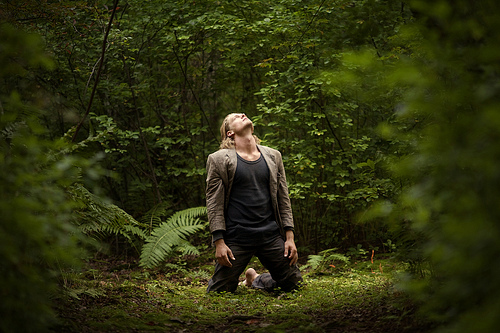
He had been sitting that way for some time when he heard the leaves rustling and whispering above him as the wind played them back and forth restlessly. There were no words in their message, but as he listened, he felt better. He was still alive and he was free now. There was still hope.

Bruce stood up and with a start, noticed a woman looking at him from across the clearing. She had black hair and was wearing a dark red cloak of a style he had never seen before. She smiled at him. “I was wondering when you would stand up. Those leaves are quite persuasive, I see.”

Bruce looked at her warily. “Was it you who made them shake like that?”

“No, that was only the wind,” she said, walking towards him. “But I had a feeling they would have that effect on you. My name is Klista. Remember it, please. And you are?”

“Bruce Riansson,” he said, with a feeling that she already knew.

“How is it that you are sitting out here alone, Bruce Riansson?” Klista asked, putting a hand on her hip. It was a gesture both familiar and imperious.

“I was exiled from Indrake,” he said. “The traitor and former pirate, Sir Denvé, came through our village as he was fleeing capture. I let him stay at my inn.”

“And you knew that it was him?”

“I have never turned away anyone from my inn. I have always considered hospitality to be a matter of humanity, not politics.”

Klista nodded. “That’s a very mature attitude. Very rare indeed, actually. Now, Bruce Riansson, I have a proposition for you. I knew you would be coming here and I was waiting for you. If you wish, you may work for me, work with me even. The work is not what you are used to, but I’m sure you will be suited to it, nevertheless.”

“Who are you?” Bruce asked, his apprehension rising again. “Why would I want to work for you?”

“I have already told you my name,” Klista said. “I did ask you to remember it, you recall. Besides that, think of me as a type of guide. I show secrets to people who need them and who are worthy. Does that not sound intriguing? As for why you should work for me, you are exiled in the wilderness in late summer with almost no supplies.” She gave him a look as if the choice were obvious.

“What would I have to do?” he asked.

“Ah, we’ll get to that in time. First, I have a test for you. I have to be completely sure about you first.” She took a leather bag off her shoulder and rummaged through it. Bruce caught a glimpse of a jumble of strange objects: a purple conch shell, a white tube with blue stars on it, and a key shaped like a spreading tree. Finally, she pulled out a box with a glass window in it and handed it to him.

“This is a compass,” she said and then saw his blank expression. “It has lodestone in it and always points in the same direction. What you have to do is follow the direction of the needle. Several miles away there is a high pass between two mountains. Reach that pass by sunset and look over the other side and you have passed the test.”

“That is all? It sounds too simple.”

“You have not seen the way yet. Remember, you must follow the needle exactly. There will be an easier way up, but do not take it. Sometimes the journey taken is more important than the destination reached. Sometimes the destination depends on the path taken there. Now go and I will see you at sunset.”

Klista walked off briskly. Bruce picked up his pack and looked at the box. The needle pointed into the trees, away from where Klista had gone. He started walking.

At first, the way was easy. There was little underbrush and the ground was level. After half an hour, the ground got steeper and soon the way was choked with brambles that tore at him with thorny claws.

He had just climbed over a pile of rocks when he saw a well-defined trail off to the right. He ignored it and kept fighting his way through the underbrush. The trail crossed his path and for a moment, he was tempted to follow it for a little ways, until he remembered and re-entered the tangle of bushes.

The mountain trail zigzagged back and forth up the slope and by the time Bruce had crossed and re-crossed it four times, he was torn and bleeding in multiple places and his clothes were shredded to rags. Already the light was decreasing, softening to the peaceful glow of dusk. He pressed on.

He crossed the mountain trail for the last time and it disappeared off to the left, going straight and following the ridge of the mountains. Above him were two steep peaks like horns, their summits tinged with red from the approaching sunset. Between them, he saw the high pass, only several hundred feet above him.

The final climb was the worst. He scrambled recklessly up as the sky darkened above him, ignoring the sharp bite of razor-like granite edges cutting into his hands. Finally, he pulled himself up to the pass and looked over.

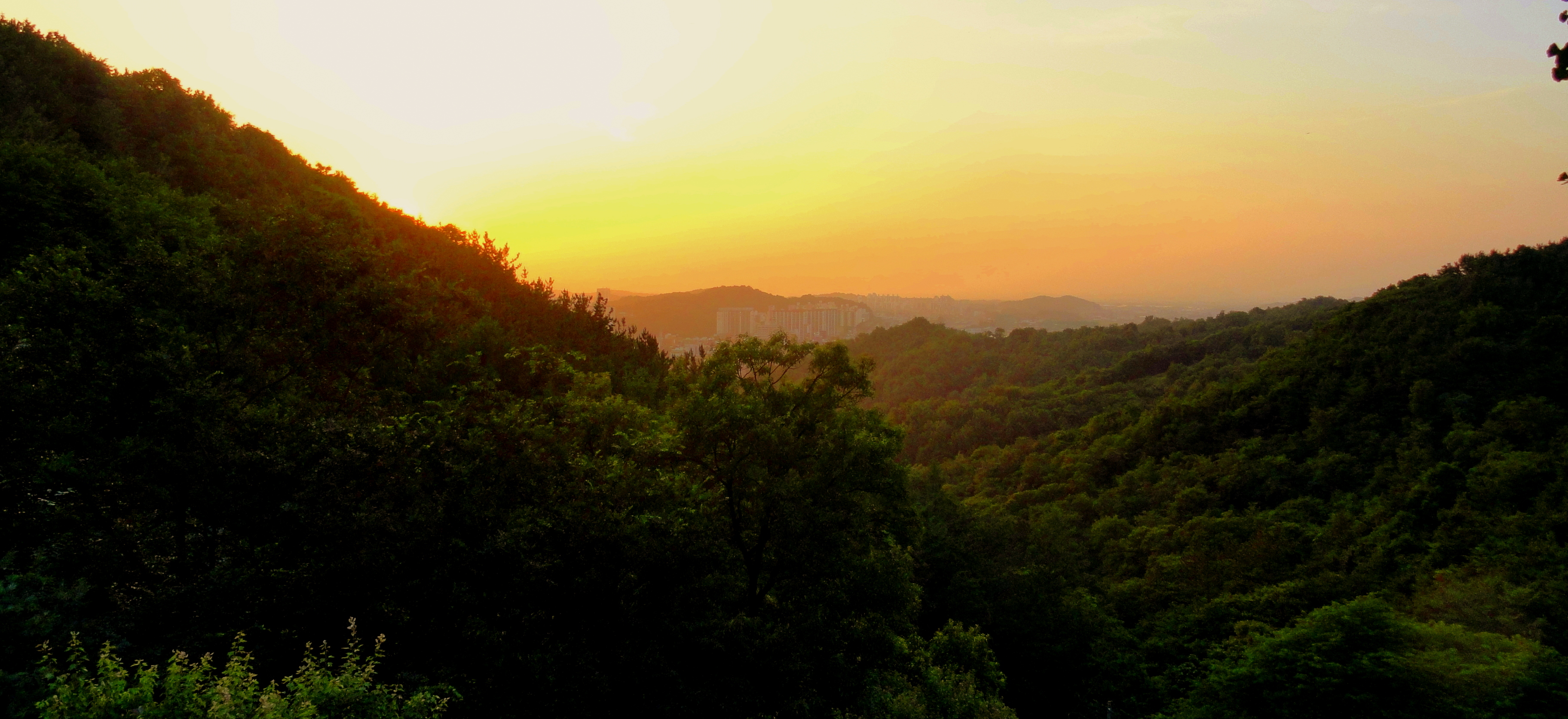
The valley below him was a mass of trees, like a vast carpet of greenery. Bruce looked farther and in the orange glow of the day’s end, he saw strange structures rising out of the trees. They were like huge blocks of stone, a hundred feet high or more, but he could see the light glinting off rows of windows. It was a vision of some alien city.
 

“You pass,” Klista said from behind him. He turned quickly.

“How did you get here?”

“I take my own paths,” she said. “What do you think that is?” She pointed to the distant structures.

“I do not know, but it looks like a city of some sort.”

“It is a city, although not one of this world. This is what I wanted to show you, a tiny taste of what is hidden behind real life. The world you were living in yesterday was infinitely smaller than the world you will be living in tomorrow.”

“Is it really over there or is it only a vision?” Bruce asked.

“It is really where it is,” Klista said. “You will find that a word like ‘there’ has very little meaning. If you mean, could you reach it by walking, then yes. You were able to see it by following the compass and you could follow it to the actual place too. But that is a long, hard road and I travel by quicker ones. Now, do you still want to join me?”

“I do not know what I can do, but yes, I am willing,” Bruce said. He offered her the compass, but she shook her head.

“You keep it. It will be very useful to you in the future, I think. This is the not the end of your journey by far, Bruce Riansson: this is only the beginning.”

I Was on Trial Once…

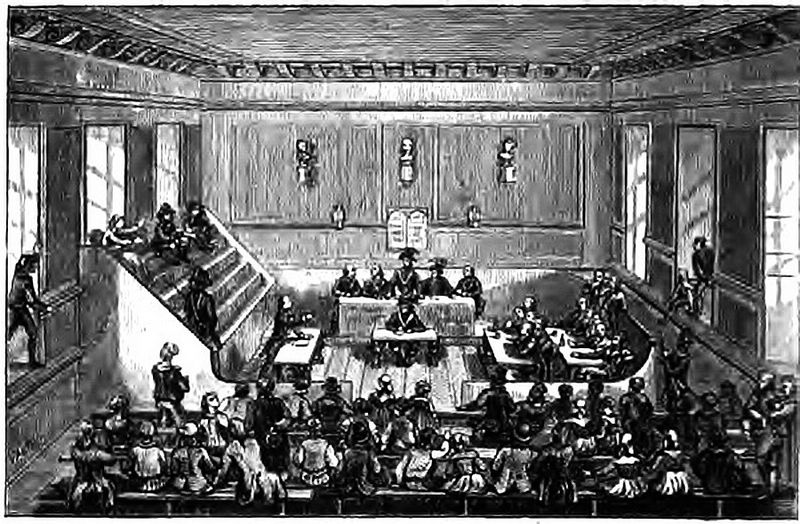
“What is your name, sir?” the magistrate demanded. I stood facing him, in front of a packed courtroom of people who seemed very curious in my fate.

“My name is Horus Vere,” I replied proudly. It is a name to be proud of.

“And what is your profession?”

“My family are traditionally glaziers, but I am more of a merchant. I find things here and there and sell them, in order to pay for my travels.”

“Ah, so a thief then?”

“Put down salvager, if you please, if there is a box marked ‘Profession’ that must be filled in,” I said. “Now, if I might ask a question, why am I here, instead of being on the road to Hatavass, as I had planned?”

“You are charged, sir, with spooking a horse and causing a thousand crowns of damage to a load of expensive pottery. Do you deny it?”

“I do not deny being there,” I said, “but it was the red poltergeist that spooked the horse.”

“A poltergeist!” The magistrate looked outraged. “You are saying you saw a poltergeist in the road?”

“No, your honor. It was invisible.”

“Then, how do you know it was there? And how can you call it red?”

“For both those questions, I have only the word of Brokker.”

“And who is he?” The magistrate’s tone was soft and dangerous.

“He called himself a spirit sage. I only met him that day. It was he that told me that a poltergeist was stealing my shoe.”

The magistrate threw up his hands. “I have no idea what you are talking about. Please start this whole mess of an account from the beginning.”
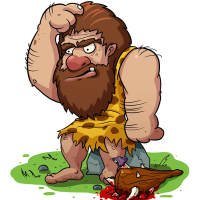
“I am afraid I have just told you everything,” I said. “I was just about to break camp when I could not find my shoe. Brokker came along and told me he had seen a poltergeist taking off with it. A red one.”

“Yes, you mentioned that detail already,” the magistrate said. The crowd tittered with delight. “Tell me then, how the horse came to be spooked?”

“Well, for a crown Brokker offered to show me where the poltergeist had gone. My shoe was hardly worth that much, but I had never seen an invisible red poltergeist before, and since having only one shoe is as good as being barefoot, I agreed. We were running along, when I banged into the fox.”

“The fox?”

“Well, it was in a cage,” I said, “obviously. It was in a pile of other wild animals in cages, all headed to circuses and menageries. You should have heard the racket.”

“Yes, I see,” the magistrate said, wrinkling his forehead. The crowd was entranced. Even if admission to the courtroom had not been free, this would be money well spent.

“So, I knocked over the fox cage, which was fine, except it broke open and the fox ran into a group of schoolchildren being led by two nuns . . .”

“Whatever are you talking about?” the magistrate asked, exploding suddenly with anger. “Why were there foxes in cages and nuns with schoolchildren wandering around in the forest?”

“This was not in the forest—it was here in the city. I camped in Fountain Square last night. Did they not tell you?” The look on the magistrate’s face showed that they had not.

“Get to the horse,” he said.

“Well,” I continued, “the fox was darting here and there, and nuns and children were screaming and crashing around when Brokker suddenly said he saw the poltergeist. It had dropped my shoe but Brokker said he could find out where it had dropped it. So we took off running through the square, dodging screaming nuns and vaulting over children. ‘It’s going for that horse!’ Brokker said and he jumped for it. I tried to follow, but I had been running with only one shoe and I tripped and fell at the horse’s feet. It reared up and started charging around the square too. Brokker said that the poltergeist had jumped on its back. The wagon wheel hit a small anvil that I had been planning to trade and the whole load of pottery slid off and smashed on the street.”

“That was quite a story, Mr. Vere,” the magistrate said, although he did not sound impressed. “Do you have anything to add?”

“Yes, your honor. I got my shoe back. Brokker produced it and said the poltergeist had given it to him, so I was obliged to pay him the crown. In any case, all’s well that ends well, right?”

*         *         *

That night, I told the story to a group of eager bar patrons at the renowned establishment, the Feathered Pork Chop.

“What happened then?” they asked. “Did they make you pay for the pottery?”

“No, I was acquitted on that charge,” I said, “although I did get fined half a crown for illegally sleeping in Fountain Square. I don’t mind though: it’s not every day you get to see an invisible, red poltergeist.”


The Mermaid’s Kiss

This story was inspired by the song, Turn Loose the Mermaids, by Nightwish. I recommend it for reading music.

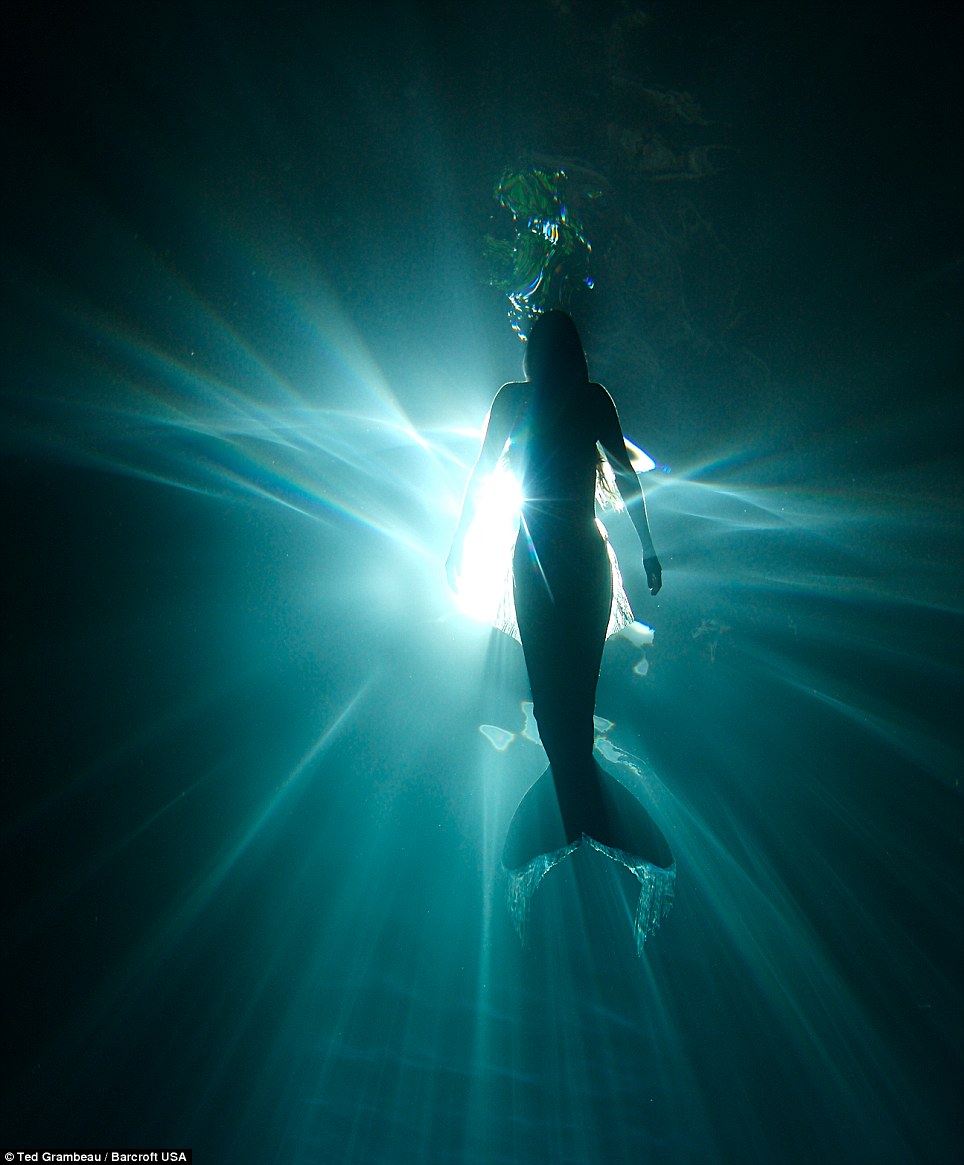
It was the kite that I saw first as I hurried along the dusky road in search of a place to camp for the night. It was a small square of dark blue that bobbed and swayed in the upper breezes, far above the hedgerows that bordered the road closely on both sides. I came to a gap and saw the world suddenly open in front of me.

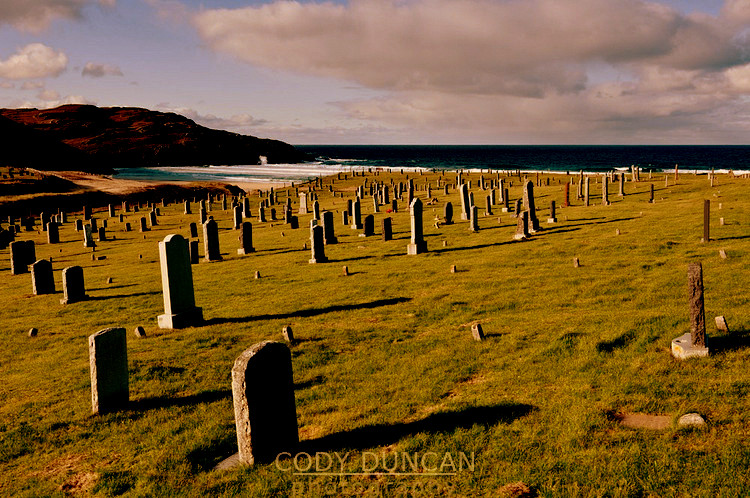
I was standing on the top of a slope that descended several stone’s throws to the edge of a firth, an arm of the ocean that stretched inland to the mouth of a fast-flowing river. On the slope was a cemetery and in the twilight, each etched stone had its identical shadow that stretched back towards the east. On one of these stones, close to the water’s edge, I saw a hunched figure sitting and holding the string of the kite.

I went down to talk to the person and perhaps find a place to stay the night. When I got closer, I saw that the figure was an old man dressed in a tattered grey jacket. He was staring out towards the firth, but looked up at me when I approached.

“You shouldn’t be here,” he said without preamble. “This is not the place for your sort.”

“And what sort is that?” I asked.

“The uncursed sort.”

This intrigued me immensely. “My name is Horus Vere,” I said. “I collect many things in my travels but mostly I love stories. Tell me, is this cursed ground?” I sat down on the gravestone of a Mr. Archibald Duggan (1550-1623) and waited for his reply.

“Why else would an old man be flying a kite alone in a graveyard at sunset, if he were not cursed?” he asked. I had no response to this feat of logic, so I waited patiently for him to continue.

“I used to come here every day when I young, to fly kites with my friends,” he said. “One day, we arranged to meet here in the afternoon, but the wind was strong that day and the others decided not to come. I launched my kite as I waited and it tugged fiercely on the string. A sudden gust snapped the string and it fell into the firth, about a score yards from shore.

“I should have left it—any sane person would have—but it was my favorite kite and I hated to lose it. So, I took off my jacket, tunic and trousers and waded into the frigid water. I was a fair swimmer, but the wind was blowing from the land and quickly pushed the kite further from me. When I finally reached it, I looked back to see that I was far from land and the wind was pushing me even further towards the middle of the firth.

“The swim back was a nightmare. I made very slow progress and I could not rest or I would be pushed out and lose what distance I had gained. My head slipped beneath the surface, but I pulled myself up. I went down again, and again I thrashed to the surface. But I was exhausted and I knew that I was about to drown.

“Finally I sank down into the darkness of the firth, too exhausted to struggle anymore. I breathed in a gulp of water and my consciousness was just starting to fade, when I felt something brush my arm. I thought it was a fish at first, but then it grasped me. Something pressed against my lips and air was forced into my lungs. I opened my eyes and saw a woman swimming in front of me, her skin a greenish tinge from the water.

“Several moments later, I pulled myself, coughing, onto the shore. The woman was beside me, and I could see now that even in the air, her skin had a greenish cast. She was naked and beautiful.”

“A mermaid?” I asked. I was beginning to think this man was either mad or toying with me.

“Do you believe in mermaids?” he asked.

“I have never had any reason to.”

“Neither did I,” the old man said. “She did not have a fish’s tail, as they do in the stories, but she was no ordinary woman.

“‘Thank you for saving me,’ I said to her and she nodded. ‘Is there anything else I can do for you?’ she asked. ‘Kiss me again,’ I said.

“I had not been meaning to say that and I was embarrassed, but she crawled carefully up to me, keeping one foot in the water, and kissed me again. Then she told me her name and slipped back into the water.”

“What was her name?” I asked.

“I cannot tell you.”

“You have forgotten it?”

“No,” he said. “It is a name I could never forget. As soon as I heard it, it crept into every corner of my mind and I could keep my mind on nothing else. I would not tell it to you, lest the same thing happen to you.

“For several years after that I would come here and meet with her. Sometimes I would summon her by flying the kite, but sometimes she would call to me with her singing. She had a high, whispering song that floated on the breeze and drew me irresistibly to her.

“When I was seventeen, the town found out that I was meeting with someone here most every day. I heard the word ‘monster’ and ‘succubus’ whispered about. They came to kill her, but I saw them coming up the road, my father leading the way. She begged me to go with her, but I was afraid.

“‘I will wait for you here,’ I said. ‘But I cannot return,’ she replied. I was still afraid and did not believe her fully. She gave me one last, long kiss and then dove into the water as the people reached the top of the hill.

“I was sent away to the southern counties by my father, but I returned and stayed here, tending the graves and flying my kite. I have waited years for my lost mermaid. I could not have stopped even if I wanted to. The memory of her last kiss still burns on my lips and her name is as fresh in my memory as always.”

The old man stopped. I wondered if he told this story to everyone who stopped by or if I were privileged somehow. The sun went down and the golden color drained out of the landscape. Soon the darkness would be complete.

“You may stay in the old cottage by the woods,” he said. “I will stay here.”

I would have argued with him, but the memorial stone of Mr. Archbald Duggan was none too comfortable and I gratefully moved to the cottage. It was shabby and dank, but when I got a fire going, it cheered up immensely.

I awoke in the middle of the night to hear the wind sighing in the branches outside. With a start, I thought I could catch words in it. I jumped up and looked out the window.

The moonlight was shining brightly on the cemetery and the black water of the firth. The old man was gone from his gravestone perch. I put my hand on the door latch, but something stopped me, perhaps my oft-unused common sense. I went back to my bedroll on the floor and lay listening to the melodic breeze playing through the trees.

The next day dawned sunny and clear. I packed up my things and went to see if the old man had returned. His seat was empty. I stood for a while, and was just about to leave when I noticed something buried in the grass by the gravestone. After digging in the tangled grass, I pulled out a rotted cross of wood with several scraps of dark-blue cloth still clinging to it. Nearby was a spool of twine that fell apart when I picked it up. It must have lain there for years.

I thought of taking a piece of the cloth to remember this place with, but I knew it was not for me. The wind was singing in the trees again as I left, but I dared not look back at the water for fear of what I might see and what I might do then.


Dead Switch

“I think my house is haunted,” Frederick said. He shifted nervously, glancing up at the hall chandelier.

“Yes, so you said on the phone,” the psychic investigator said, frowning slightly. This was just a preliminary visit. No point in rolling out the TV cameras just yet.

“You see, the chandelier flickers on and off sometimes, just on its own. Usually at night.”

“I see. Like a short in the wires?”

“No, I’ve had it checked out three times by electricians. They say everything is normal.”

At that moment, the chandelier flickered on and then immediately went off. It flickered on and off a few more times, then nothing.

“You see?” Frederick cried. “It’s haunted.”

“I see,” the psychic investigator said. His demeanor had changed completely. “You may be right. In my expert opinion, I would say this is strong evidence of poltergeist activity.”

*         *         *

At that moment, eight hundred miles away, Jon Tagg stood in his brother-in-law’s bathroom, flicking the useless switch up and down.

“Hey, Dave, I think your light’s broken,” he called.

“You gotta use the one on the right,” Dave called from the kitchen. “Don’t use the switch on the left. I don’t know what it’s for.”


The Thing in the Mausoleum

(This is meant as an homage to H.P. Lovecraft. It’s not as good as his work, of course, but it’s a similar style.)

Brock Harbor has been destroyed and no one can agree on how it happened. The official story, the one published in the paper, tells how a propane refueling station exploded, leveling most of the buildings in the town of 4000 and starting fires that claimed the rest. No official reports mention the troops that descended on the town with flamethrowers just before dawn or the eerie glowing thing that that many witnesses claim to have seen moving among the houses. I was more than a witness. I helped start it all.

Dr. Robert Julius was a brilliant scientist and a close friend of mine for many years. He was primarily a physicist, but later in his life he became fascinated with the occult, at least  in its original meaning of “that which is hidden”. He was convinced that there was a connection between traditional science and spirits. One day I came into his laboratory to see him poring over a large manuscript written in a heavy, Gothic script.

“It’s old German,” he said in response to my question. “A translation of an older Persian work on what the text calls damons.”

“Demons?” I asked, my lips curling in amusement.

“Not exactly,” he said. “These beings have often been confused in folklore with the traditional spiritual demons, but the Persian actually means ‘the things that lurk beyond’. I call them ‘Those Beyond’. What they are, however, I am not entirely sure. The text hints at a physical body, but also extreme longevity and powers of some sort.

Those Beyond could not be killed, but they could be contained and held captive, Robert continued. The manuscript gave a symbol that was said to be used in containment rituals, a radiant sun with a curling serpent entwining it. I was not surprised when he told me that he was searching everywhere for an example of that symbol.

Two months later, I was awakened in the middle of the night by a phone call from Robert. At first, I feared bad news, but his excited tone soon reassured me. He had found the symbol, he said, among photos from a cemetery in Brock Harbor, Connecticut. It was small and faded, but he was positive it was the same one. I valued my sleep and so would not let him continue too far, but promised that I would go to his laboratory the next day.

The next day he showed me the photos and I will admit that I became intrigued. The symbol was found stamped on the door of the  mausoleum of a family named Drake.

“They say that the grandfather of the family, Jeremiah Drake, had seen action against the Ottomans during World War I and had reportedly returned to Brock Harbor with several strange objects. He had become obsessed with death and had built the mausoleum while still in his forties. The whole family became close and secretive and it was said that at times they visited the mausoleum in the dead of night. The last of the Drakes died ten years ago, but by then, such an aura of fear surrounded the mausoleum that the town coroner went against the wishes of the deceased and had him cremated instead.”

“And you are going to go find this mausoleum?” I asked, knowing full well the answer.

“We are going to go find it together,” he said, giving me his characteristic mischievous smile.

I put up some token resistance, but the truth was I found the proposition exciting. Not that I truly believed we would find anything, of course. We left the next day and took the train north to Brock Harbor. We reached the town just as the sun was going down.

We found a hotel and a place to eat and then waited restlessly for the midnight to come before we started. Robert asked a few of the locals about the Drake mausoleum but as soon as he mentioned the name, they got up and left, giving him dark looks as they did.

A little before midnight we went to the room and Robert went through the equipment he had brought: a lantern, rope, crowbars, and finally, a revolver.

I looked at him questioningly. “You said these things couldn’t be killed. What possible use could that be?”

“You never know, my friend,” he said with a smile. “Best to be prepared for anything.”

We left the hotel a little before midnight and walked down the main street. The cemetery, we had discovered, was on the hill overlooking the town. The iron wrought gate was locked but we climbed it and Robert lit the lantern.

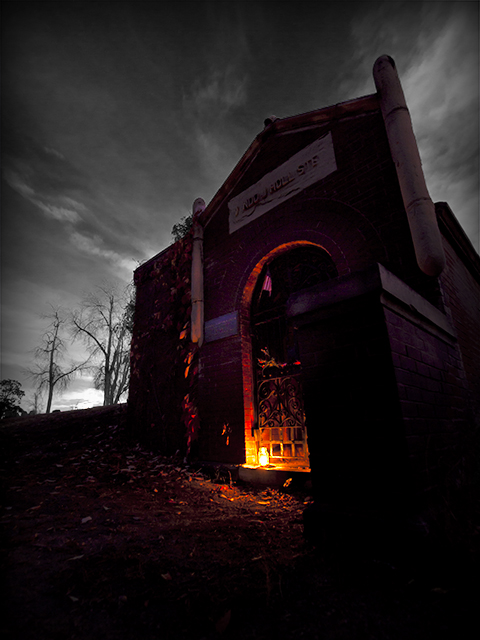
The mausoleum was immediately apparent. Set in the back of the cemetery, it loomed fifteen feet tall above the other graves. It was made of black stone that was as dark as coal and seemed to absorb the light of our lantern. No other graves stood near it and it was surrounded by a low ridge of raised ground. A shiver went down my spine as I stepped over it.

The doors of the mausoleum were made of a heavy, dark wood and banded with iron, but the handles were only padlocked together with a chain. Robert took out a crowbar and after a moment of effort, forced the lock open. The noise of the chains rattling to the ground seemed like bells in the night silence. I looked around in panic, but no one was nearby. Robert snorted at my cowardice and pushed the doors open.

Inside the vault, racks on either side held eleven coffins, with space for five more. The center was open and paved with black granite. At the far end was an altar carved with the symbol of the serpent coiling around the sun.

“Look,” Robert said. He pointed to the top of the altar and I could see the tiny skeleton of some animal—perhaps a cat—that had been cut in half. The skull was missing.

“What now?” I asked. Fear was coming over me in waves. I could not see how Robert could appear so calm.

“Hide the lantern for a moment, would you?” Robert said. He wasn’t looking at me; he was examining the sides of the altar. I threw my coat over the light and the vault was thrown into utter darkness.

All except for a tiny square of light. It was shining in thin lines, as if through thin cracks. Robert had me take out the light again and I saw that the light had come from around the central stone of the altar, the one with the symbol carved in it.

Robert proposed levering out the stone but I refused to help. All I wanted to do was escape and I repented of every thinking of helping him. In the end, I went outside to keep watch. I heard the clank of the crowbar and the slow scrape of stone. Then there was a thud and an unearthly light suddenly shone out of the door of the mausoleum.

I looked in, although my knees were shaking. Robert was standing frozen in silhouette in front of the light that was now pouring out of the hole in the altar. It seemed to grow brighter and then spread, as if it were seeping through other cracks. I heard a stone crack and the top of the altar exploded upwards, showering the inside of crypt with stones and tiny bones.

“Robert, don’t be a fool! Get out of there!” I shouted. He didn’t move, even as the light increased and something crawled and groped its way with luminous tentacles out of the hole where the altar had been.

Robert’s head suddenly jerked to the side convulsively and he clawed at the revolver in his pocket. “Get out of here, Freddy!” he shouted. The last thing I saw was Robert’s black form pointing the revolver at the hellishly bright thing that now filled most of the mausoleum. Then terror overcame me and I ran and stumbled to the cemetery gate. Just as I reached it, I heard a shot.

I was torn. I could not go back, but I did not want to leave Robert, even if he were dead. I looked back to see that the glowing thing had emerged from the mausoleum and was making its way swiftly towards the fence. It was an amorphous, writhing mass of half-formed serpent-like shapes that constantly grew out and then dissolved back into the central mass. The fence seemed to disintegrate in front of it, and then it was gone, down the hill and towards the town.

I made my faltering way back to the mausoleum. The lantern was still on, although knocked to one side. In its flickering light, I could see Robert’s body lying on the cold, black marble, shot through the head with his own revolver. I left him and ran.

The thing was among the houses by then. It seemed to have grown and was slowly crushing the houses beneath it, enveloping them one by one. I heard screams of terror and pain like I have never heard come up the hill and I thought I would go mad.

I saw many things that night, some of which I only remembered later through hypnosis. The army found me, running wildly along the highway, sobbing and tearing at my hair.

That was two months ago. The doctors say I have made great improvement and they have finally allowed me to go home. I went willingly, but there are times I wake up to hear those terrible screams coming back endlessly to me through the memories of the night.


The Girl Who Could Snee

This is not directly related to the story, but it is the inspiration. Source

There was once a little blind girl named Margaret who had few friends she couldn’t see. This sounds like a lonesome proposition for someone born blind, but in fact, Margaret had many friends. She could not see them in the traditional way, but that did not bother her one bit. When her mother told her that she was blind and could not see, she accepted it calmly and then proceeded to make up her own word for her perception of those creatures that were dancing and waving all around her. She called that sense “snee”. She couldn’t see at all, but she could snee with the best of them.

The things she snaw (the natural past tense form of snee) were usually larger than she was and generally happy. They differed from each other much more than humans did. What’s more, they drew to Margaret like a horde of hungry children to a single lollipop. Apparently there were not many people who could snee.

The sense of snight was a strange one. She could not snee anything she could touch. When she asked her mother why this was, her mother (who did not understand the idea of sneeing) patiently explained that it was because she was blind. As well, with the creatures Margaret could snee (she called them snurps), she could tell their emotions, their motivations and their basic personality at once, as if they were wearing all that information on a badge on their chest. This was good to know, but all of the snurps Margaret snaw were kind and benevolent. Actually, she had never sneen a bad snurp in her life.

Of all the snurps Margaret knew, three were especially close to her. They didn’t have names before she met them, but she called them Splik, Drizzlepop, and Mr. Crustypeppers.

“Good morning, Margaret.” She woke up and saw her three snurp friends looming over her (she did not need to open her eyes to snee things. This made it hard to get to sleep when they were capering around her at night, generally acting like buffoons). The alarm clock went off, beep, beep, beep and she swiped at it, accidentally knocking it to the floor.

“Beep beep beep,” Drizzlepop said in a chortling monotone. “Beep beep beep. I like human music.”

“Happy birthday, Margaret,” Mr. Crustypeppers said. He held out his two translucent blue arms that looked like they were carved from ice. There was just empty space between them. “We baked you a cake! You just can’t snee it,” he added with a wink.

“Thank you guys,” she said, sitting up in bed and yawning. “Thank you, Mr. Crustypeppers, you piece of garbage. You really are a stupid cow.” Mr. Crustypeppers beamed and put the invisible cake carefully down on her desk, also invisible to her. She had once told the snurps about insults and Mr. Crustypeppers had been so tickled with the idea that he had insisted she insult him at every opportunity. If she forgot for a while, he would prompt her, saying, “So, Margaret, who’s a stupid cow?” Then she would remember and say, “You are, Mr. Crustypeppers,” and he would grin with pleasure, showing both rows of his long, blackened fangs.

In reality, it wasn’t her birthday. Every so often, the snurps would get it in their heads that it was her birthday and they would have a party. She had told them about birthdays but she wasn’t sure they really understood it. She wasn’t sure they understand the idea of time, for that matter.

Margaret was getting dressed when her mother came in. The slurps were outside by the road—Margaret could see them capering around, running back and forth, dodging things that were invisible to Margaret.

“Marg, we’re going to go for a drive after breakfast,” her mother said. “Dad got the day off, so we’re going to go have a picnic. Does that sound good?”

It did sound good to Margaret and an hour later, they were on the highway, headed for a state park called Pickett’s Notch. Margaret had never been there before. Of the three snurps, only Splik was in the car with her. He liked to sit down, although his tentacle-like arms were hanging down through the floor of the car and bumping along on the road surface. He was much taller than her and his head was probably sticking up through the roof. Drizzlepop had no legs and was floating along next to the car. She could just hear him singing along with the hum of the engine. Mr. Crustypeppers was nowhere to be seen. He often disappeared when they went on long trips and showed up when they arrived. Margaret was not sure how he traveled.

On the way, she snaw other snurps floating by or bounding through the air above them. They all waved and called her name. Even snurps she had never met before knew who she was. She gave small waves in greeting, but could not say anything without worrying her parents.

The breeze felt fresh and warm when Margaret opened the door and stepped out at Pickett’s Notch Park. Her mother told her how beautiful the view was; how green the trees were and how she could see for miles out over the valley.

Margaret could see nothing. Instead, she snaw two green snurps standing a little ways off, staring at her. She could tell instantly that they were not friendly and they did not want anything good for her. It was a scary feeling to see that kind of malevolence in a snurp. The green snurps just stared at her, not moving.

“Mom?”

“Yes?”

“I don’t like it here. It’s scary,” Margaret said.

“Scary?” Her mom laughed. “What are you talking about? It’s a gorgeous day: the sun is shining and there’s a wonderful breeze. Plus, there are other people here. See?” Even after eleven years, her mother still had lapses of forgetting she had a blind daughter.

She took Margaret by the hand and led her towards the green snurps and then past them. Margaret’s sense of unease continued to grow. They went down a short slope and Margaret suddenly snaw another snurp come into view. It was one of the biggest ones she had ever met and thin and willowy. She knew immediately that it was evil.

It looked at her for a moment, then started towards her. “Margaret,” it said in a dry hiss of a voice. “I have heard quite a bit about you. I heard you could see us.”

“I can’t see a thing,” Margaret said. “But I can snee you fine.”

This response made the snurp pause. At the same time, Margaret felt a hand on her arm.

“Come sit down, Marg.” It was her father. “Your mother has a blanket laid out.” There was worry in his voice. She knew that her parents sometimes overheard her talking, apparently to no one, and they didn’t know what to do about it. They worried, but not understanding, they tried to ignore it. They couldn’t hear the snurps, only her.
“I’ll be there in a moment,” she said. Splik and Drizzlepop had moved in front of her and were trying to make themselves look bigger. She looked back to see other snurps above her at the top of the unseen hill. She had never sneen snurps fight or attack a human and she wondered what would happen.

At that moment, Mr. Crustypeppers appeared out of nowhere. He gave a keening scream, like the howl of a furious predator. Hearing that noise of rage from her sweet, happy Mr. Crustypeppers scared Margaret more than anything.

Several other snurps appeared behind the tall, willowy one. There were about twenty of them, then twenty-five. She looked behind her. Only her three friends were close. There were other snurps further back, looking on.

There was going to be a fight and someone was going to get hurt. She was not sure how a snurp could get hurt, but her three friends were vastly outnumbered and about to defend her.

“Mom, Dad!” she cried. They were there in a moment, asking what was wrong.

“I know you won’t understand, but this place is dangerous. Please, we have to get out of here now.”

“But Marg, we just got here. I made all this food.” There was hurt and disappointment in her mother’s voice. Just be normal and let’s go have a good time, Margaret added mentally, in her mother’s voice.

“I’m so sorry, but we have to go now.” Margaret started moving back up the slope, feeling her way as she went. Her parents did not say another word. Her father took her arm and gently guided her to the car. She could hear the clink of dishes as her mother packed up the food she had prepared.

Margaret looked back. The evil snurps had followed them back to the car, but had not tried to attack. Splik got in the car with her, his eyes glowing in a way she had never sneen before.

They had a subdued picnic in the backyard. Her parents did not ask what the trouble had been at Pickett’s Notch and she was too disheartened to try to explain what they could never understand.

It was really hard having parents who could not snee.

That night, her three friends crowded around her bed as she went to sleep.

“Would those bad snurps have hurt you?” she asked them.

“We will protect you,” Drizzlepop said and the others nodded, conveniently not answering the question.

“Thank you for appearing and defending me, Mr. Crustypeppers,” Margaret said. “You really are a stupid cow.”

The grin on his face told her that it was all she needed to say.


Alone on Top of the World

Dawn came far earlier than it did for those down below. The bright, cold rays hit the upper edge of the valley, making the bare rock glow as if on fire. The sheep began to get restless. Aerin woke up.

It was bitterly cold in her small valley on top of the world. Even an hour later, when the sun reached the grass on the valley floor, she walked around in her huge, wooly cloak that made her look twice as big as she really was. The sun rose, pale and watery in the thin air, and shone its cold rays on her little world.

It was just her, in that tiny valley on the summit of Mt. Odinokii—her and her flock of Ambrulo sheep. Everything about the valley was special. There was a special reservoir cut below the valley because rain almost never fell that high up and every drop that did was precious. The grass was special since normal grass would not grow in such cold and thin air. The sheep were bred specially for high altitudes and it was said that it was the thin air that made their hearts delicious beyond imagining.

Aerin herself was special. She had been chosen and had trained for five years until she was an expert on everything concerning the Ambrulo sheep: breeding, diet, surgery, infant delivery, psychology. She stood alone in expertise concerning the Ambrulo.

She led the sheep out of their pen and into the long fenced-in lane towards the water trough. As they walked, the sheep pushed against levers that drove the pump that brought the water up from the reservoir below. Aerin walked next to them, calling them by name and inspecting them. Once they had all drank and started grazing, she went over to the pulley and looked down.

The pulley was her only contact with the world. There were actually two pulley and two platforms: when one went up, the other went down, a thousand feet or more to the first staging platform. Beyond that, there were more ropes and pulleys and then a narrow, treacherous road that wound for miles down the side of the mountain until it reached habitable regions.

Every two weeks, she sent a sheep down and in exchange, received its weight in food—her only food for the next two weeks. The sheep was then brought down the mountain and two hundred miles to the palace, in full haste and with a full security detail. There, its heart was prepared by the one chef in the kingdom who was qualified, and then eaten by the king and his nobles.

Aerin went to the grazing flock and walked through them, burying her hands in their thick coats as she passed. “Nivis, perhaps? No, let him grow a little more. Jasquet, maybe? No, let her stay with her lamb a little longer. Peros? Okay, let it be Peros.” She guided the chosen sheep out of the flock and towards a scale where she weighed it.

A flash of a red flag far below told her that they were ready. She guided Peros onto the platform, then closed the gate. A lever pulled, the anchor released and the platform swung free. She began adding small weights to the platform, until a moment later, sheep and platform began to descend.

Aerin stood looking out over the world, waiting. The darkest of blue skies above her reached out in all directions until it reached the curving horizon far away. Below, the land spread out like a mosaic of greens, browns and blues, except where huge white masses of clouds obscured her view.

Many minutes passed before the ascending platform arrived, filled with food and the next shipment’s weight requirement. Long before, there had been notes for her from family and friends and the workers on the lower stages. No more, though. She unloaded her food in silence and carried it into her cave.

She lay on top of the observation tower, her high platform built in the very center of the valley. The sun had passed its zenith and was slowing dipping towards the western curve of the Earth. Aerin lay looking up into the featureless dark blue and this was how the high-air sprites found her, as they always did.

“Aerin, Aerin, come play with us. Come fly with us.” Every time, like a greeting.

“I have no wings, my friends.”

“Neither do we,” they laughed. “Wings would do no good up here. Come, though, and be like us.”

“But who would take care of the sheep?”

“What care do they need? There is nothing to harm them here.”

“Who will give them water?”

“Let them figure out how to walk through the fenced lane by themselves. If they are too stupid, then maybe they do not deserve to live.”

“Who will send them down every two weeks to the king?”

“The king? He will not starve without an Ambrulo heart to eat every two weeks. Do not worry about him.” There were many sprites around her now, laughing, playing, beckoning her towards them. “Come, come be one of one, Aerin the Lonesome, Aerin the Solitary, Aerin, Queen of the Upper Airs.” They laughed, but they were not mocking.

“And how would I become like you?” she asked, although she knew what they would say.

“Leave your confines. Jump from the edge of the mountain. Fly up among us and soar through the atmosphere, higher and higher. Too timid, too shy, too tied to the cruel, hard earth.”

“I am not like you,” she said, as she had said many times before. “The Earth has a pull on me which I cannot escape, even if I tried.”

The sun had reached the borderland of the western horizon. Already, at the base of the mountain, it was full night. Aerin got up and herded the sheep into the cave, shutting the heavy doors against the freezing darkness that encroached on them.

She went to stand at the western edge of the valley and watched the sun descend to meet the Earth in a rack of fiery clouds. As she looked down on the world, alone, her heart ached with a pain that had nothing to do with the cold or thin air. The sun went down and black, icy night covered everything.

The sprites were playing and shouting in the air far above here, dancing among the cascade of glittering stars that pierced the blackness. The ache in her heart eased as she watched them and she smiled as she pulled her hood up around her head.

Life is still beautiful, she thought.


See the World Through a Cardboard Tube!

A blue van with lightning bolts painted on it pulled up in front of Brent’s school at lunchtime. The students, being trusting teenagers, crowded around to see what it was. A man and a woman stepped out, dressed in outfits that could only be described as castoffs from a magician’s garage sale.

“Step right up!” the man said, somewhat unnecessarily, since he was in danger of being crushed against the side of his own van. “See the world as you have never seen it before!”

The crowd of middle-schoolers remained silent, seeing where this was going, but the man refused to give details.

“Who will be the first one? Come into the van and we’ll give you the instructions.”

At this point, an adult would have been running in the opposite direction while calling the police, but teenagers are thoughtless and curious: a dangerous combination. After a moment, a girl named Stacy raised her hand.

“Sounds good. What do I have to do?” Stacy was always self-assured and forthright. Some had speculated that she had probably cut her own umbilical cord.

Brent watched with the others as the woman led Stacy into the back of the van. A moment later, she emerged, seemingly unscathed, with a cardboard tube in her hands, like one that comes in a paper towel roll. It had red stars drawn on it in pen.

Stacy held the cardboard tube up to her eye and gasped. “Oh wow.” It sounded like a moan. She slowly moved the tube around and when she turned it on the crowd, she laughed. “This is amazing, guys,” she said.

This reaction caused a ripple of discussion to go through the crowd. Half the students were intrigued; the other half tended towards derision. Brent was in the latter group. It just seemed too absurd, although part of him wanted it to really be something amazing, and not make-believe or a drug trip.

A minute later, Stacy gave the cardboard tube back and grabbed her boyfriend, Tim. “You have got to try this Tim,” she said, cutting off his refusal with an imperious look. She practically pushed him into the back of the van.

The students were captivated now. Tim was one of the most popular boys in school. What would his reaction be? A few minutes later, the van door opened and Tim got out. He held the same tube and put it up to his eye.

He didn’t say anything, but as he looked around, his mouth slowly fell open. The crowd was dead silent. A tear actually rolled down his cheek as he handed the tube back a few minutes later. The students went crazy. Whatever was in that tube, it had made one of the coolest boys in school cry.

There was no shortage of takers now. The man picked a few more and their reactions were even more outrageous. A few laughed or jumped up and down. One just full-on bawled, and kept saying how incredible the sight was.

“We have time for one more,” the man said. “Who will it be?”

Brent found himself raising his hand, although he had not planned to. The man pointed to him and the woman led him into the back of the van.

“Can you keep a secret?” the woman asked. It did not seem a promising beginning to Brent, seeing that he was now alone with her in the back of a van.

“What kind of secret?” Brent asked.

“The biggest kind of secret in the world. The kind you couldn’t tell to your best friend.”

“No, probably not,” Brent said after a while. “I would try, of course, but it if was a big secret, it would probably slip out at some point.” He had a troubling habit of being honest.

“Well, I suspect you could,” the woman said with a smile, “but I appreciate your honesty. Now, go out and look through this tube.” She handed him a cardboard tube decorated in pen with blue stars.

Brent stepped out of the van. Half the crowd had wandered away after hearing that Brent was going to be the last one. The rest of them were staring at him. He put the tube to his eye.

The world disappeared.

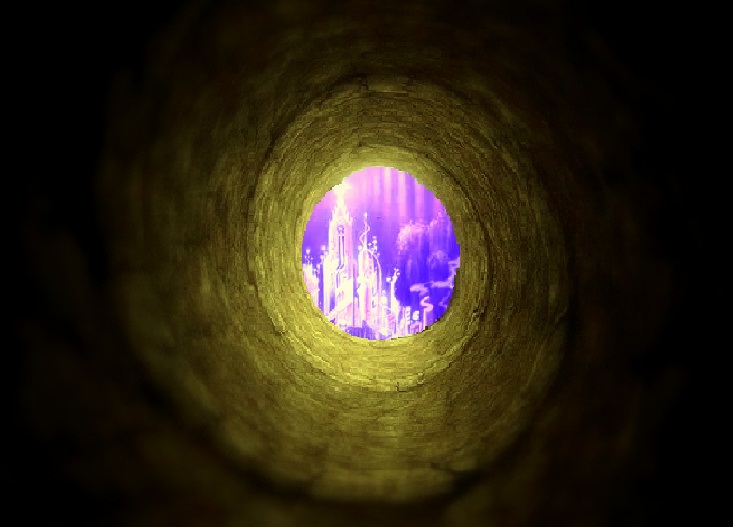
The school was gone. In its place was a high castle with strange mountains climbing up behind it. The sky was a dark purple, with coruscating lines of pink running through it. Small, blue creatures like dragons flew around them, landing and taking off nearby. A group of trees was strolling around, having what looked like an animated discussion.

Brent looked back at the van. It was gone. In its place was a woman dressed in a red cloak, sitting on a huge black Pegasus. She smiled at him.

He took the tube down from his eye and the real world flooded back. The students looked unimpressed by his reaction and the crowd started to break up.

“Here you go,” Brent said, handing the tube back to the woman. She held up her hand.

“You keep it. I’ll make another one. My name is Klista, by the way. Remember that.”

The next day, Tim came up to Brent after school. “I saw that they picked you to look into the tube. So, how much did you get?”

“What do you mean?”

“That woman didn’t give you any money?” Tim asked.

“No, did she give you some?”

“Yeah, she brought me into the back and asked if I could keep a secret, so I said yes. She said they were doing an experiment and that she would give me money to go pretend I saw something amazing when I looked through that tube. That’s why I cried. Nice touch, eh? I’m thinking of taking up acting, maybe go in for the school play. Between Stacy and me, we got fifty bucks. You really didn’t get anything?”

“She let me keep the tube,” Brent said.

“The tube?” Tim laughed. “Man, you really got gypped.” He turned and walked away.

Yes, you did, Brent thought.


The Elephant's Trunk

🐘 Nancy is a storyteller, music blogger, humorist, poet, curveballer, noir dreamer 🐘

Thru Violet's Lentz

My view, tho' somewhat askew...

The New, Unofficial, On-line Writer's Guild

Aooga, Aooga - here there be prompts, so dive right in

Just Joyfulness

Celebrating joy

Tao Talk

You have reached a quiet bamboo grove, where you will find an eclectic mix of nature, music, writing, and other creative arts. Tao-Talk is curated by a philosophical daoist who has thrown the net away.

H J Musk

On reading, writing and everything in between ...

Clare Graith

Author, Near Future Sci-Fi, Dystopian, Apocalypse

Dirty Sci-Fi Buddha

Musings and books from a grunty overthinker

Rolling Boxcars

Where Gaming Comes at you like a Freight Train

Lady Jabberwocky

Write with Heart

Fatima Fakier

Wayward Thoughts of a Relentless Morning Person

Life in Japan and Beyond

stories and insights from Japan

The Green-Walled Treehouse

Explore . Imagine . Create

One Minute Office Magic

Learning new Microsoft Office tricks in "just a minute"

lightsleeperbutheavydreamer

Just grin and bear it awhile

Linda's Bible Study

Come study God's Word with me!

Haden Clark

Philosophy. Theology. Everything else.

Citizen Tom

Welcome to Conservative commentary and Christian prayers from Mount Vernon, Ohio.

The Green-Walled Chapel

Writings on Faith, Religion and Philosophy

To Be A Magician

Creative writing and short stories

My music canvas

you + me + music

Eve In Korea

My Adventures As An ESL Teacher In South Korea

Luna's Writing Journal

A Place for my Fiction

Upper Iowa University

Center for International Education

Here's To Being Human

Living life as a human

jenacidebybibliophile

Book Reviewer and Blogger

yuxianadventure

kitten loves the world

Strolling South America

10 countries, 675 days, 38,540km

It's All in Finding the Right Words

The Eternal Search to Find One's Self: Flash Fiction and Beyond

Reflections Of Life's Journey

Lessons, Joys, Blessings, Friendships, Heartaches, Hardships , Special Moments

Ryan Lanz

Fantasy Author

Chris Green Stories

Original Short Fiction

Finding Myself Through Writing

Writing Habits of Elle Knowles - Author

BEAUTIFUL WORDS

Inspiring mental health through creative arts and friendly interactions. (Award free blog)

TALES FROM THE MOTHERLAND

Straight up with a twist– Because life is too short to be subtle!

Unmapped Country within Us

Emily Livingstone, Author

Silkpurseproductions's Blog

The art of making a silk purse out of a sow's ear.