Tag Archives: Korea

What is “masochism” in Korean?

So what kind of a masochist would voluntarily take a 3-hour language exam for fun? Yeah…

I have returned to the land of blogging after several weeks of mostly absence, a lot of which was due to the fact that I was studying for a large Korean exam known as TOPIK, or Test of Proficiency in Korean. As of today, it is finally over. It is quite difficult and by the third hour, it gets very exhausting. I did it mostly to have some idea of my skill level and to have something to show others, maybe even for a job later. So, it wasn’t really for fun, but it doesn’t have any immediate impact on my life.

The test is divided into two parts with a break in the middle: the first is grammar, vocabulary and writing, including writing an essay. The second part is listening and reading. I took this same test about 4 years ago and at that time, I did terrible on the grammar and actually pretty good on the listening. This time was the opposite (at least how I felt about it; we’ll see in a few weeks). The hardest questions were in the writing section. They write a paragraph and leave out a phrase, which you have to fill in from context. No multiple choice, no hints. I call them the widowmakers. Here’s an example:
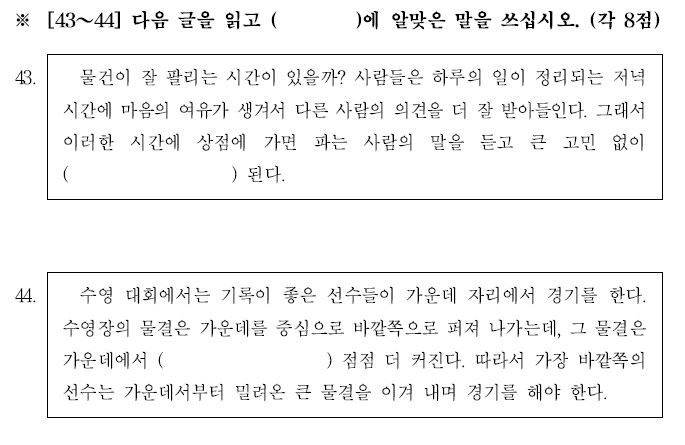
TOPIK questions

See what I mean? Hard.

It may not be evident to people in North America or Europe, but Korean is becoming a very popular language of study, especially in Asia, and so this is a pretty popular test. I live in a relatively small city in Korea and there were over 1100 people who took it today. Mostly Chinese, but also a lot from almost every other country in central and east Asia, plus a smattering from other countries as well. Anyway, now I’m going to forget about studying Korean for a while and get back to writing.

By the way, you may have noticed that I never answered the question in the title: what is “masochism” in Korean? There are two answers. One is a loanword: “mae-jeo-ki-jeom” (which sounds a bit like “magic kissing”) and the longer “pi-hak-seong byeon-tae seong-yok” which is literal translation of exactly what masochism is. So there you have it: go wow your friends.
This was one of the first results when I did a Google Image search for "Korean masochism" although it was due to this post

This was one of the first results when I did a Google Image search for “Korean masochism” although it was due to this post


Patbingsu: Korea’s Summer Ambrosia

When I grew up, in Canada, there were two main cold treats in the summer: ice cream and those long freezies that cut the sides of your mouth when you ate them. And maybe popsicles.

Like sucking on a cherry flavored dagger

Like sucking on a fruit flavored dagger

It wasn’t until I came to Korea that I discovered something better than all of that. You heard me. Even better than ice cream, and not just because this thing sometimes includes ice cream. It’s called patbingsu (νŒ₯λΉ™μˆ˜) which translates as “red bean ice water”.

Okay, I admit that’s not a very delicious-sounding name. Bear with me.

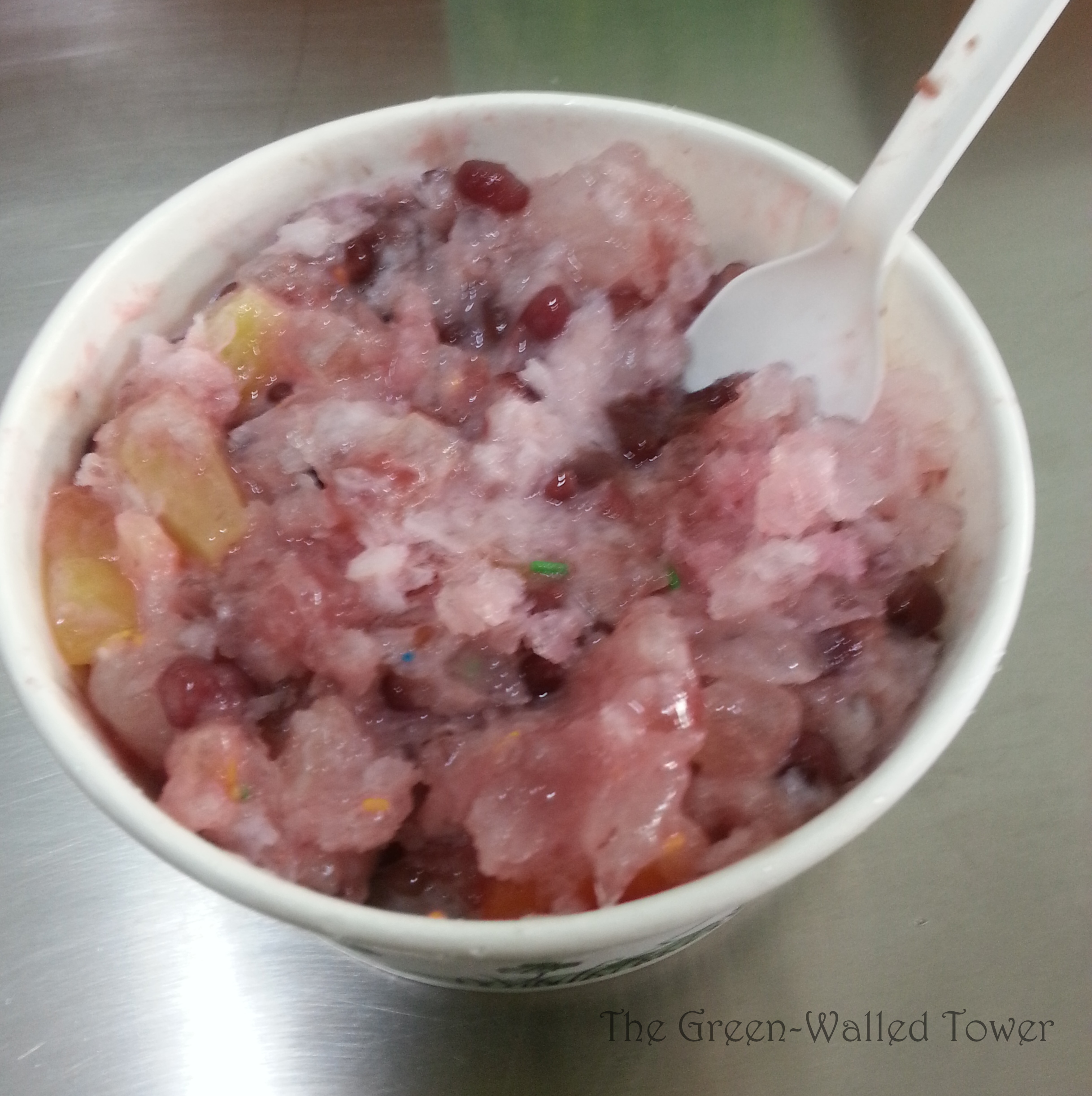
The main ingredient of any patbingsu is shaved ice, which makes up most of it. This guarantees it’s about the most refreshing you could eat on a hot summer day. After that, there are sweetened red beans. Some people don’t like them, but I really do. Beyond that, it’s whatever you want to put on it. The most common toppings are ice cream, condensed milk, fruit cocktail, fresh fruit, small candies, strawberry syrup, small little rice cakes that look like marshmallows, sprinkles, etc.

This has long been a summer mainstay. Everywhere serves it over here, even fast-food restaurants like McDonald’s and KFC. Here is what I think of a traditional patbingsu looks like. This is what I ate today at a hole-in-the-wall food stand near my school.

Yum...

Yum…

Of course, this is how it comes but you can’t eat it like this. First you have to mix it up really good until it doesn’t look as pretty.

patbingsu 2

These days, patbingsu has become a more high-class treat and so has generally become much more expensive and made with higher-quality ingredients (not better though, in my opinion). The above patbingsu cost me about $2.50.

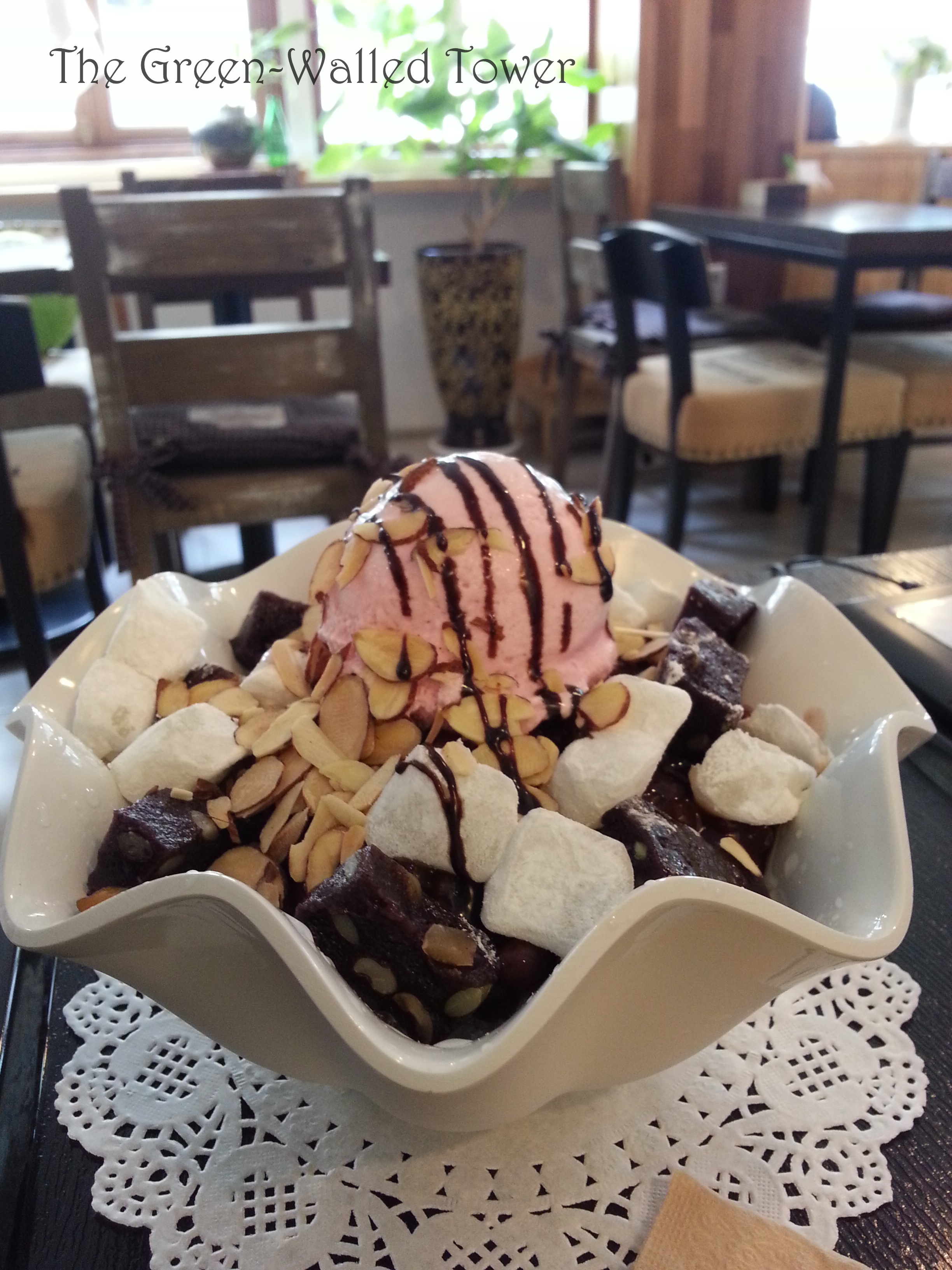
Here is one I had a week or so ago at a coffee shop:

patbingsu 3This one is much fancier and has sliced almonds, pieces of ddeok (rice cake) and things that look like brownies but aren’t (I ate it and I still don’t know what they were). It was good, but almost twice the price as the one above and not quite as good.

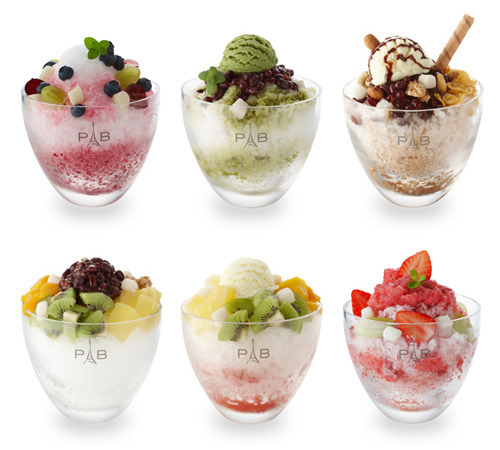
These days, there are other kinds of bingsu, for people who don’t want red beans. I have see fruit bingsu (very good), yogurt bingsu, coffee bingsu, green tea bingsu, rice cake bingsu, berry bingsu, etc. Here is the selection at a national bakery chain, Paris Baguette:

Paris Baguette bingsuThese are all quite delicious (except maybe the green tea bingsu) although they are quite expensive. The most expensive bingsu I ever bought was a 2-person strawberry frozen yogurt bingsu for about $12.00.

Whenever I finally go back to North America, this will be one of the hardest things about Korea to leave behind. One solution is to live near a large Korean population. Another idea is for all of you who live in North America to start popularizing this dessert and really make it catch on in a big way (you can start by sharing this post). That way, when I get back, it will be there waiting for me.

It’s win-win, trust me.


Is Water Chess Nuts? – Visual Fiction

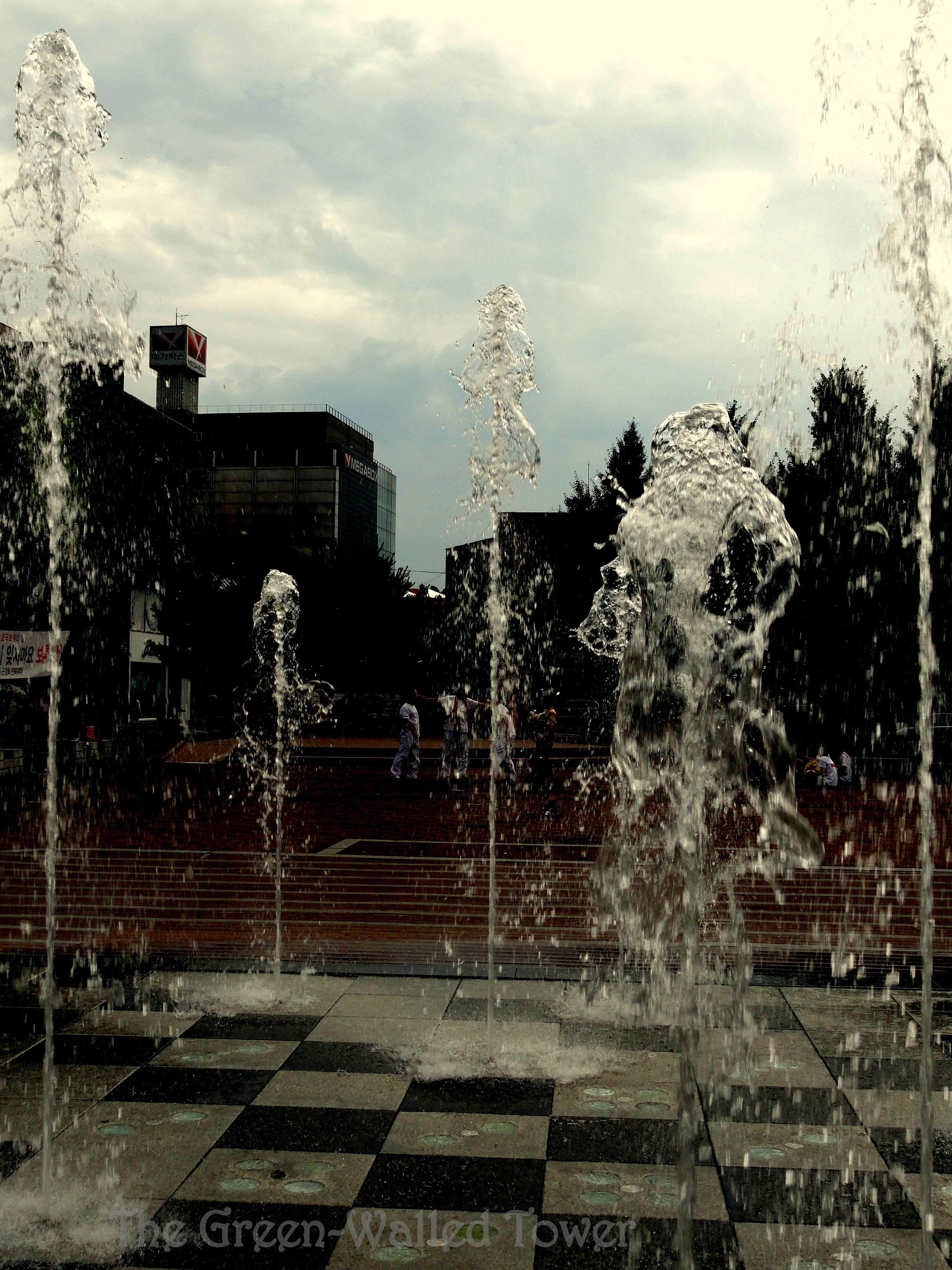
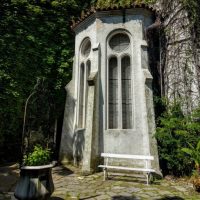
taken in Jeonju, South Korea

taken in Jeonju, South Korea

Is Water Chess Nuts?

Two men sat on the bench in the park, a controller between them that changed the water jets streaming out of the stone chess board.

β€œKnight to E4. Check.”

β€œE4? How is that check?”

β€œYour king is on F6.”

β€œNo, that’s your piece, and it’s a rook.”

β€œBut the rook is only supposed to be 1.6 meters high, not 1.9 meters high like the king.”

β€œThat is only 1.6 meters. And see? It’s a straight stream like all the black pieces. The white pieces are more of a misty stream.”

β€œIt looks misty from here.”

β€œIt’s not. See only those three pieces aren’t misty: your king, your rook and that knight.”

β€œI have more than three pieces. Don’t I?”

β€œNo, I captured the rest. Don’t you remember?”

β€œAre you positive?”

β€œAre you calling me a liar?”

At that moment, a group of squealing kids ran onto the chessboard and jumped into the jets of water. In an instant, the game was over and the men’s friendship was saved.


The Ajummas of Summer

(Ajumma (μ•„μ€Œλ§ˆ) is the Korean word for a married woman, especially middle-aged)

Ajummas

As I approached the bus stop,

A (fairly) young, Canadian man, dressed in conservative business clothes,

I realized I could not have been more out of place.


How to Eat a Triangle Kimbap

On Sunday, when I wrote my Once Upon a Hike in Korea post, I mentioned bringing a triangle kimbap with me for food and I promised to explain what that was today.

First of all, for those of you who don’t know what kimpab is, it is a common Korean food made of rice and seaweed wrapped around various vegetables and meat, rolled up and cut into slices.

Kimbap

Kimbap

It is very common as a picnic or snack food and it is what moms often make for their kids when they’re going on a field trip.

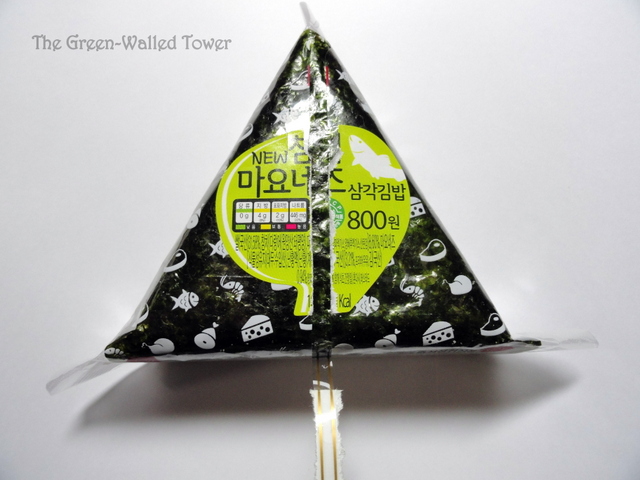
Kimbap is usually made fresh, either at home or at a restaurant where they make it right there for you. However, there is another kind called triangle kimbap that is sold in convenience stores. It looks like this:

triangle kimbap 1

These come in many different types (usually various kinds of meat) but this one is my favorite: tuna mayonnaise. These tend to be less healthy than the regular variety and don’t have vegetables in them. As you can see, this cost 800 won, which is about 70 cents US, so they’re pretty cheap.

Another thing about these is that the shelf-life is insanely short, as it should be with anything like this. As you can see, the sell-by date is not just in days, but also in hours. This one was made at 9am on June 10 and was good until 22pm of June 11, or about an hour after I bought it.

Triangle kimbap 2

The thing about these is that the insides are wet and they’re surrounded by dry seaweed, so how do you keep the seaweed dry and crisp until you want to eat it? The answer is that the seaweed is wrapped separately in plastic from the inside but still wrapped around the rice. So, to open it without totally disassembling takes a special design. This is how you do it.

Step 1: Pull the middle tab, cutting the outer plastic totally in two.

Triangle kimbap 3

Step 2: Pull the two sides apart. You have to do this gently, since the seaweed is folded under and it’s fragile.

Triangle kimbap 4

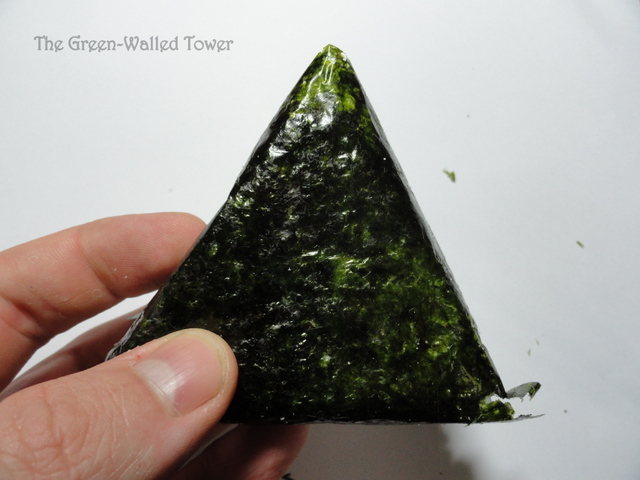
The wrapping is all gone now. Now you can open up the seaweed and see what the inside is like. It’s basically a triangle of rice with an indentation where they put whatever kind of meat is in it.

Triangle kimbap 5

This is a great snack and easy to eat with your hands. And now, if you ever come across one, you’ll know how to eat it.

Triangle kimbap 6

I had never seen anything like this until I came to Korea, but I’m curious: is there anything like this in any other countries that you know of? I’m always interested in learning about other cultures.


Once Upon a Hike in Korea

Once upon a time, in the far-off country of Korea, lived a man named David who liked to hike. One Thursday, the government said that there would be a holiday to honor soldiers who died in war, so David decided to go hiking. The weather was hot, but he decided to go on a course of four mountain peaks. First he assembled his inventory.

He brought:

– 3 liters of drink (+4 to Life)

– a Snickers bar (+2 Energy, +2 Yum)

– triangle kimbap (see blog post on Tuesday) (+2 Health)
– peanut butter jam sandwich (+1 Health, +1 Cheap)

David also brought his trusty Staff of Walking (+2 Hiking, +3 Attack versus spiderwebs) and put on his magical Boots of Hiking. They were 16 years old, so while this gave him +2 to Nostalgia, they also made him -3 resistance versus blisters forming. You can’t have everything in life.

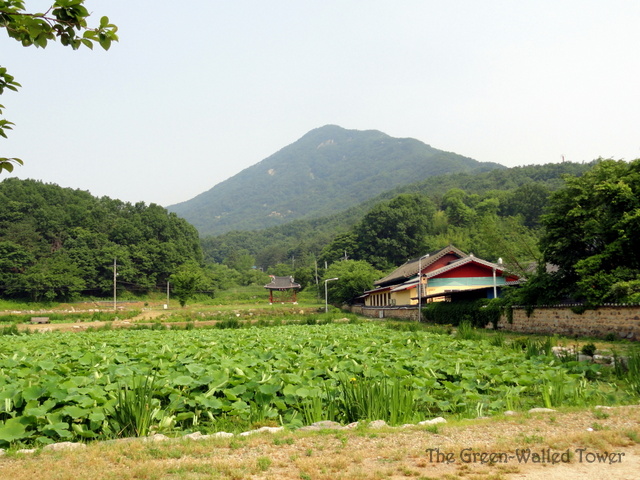
David took a crowded bus to a nearby valley that was green on all sides. He started at a temple at the base of the first mountain.

1

The initial climb was brutal. The weather was hot and the air was still and sweat stung his eyes. Still, he pushed on and the slope gradually leveled out to a nice path between tall trees. Nearer the top, there were breezes that cooled him a little.

Hiking in Korea 2

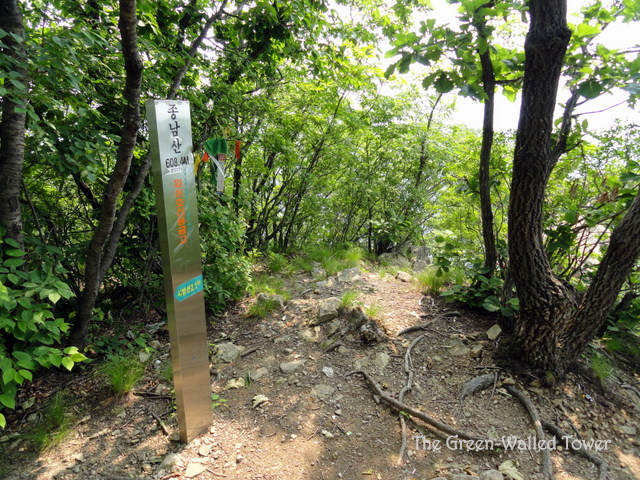
An hour later, he got to the top of the first mountain, Jongnamsan. So far, he had seen no people.

Hiking in Korea 3

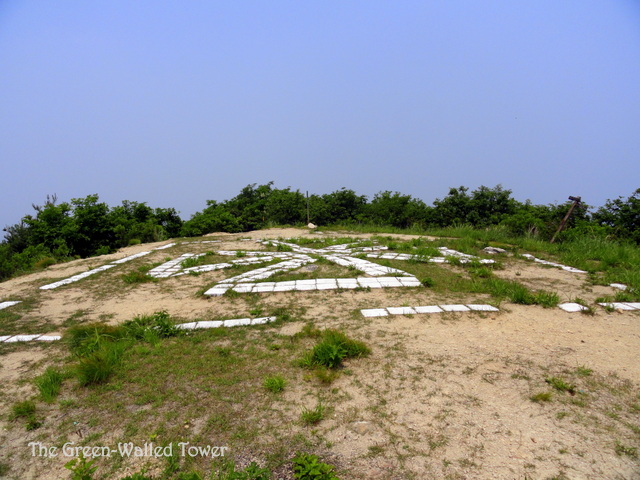
The path between the first and second mountains was much easier. For most of it, David walked along on a level, shady forest path. Here, there were more people (14 in all, and one dog). The second mountain peak Seobangsan was empty and barren and had a place for a helicopter to land. It was hot and David didn’t stay there long.

Hiking in Korea 4

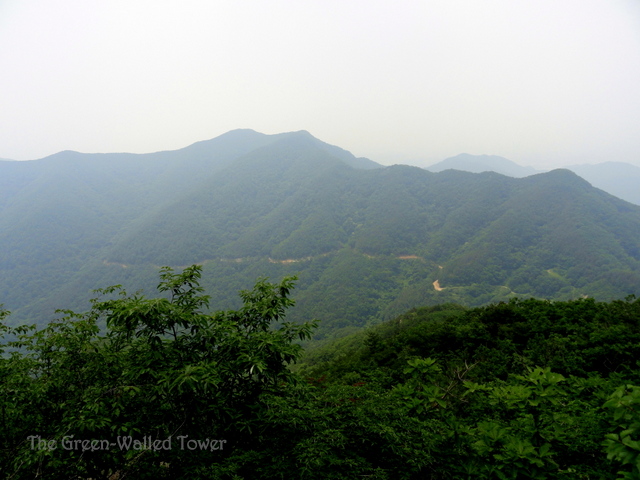
As he started to descend, David caught a glimpse of the valley he had traveled along. The air was hazy and the distance faded out into white. The flies were becoming annoying. There were no biting flies or mosquitoes, but there were millions of flies around. There was a dull roar in the otherwise silent woods from the sound of their combined humming.

Hiking in Korea 5

The path went steeply down to a lowΒ  pass between the second and third mountains. On the way, he passed a tall stone gate that was blocking his way. Just as well it wasn’t a solstice or midnight or anything or he probably would have been whisked away to another world. On the pass between the mountains, he met a Korean couple and advised them on the routes to take, as well as informing them that the map board that was located there had been printed backwards (for some reason). Then he set off for the third mountain peak.

Hiking in Korea 6

The third mountain was the most difficult. It was taller than the others and by this time, four hours into the hike, David was getting very tired. He struggled up the steep slope and up and over some deep clefts in the ridge until he was able to look back at where he had come from.Β  He saw that a narrow road was being built all around the valley. This disquieted David a lot, since the only reason he could see for it was logging and he hated to see the beautiful valley he loved so much logged and denuded.

Hiking in Korea 7

The third mountain, Seoraebong, was at the intersection of three mountain ridges and now David left the first valley and struck out onto a new ridge, an almost straightΒ  line to the last mountain at the very end of it.

Hiking in Korea 8

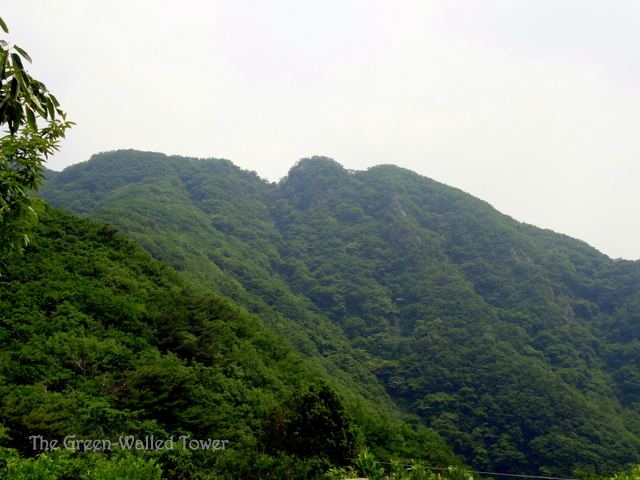
This last ridge was much easier in some ways, but by this time David was very tired and his knees were hurting. Looking back, he could see the double notched ridge of the third mountain.

Hiking in Korea 9

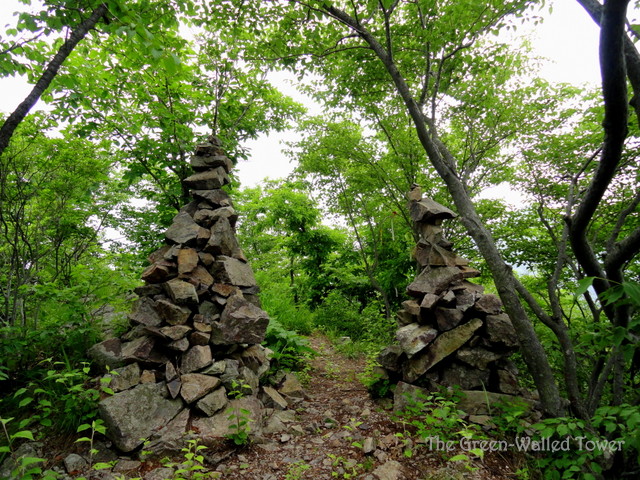
Along the way, he passed many interesting things, like more stone cairns and towers, plus the Wood of Confused Pines. They went in all directions, as if they had had a fight when deciding what direction to grow in.

Hiking in Korea 10

Finally, David reached the final mountain peak, Ansusan. It looked over the prosperous farming region of Gosan, where newly-planted rice fields were laid out in neat rectangles as far as the eye could see.

Hiking in Korea 11

Coming down from Ansusan was much more difficult than going up the first mountain. The slope was steep rock and David had to use ropes and chains to hold onto as he went down.

The first time David went down this slope was in the dark. On Halloween.

The first time David went down this slope was in the dark. On Halloween.


The path kept going down steeply. After it entered the trees, the path became more dangerous, with loose rocks and fallen leaves covering everything.

Hiking in Korea 13

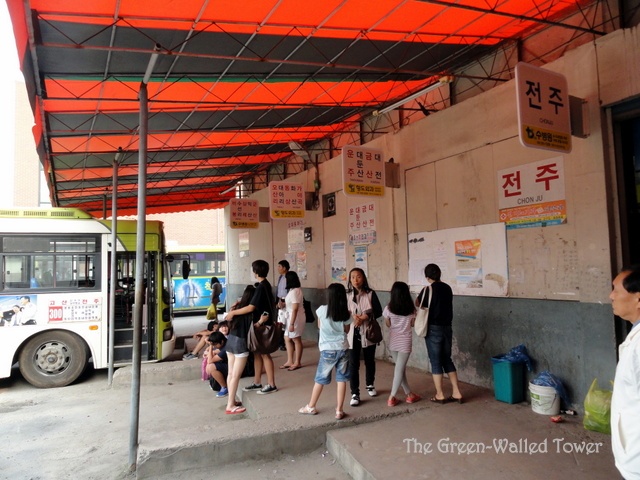
Finally, 8 hours after getting off the bus, David arrived at another bus terminal and waited with other hot people for a bus back to his city of Jeonju. It was a long, hot day and he was very sore and tired, but overall it was quite magical.

Hiking in Korea 14


Korean movie previews: And now for the coming distractions…

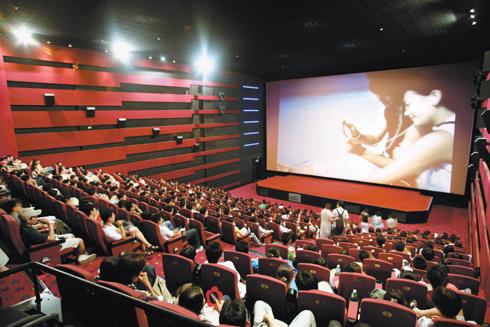
One of my favourite parts of going to the movie used to be the previews at the beginning. It was like getting to watch a bunch of free movies, almost harkening back to the days when your nickel got you a newsreel and a cartoon before the main feature. Honestly, I haven’t been to a movie in North America for a while (although I hear popcorn has to be purchased in gold now) but in Korea, the previews before a movies are a whole different thing.

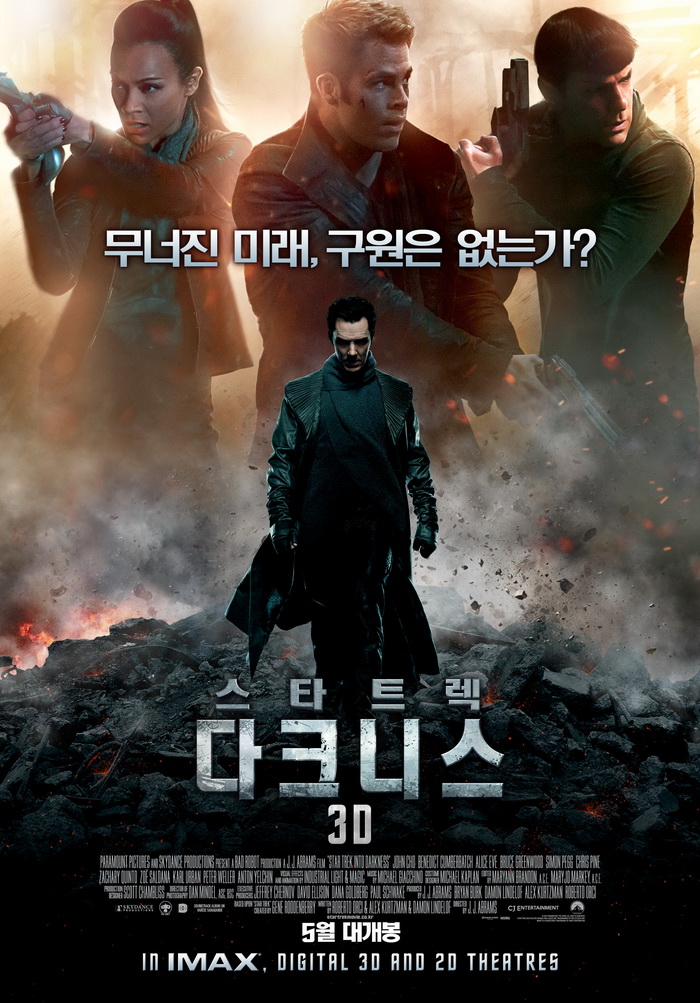
Specifically, they’re advertisements. And there are a ton of them. It’s interesting to see trends change over time. There are always cellphone commercials, since this is Korea, but there used to be an insane amount of alcohol commercials. This last weekend, when I went to see Star Trek: Into Darkness, there wasn’t a single one, which is good, I suppose. Here is a list of the commercials I did see before the movie though.

1. hanium.or.kr, which is an IT knowledge sharing project in Korea

2. Hanbit optometry

3. a spot about the rules of the theater (cellphones on vibrate, be courteous, etc), performed by a Korean skit comedy group, similar to Saturday Night Live

4. koreatree.or.kr (λ‚˜λΌμ‚¬λž‘ν°λ‚˜λ¬΄), which, according to their website, is a campaign to promote patriotism, freedom, and hope in the future in Korea

5. Saemaeul financial association

6. a trailer for the Korean movie 마이 라띠마 (Mai Ratima), which is about a love affair between a lower-class Korean man and a Thai mail-order bride.

7. Nivea lotion

8. U+ LTE cellphone service (this is LG’s cellphone company. There are three cellphone carriers and they all advertised before this movie)

9. Nivea again

10. Maxim coffee, specifically what I call “coffee sticks”. It’s a thin tube with instant coffee, sugar, and creamer in it and makes about 150ml of coffee.

11. Hyundai Motor Group

12. Restylane, which apparently is a wrinkle remover.

13. Korean Air, specifically about flights to the Maldives, which I admit, looks pretty good

14. a Megabox theater announcement about fire exits, illustrated by the animated character, Pucca.

15. Hyundai again, although this one might have been for Hyundai real estate. I can’t remember.

16. Home CC, which is the interior decorating branch of a paint and chemical company, KCC. They own the basketball team in the city where I live.

17. LG: specifically for pocket-sized photo printers that connect to your cellphone.

18. a GPS system called λ‹€λ³Έλ‹€ (Dabonda: “sees everything”)

19. a trailer for a movie called μ€λ°€ν•˜κ²Œ μœ„λŒ€ν•˜κ²Œ (Eunmilhage, Widaehage: “Secretly, Greatly”), which is an action/comedy about a North Korean sleeper agent in Seoul.

20. Samsung Galaxy S4 phone

21. Megabox commercial again (Megabox is the name of the theater I went to)

22. Chevy (ever since GM bought Daewoo a couple years ago, there are suddenly a lot of Chevy cars around. Besides that, it’s 95% Hyundai and Kia.)

23. a PSA against illegal sports gambling

24. Samsung Galaxy S4 again

25. Olleh Warp cellphone service (the cellphone service brand of KT)

26. Olleh Warp again

27. a trailer for the movie White House Down

28. U+ LTE cellphone service again, this time toting their unlimited voice plan

29. Megabox again

30. SK Telecom LTE unlimited


So, there you have it. 30 commercial in total, with only 3 movie trailers and only one of those an English movie. But then we got to seeΒ  Star Trek, so it was worth it.

This is the case at every single movie you go to here, although I guess after 8 years, I’ve gotten used to it. And honestly, it beats having to pay $20 for a bucket of popcorn.

Here's the movie I saw.

Here’s the movie I saw.


Do you have mercy? – A true story

This is something that happened to me a few years ago, but I was reminded of it today when I read Swarupa’s post, To help or not to help: that is the question.


If you have read my post about hiking various islands by myself, you probably know that I like to get out in the middle of nowhere by myself. Call me a lone wolf.

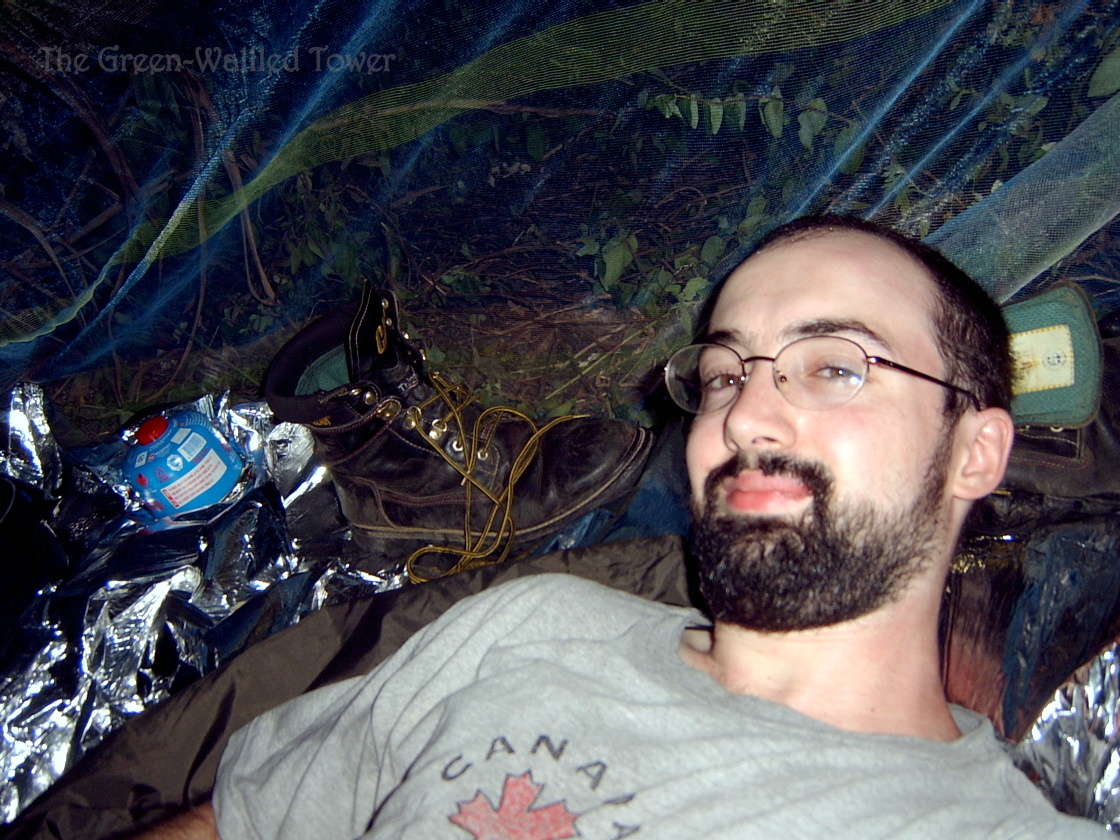
A few years ago, I took a trip to a small island near here called Wido. My plan was to camp without a tent: using only a sleeping bag and mosquito netting, because why not? I hiked to the end of the island and found a great place on the edge of a cliff overlooking the ocean.

Of course, the most glaring drawback of mosquito netting is that it doesn’t do much in the rain. The weather that day had been absolutely perfect, overcast and cool but not rainy. However, as I lay down under my mosquito netting I saw the first flash of lightning off in the distance. I watched it far out over the water, silent because of the distance, and prayed it would turn aside.
Nevertheless, I got ready to move if I had to. I didn’t have anywhere else to go but if it rains hard when you under mosquito netting, anywhere is better than staying there. Sure enough, 20 minutes or so later, it started to pour. I packed everything up in the dark with just a glowstick for light and stumbled up the steep, thornbush-covered slope clutching the glowstick, an umbrella and the wet bundle of my ground pad and mosquito netting.

That night inside the mosquito netting, pre-rainstorm

That night inside the mosquito netting, pre-rainstorm

I made it back to the main road and decided to keep walking up the road in the direction I had planned to go the next morning, in hope of finding a gazebo (which were common enough there) I could shelter in. I started out but soon it really started to pour, with strong winds blowing towards me. My umbrella was old but even so, no umbrella is any good against sideways rain. I was completely soaked, my boots were squashy and my umbrella kept turning inside out. It was late at night and now I knew that I couldn’t stay in a gazebo even if I found one since it would be soaked too. I walked with my head down, splashing through the puddles and just keeping my eyes on the white line at the side of the road. I wasn’t unhappy; I’d wanted an adventure and you can’t get much more adventuresome that that, but still, I was tired and ready for somewhere dry to lie down.

After about 20 minutes, I saw a sign for a motel and turned off. As soon as I reached the sign, the rain stopped suddenly and completely. Divine sign or coincidence, I don’t know. It turned out that the motel was out of business but as I was standing there, a woman came out and told me she had a room where I could stay in her pension (which is like a motel). It was 50,000 won a night (about $50) but she said she’d give it to me for 40,000. As I was fumbling for my wallet, I said I wasn’t sure if I had enough and she assured me she would let me stay in any case. Setting aside ferry fee, I had 30,000 on me. So she took that and let me in.

I must have looked like a real charity case, as I stood there dripping wet. She immediately took my sopping boots to the sink and then led me to the bathroom and gave me some towels to clean up with. I stood in the bathroom while she bustled around cleaning up the room. As we chatted, I found out she was a Christian (actually she asked me) and that she had an adult son in New Zealand and a daughter in Seoul. Also, she was concerned because I was alone (“Don’t you have any friends?”). Koreans never do anything like that alone.

All my wet things flung here and there.

All my wet things flung here and there.

Before she left, I told her that I would come back some time and pay back the money I owed her. She brushed off the offer and said something I will never forget: μžλΉ„ μžˆμ–΄μš”? (jabi isseoyo?) This can mean ‘Is there mercy (in the world)?’ but it can also mean ‘Do you have mercy?’ I said yes, of course, and she soon left. I said good-bye to her the next day and continued my trek back along the coast to the ferry (absolutely beautiful weather that day).

*Β  Β  Β  Β  *Β  Β  Β  Β  *

A few weeks later, I was sitting at a bus stop when a very old woman sat down next to me. After a few minutes, she moved over next to me, tapped me on the knee and said something. Older Koreans often have a strong accent and I didn’t understand, although when elderly people talk to me they either want to ask me where I’m from, tell me about Jesus, or ask for money. It was pretty clearly not the first two and soon she said held out her hand and said she was hungry.

I said what I always say when they ask for money and asked her if she didn’t have a family that could take care of her. She didn’t answer but kept asking for just a bit of money. I finally decided to give her a few dollars, but when I opened up my wallet I only had a 1000 and a 10,000 won bill. It seemed almost an insult to give her the 1000 since you can’t really buy much with that, so I just gave her the 10,000. Her face broke into a wide grin and she patted my hand and said she was going to go get something to eat right away. She got up and began to make her slow, hobbling way down the street.

As I watched her go, I suddenly realized that that 10,000 won was the exact amount the woman on Wido had forgiven me when I didn’t have it. I could hear her words again in my head, “Do you have mercy?” I thought of myself, standing dripping wet on her doorstep late at night and Jesus’ words, “I was a stranger and you invited me in.” and the words, “I was hungry and you gave me something to eat.” I also realized that my debt of mercy was far from being repaid. I have many more 10,000 won notes to give away, in different shapes and sizes, some in monetary form, some not.

I hope I never forget that woman’s words: “Do you have mercy?”


Chinese Food: Korean Style

If there is one food that is all over the world, it’s Chinese food. For most people, it’s not hard to believe that the food they eat at a Chinese buffet is not exactly what Chinese people eat every day at home, but what people don’t always realize is that Chinese food is not the same in every country. There were Chinese foods in Canada that I have never seen in the US and I have heard of differences in other countries as well.

However, nowhere (in my experience) is Chinese food as different as in Korea. I have heard that what is considered Chinese food in Korea comes from the northeast of China, but it is quite unique (except for fried rice: everywhere has fried rice). Here are the main dishes you see at Korean Chinese restaurants.

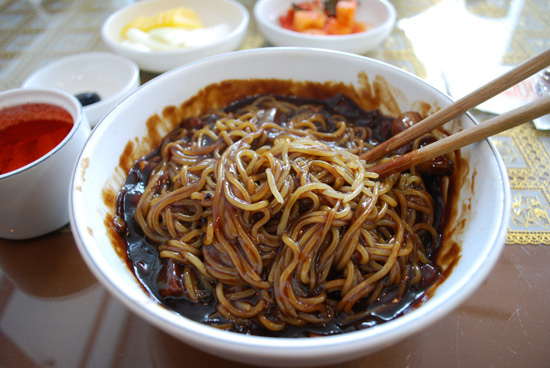
Jajangmyeon

Jajangmyeon (자μž₯λ©΄): Jajangmyeon is kind of the go-to Korean Chinese food. It is noodles in a black soybean-based gravy. It doesn’t have a strong flavor, but it’s very good. There is also jajangbap, which is the same, but with rice instead of noodles.


jjambbong

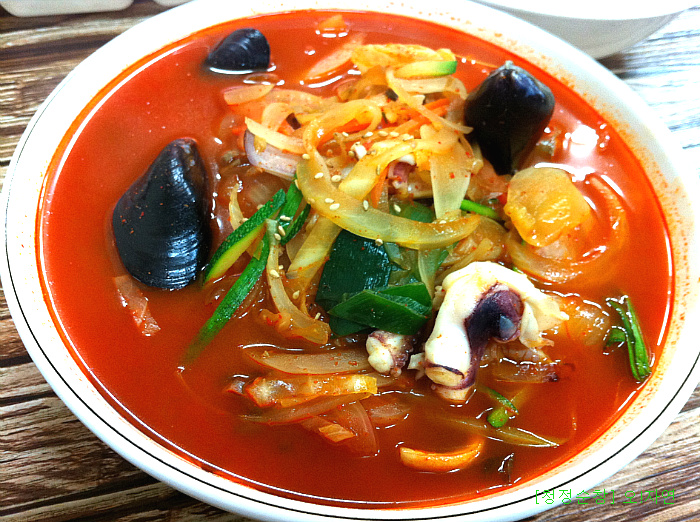
Jjambbong (짬뽕): This is the other main Chinese food here. Jjambbong means something like “hodge podge” so it’s a mixture of many things. As you can see by the color, it is very spicy. Jjambbong consists of noodles and various types of seafood such as squid, mussels, sea cucumber, and if you get the expensive stuff, a lot more. It also has a lot of onions in it.


tangsooyook

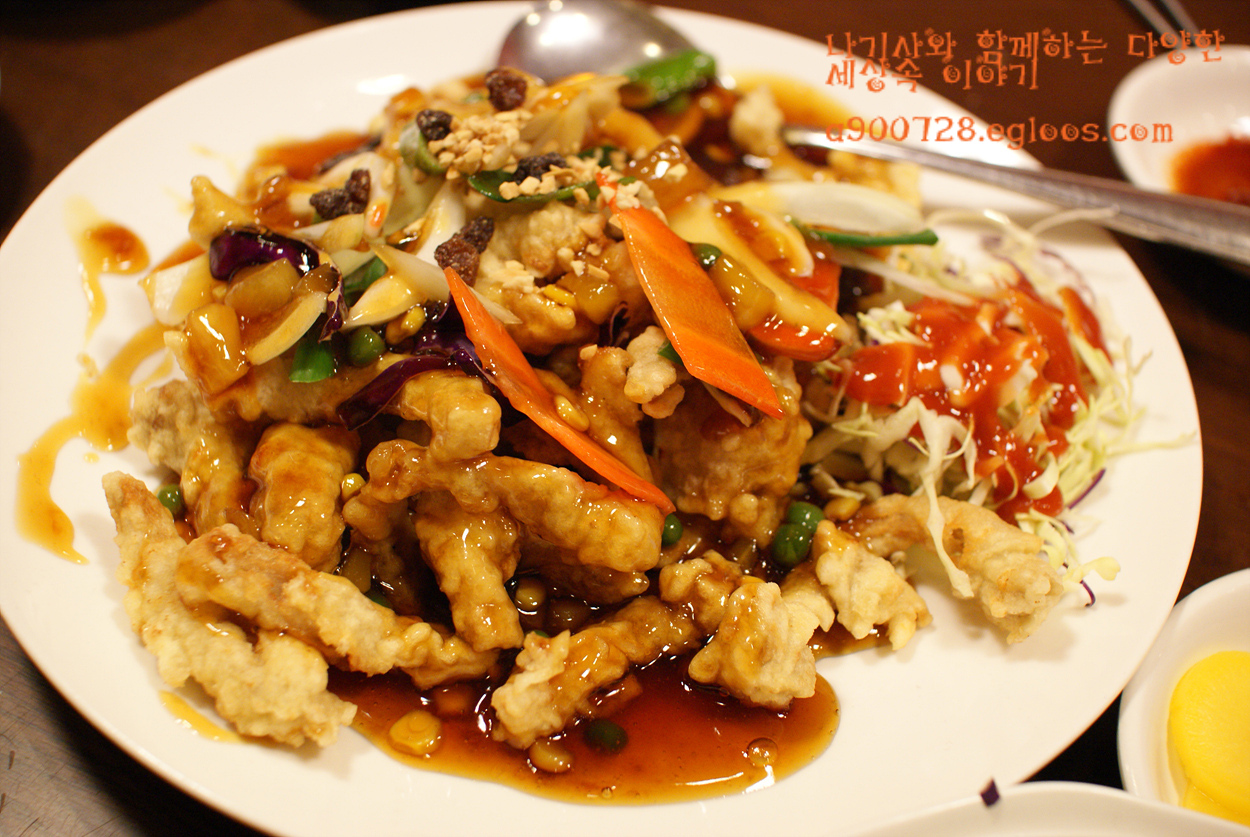
Tangsooyook (νƒ•μˆ˜μœ‘): This is fried pork (or beef, if you want the really expensive stuff) served with a sweet and sour sauce. In some ways it is similar to sweet and sour pork in North America, although (in my opinion) it’s a ton better and also is a lot more expensive. A small serving is about $15 and a large is $20 or more. Of course, a small serving is enough for 2-3 people. This is one of those dishes that only comes in group sizes. Koreans almost always eat out together and so a lot of their food is geared towards groups (I have been turned away from restaurants for being alone, since they had nothing on the menu for only one person). This is one of my favorite Korean Chinese foods.

japchae

Japchae (μž‘μ±„): This is the final mainstay of Korean Chinese food: japchae. This is perhaps a little more familiar looking. It is rice noodles mixed with meat and vegetables. It’s usually pretty mild, although some places make it really spicy.

Here’s what it looks like when you get it delivered:

chinese korean delivery

This is a meal that my wife and I ordered last November when we wanted to splurge. She got the fried rice and I got the jjambbong (lower right). The three-section dish in the lower center is a constant with Korean Chinese food: yellow pickled radishes (which are Korean, originally from Japan), black soybean paste, and raw onion pieces (not pictured, because my wife eats them immediately).

The tansooyook is in the middle, with a big bowl of its sauce. And as if that’s not enough food, they also threw in an order of mandoo, or dumplings, (upper right) for free. Because Korea is all about the free stuff.

They give you wooden chopsticks, but real spoons and real dishes. You eat and when you’re finished, you put them outside your door and the delivery boy comes and gets them later. I’m very glad this system works here, since using real dishes is so much nicer than styrofoam or paper.

I have grown very fond of Korean Chinese food but the problem is, that once I leave Korea, it will be very hard to find. It’s not Korean food, so you can’t find it in most Korean restaurants outside of Korea. And it’s not normal Chinese food, so Chinese restaurants don’t have any of it. There are restaurants in Korean districts, such as in New York or LA that have it, so I’ll have to make a trip to a city every now and then to get it. If you’re near a Korean district, I’d recommend seeking it out.


My Experience with Korean Bullfighting

When we think of bullfighting, the image that comes to mind is undoubtedly Spanish: matadors, flashing capes, and Hemingway’s Death in the Afternoon.

Korean bullfighting is very different. There are no humans combatants: the bulls fight each other, and it is more like wresting than a death struggle. The bulls do have sharp horns so it is possible to draw blood, but that is pretty rare and bulls being injured or killed is all but unheard of. At least in my experience, I have never seen it.

bullfighting 1

I first heard about Korean bullfighting (called so-ssaeum, or μ†Œμ‹ΈμŒ) from a co-worker of mine, who mentioned that there was an annual festival near Daegu. I was intrigued, because for a Canadian, the whole idea of bullfighting is very strange and exotic. Imagine my surprise when I found out that the town where I teach has an annual bullfighting tournament as well.

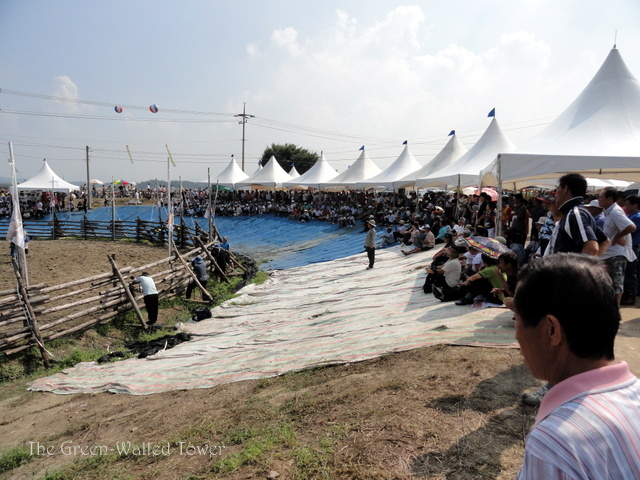
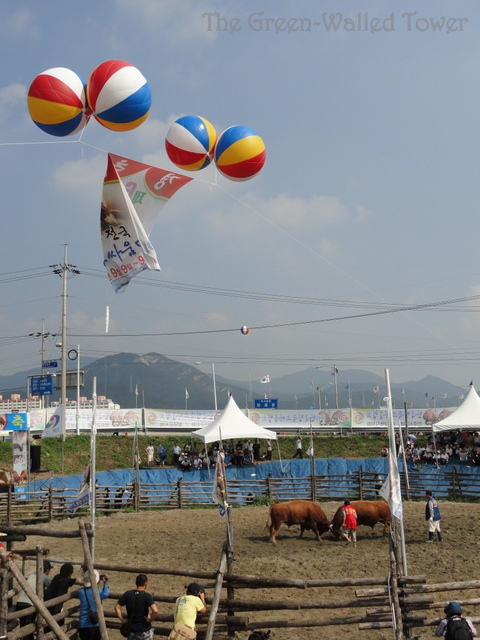
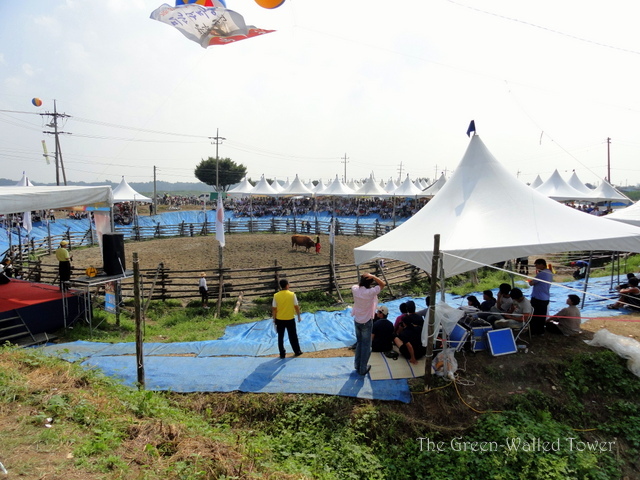
I went after school, the only non-Korean in a crowd of several hundred people. The ring was fenced off by wooden poles and the entrance was built like a tunnel through a high bank, where the people sat. It may seem like this did not give much protection, but in Korean bullfighting, the bulls are fairly docile and do not attack people. They are very used to being handled and taken care of and they only fight each other. That being said, I still wouldn’t play around with a 1-ton bull that didn’t know me.

bulfighting 2

The tournament is four days long and has a festival atmosphere to it. Besides the fights, there are also booths selling food and local products, plus a stage for music. People sit on the ground under tents to watch the fights.

bullfighting 3

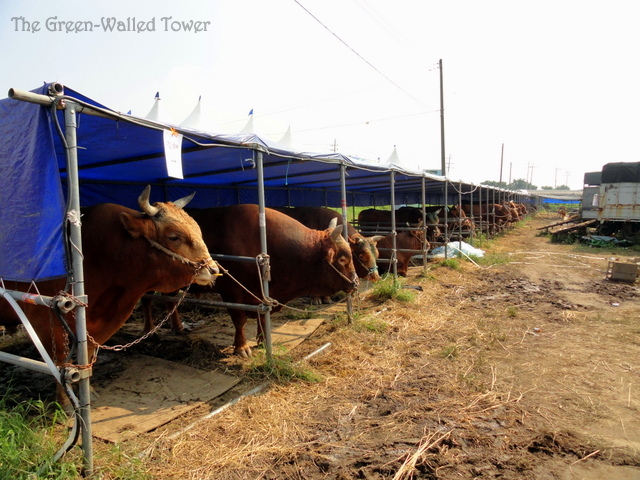
The bulls are tied up in booths in a separate area until it is time for their fight. They are sent to fight in a rotation and then on the last day, the semi-final and final matches are fought to decide the ultimate champion.

bullfighting 4

bull closeup

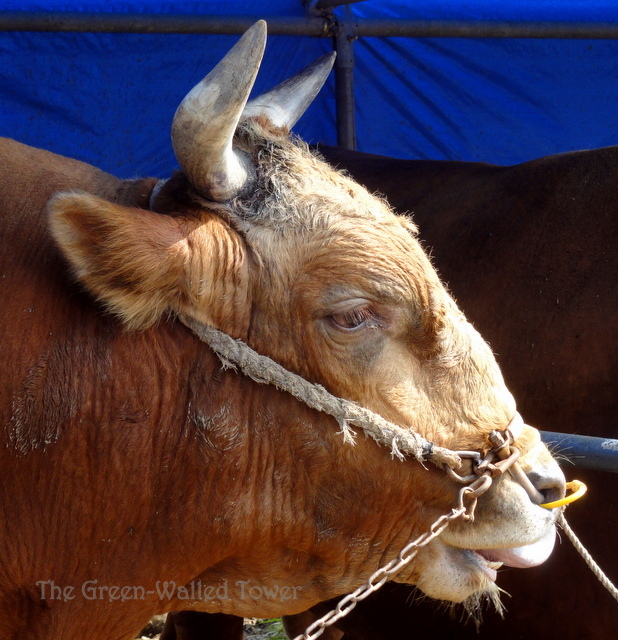
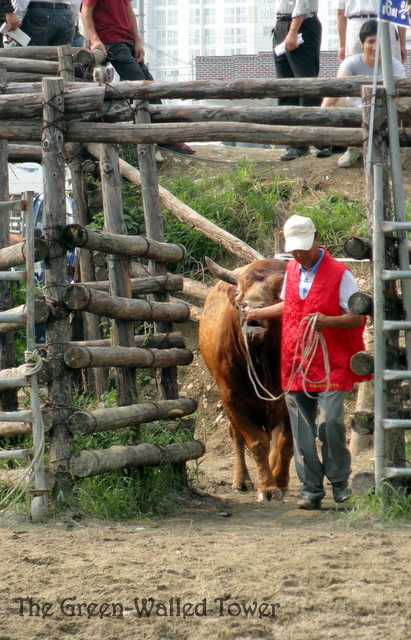
When it is time for their fight, the owners leads the bulls into the ring one at a time, leading them by a rope tied to the ring in their nose. The only people allowed in the ring are the bull owners and the referees.

bullfighting 5

The referees wear special uniforms. The bulls are not subject to any rules, of course, but the referees make sure the owners do not interfere. Occasionally, one of the bulls will refuse to fight and the referees call a forfeit after a certain amount of time.

bullfighting 6

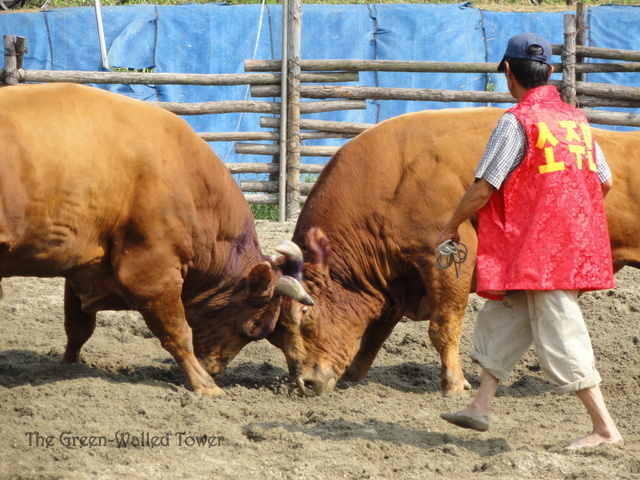
The bulls fight by butting their heads together and trying to twist around to jab each other with their horns. Their skin is so thick that although I’m sure it hurts to get jabbed with a horn, I never saw a bull draw blood with its horns.

bullfighting 7

One of the owners is designated blue and the other is red, as shown by the vests they wear. They usually stand near the bulls and shout encouragement and are ready to catch them, if need be.

bullfighting 8

I saw one fight where the man in the ring wearing the owner’s vest wasn’t actually the owner, but an employee. The real owner did not like what he was doing and kept yelling at him, but the man in the ring just ignored him. Finally, the owner walked into the ring, picked up the man bodily and carried him out of the ring, while the crowd roared with laughter. Then the owner put on the vest and came in to finish the fight. Not that the bulls took any notice, of course.

bullfighting 9

Luckily the employee was much smaller than the owner.

The fight lasts until one of the bulls gives up, usually by suddenly breaking off and running away. Most fights only last a few minutes, although some can go 15 minutes or more. The very long fights are pretty intense, especially when you consider that the bulls are straining against each other in the hot sun the whole time; almost a ton of muscle pushing in each direction. Always though, one of the bulls runs away eventually and a roar goes up from the crowd, of congratulations for the winner, or derision for the losing bull.

bullfighting 10

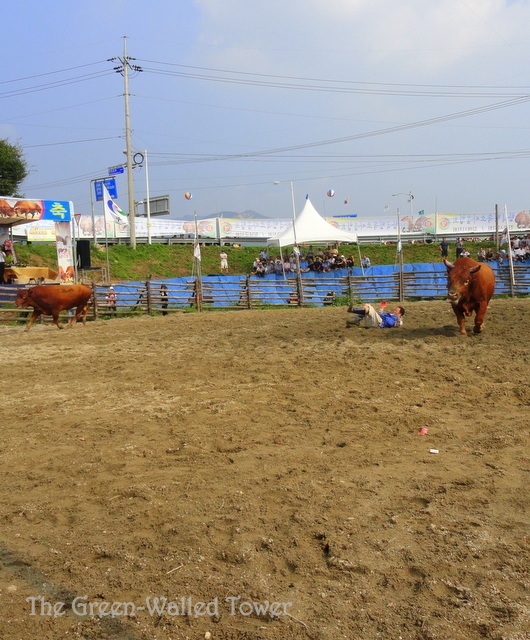
The fight is over. This owner fell down trying to catch his bull.

The bulls then go back through the tunnel to the stalls, very hot and thirsty. The owners hose them down, give them a lot of water and put them back in the shade to wait, either to go home or to fight again.

bullfighting 11

Overall, it was a very interesting experience. While some people may argue that it is exploitive of animals, it is much more humane than the Spanish variety, where the animal always dies in the end. Also, because the bulls are evenly matched, the outcome is not a foregone conclusion, as with Spanish bullfighting. Yes, there is some tension as to whether the matador will emerge unscathed, but ultimately, the bull never wins. In Korean bullfighting, there is a certain majesty watching two huge animals wrestle as they might in the wild and they also live to tell about it.

What do you think? Do you think this is an improvement on other types of animal sports or is it all cruel and manipulative? Let me know in the comments.

bullfighting 12


The Elephant's Trunk

🐘 Nancy is a storyteller, music blogger, humorist, poet, curveballer, noir dreamer 🐘

Thru Violet's Lentz

My view, tho' somewhat askew...

The New, Unofficial, On-line Writer's Guild

Aooga, Aooga - here there be prompts, so dive right in

Just Joyfulness

Celebrating joy

Tao Talk

You have reached a quiet bamboo grove, where you will find an eclectic mix of nature, music, writing, and other creative arts. Tao-Talk is curated by a philosophical daoist who has thrown the net away.

H J Musk

On reading, writing and everything in between ...

Clare Graith

Author, Near Future Sci-Fi, Dystopian, Apocalypse

Dirty Sci-Fi Buddha

Musings and books from a grunty overthinker

Rolling Boxcars

Where Gaming Comes at you like a Freight Train

Lady Jabberwocky

Write with Heart

Fatima Fakier

Wayward Thoughts of a Relentless Morning Person

Life in Japan and Beyond

stories and insights from Japan

The Green-Walled Treehouse

Explore . Imagine . Create

One Minute Office Magic

Learning new Microsoft Office tricks in "just a minute"

lightsleeperbutheavydreamer

Just grin and bear it awhile

Linda's Bible Study

Come study God's Word with me!

Haden Clark

Philosophy. Theology. Everything else.

Citizen Tom

Welcome to Conservative commentary and Christian prayers from Mount Vernon, Ohio.

The Green-Walled Chapel

Writings on Faith, Religion and Philosophy

To Be A Magician

Creative writing and short stories

My music canvas

you + me + music

Eve In Korea

My Adventures As An ESL Teacher In South Korea

Luna's Writing Journal

A Place for my Fiction

Upper Iowa University

Center for International Education

Here's To Being Human

Living life as a human

jenacidebybibliophile

Book Reviewer and Blogger

yuxianadventure

kitten loves the world

Strolling South America

10 countries, 675 days, 38,540km

It's All in Finding the Right Words

The Eternal Search to Find One's Self: Flash Fiction and Beyond

Reflections Of Life's Journey

Lessons, Joys, Blessings, Friendships, Heartaches, Hardships , Special Moments

Ryan Lanz

Fantasy Author

Chris Green Stories

Original Short Fiction

Finding Myself Through Writing

Writing Habits of Elle Knowles - Author

BEAUTIFUL WORDS

Inspiring mental health through creative arts and friendly interactions. (Award free blog)

TALES FROM THE MOTHERLAND

Straight up with a twist– Because life is too short to be subtle!

Unmapped Country within Us

Emily Livingstone, Author

Silkpurseproductions's Blog

The art of making a silk purse out of a sow's ear.