Category Archives: Dark

The Circle of Unbeing, Part 3

Click to read Part 1 and Part 2 of the story.
fireplace

When Pavel reached the house, he took the axe from behind the door and began to sharpen it. His mother looked up from the hearth, where she was cleaning out the ashes.

“What are you doing home? What’s wrong?”

Pavel looked at her, hesitated. “Wolves,” he said.

He stayed home all day, sharpening knives, watching, and fidgeting, until his behavior began to frighten his mother and he left. No one from the mayor’s manor came to summon him, which both relieved and worried him at the same time.

Night eventually came and Pavel and his mother sat silently in front of the fire—her with her mending and Pavel staring into the fire, the axe on his knees. He looked up to see her gazing at him.

“Do you think you will need that here? Do you think the wolves will come into the village—break into our house?”

“I—I’m not sure,” he said.

“It’s not wolves you’re worried about, is it?” she said.

There was a clattering outside, like wood falling off the pile. Pavel jumped, then went to the small window by the door. The moonlight was shining on their small path and garden but there was no movement.

At that moment, the chickens behind the house began to scream. Pavel had never heard them make such sound—did not know they could make such a horrible, rending shriek. He put his hand on the door handle but could not will himself to open it.

“Well, are you going?” his mother cried suddenly. “You got the axe. If wolves are at the chickens, you’d better go now or they’ll all be killed.”

Still, Pavel could not make himself open the door or explain why. He felt paralyzed. The chickens stopped abruptly and there was total silence for a space of several breaths. Just when he thought it was safe, there was a thump against the door. It came again. Someone, or something, was knocking with heavy, irregular strokes on the outside.

Thump . . . thump . . .

“Are you going to open it?” his mother asked. “Pavel, are you okay? What’s wrong? If it were wolves, they wouldn’t be knocking. Pavel, let the poor person in and out of the cold. Pavel?”

His hand was still resting on the door handle, but all he could think of was some way to barricade the door. Pull the beds across and push them against it. Block the window. Anything and everything to keep the evil outside. He looked up to see his mother next to him and before he could do anything, she pushed him aside and threw the door open.

A gust of frigid wind burst into the room, causing the fire to gutter. Pavel heard a rasping, croaking sound and then that hideous deformed face he had seen in the dungeon emerged into the light of the fireplace. His mother gasped and stepped back. The creature shuffled over the threshold.

Pavel stepped in front of his mother, brandishing the axe, but he was too transfixed with horror to strike. Now that he could see the monster in better light, he saw that it looked like a man, although one shriveled and twisted by some evil force. Its skin was yellow and thin and its eyes were bloodshot and roving. They latched onto his mother’s face and the mouth opened.

“Ah . . . An . . . Anca.” Pink spittle dribbled from its mouth as it expelled the word. Pavel’s mother was staring at the creature, her eyes growing wider and wider until she started to scream. She fell back on the floor, covering her face with her hands and screamed and screamed. Even when she fell into a coughing fit, she continued to writhe and tear at her hair.

“Mother!” Pavel ran to her side, trying to make her stop. He kept his eyes on the monster. It pulled itself a little closer.

“Pa . . . vel,” the monster rasped, staring at Pavel with its bulging eyes. And then, in a moment ghastly revelation, Pavel knew what the slavering ghoul in front of him was. It was his father.

It had been, at least. Now, one could hardly call it human. Pavel felt nothing but loathing for it and he wished he had the resolution to cut it in two with the axe. But he could not. Not now.

The monster that been his father saw the swaying of the axe in his hand and moved closer. “Kill . . . me,” it said. “The axe . . . will do nothing. In the high . . . tower there is . . . a dagger. Only it . . . can . . . kill me. I will . . . meet you . . . there.” It stopped and started to hack in short, sharp croaks. Pavel could barely look at it. “Kill me . . . son,” it said again and then, suddenly, it pulled itself around and was gone through the open door.

Pavel shut and locked the door. The fire had sunk low and the room was dark and icy. “Mother, sit up. Please,” he said, going to her and helping her up. All the strength seemed to have left her, but she got up, unresisting, and let him guide her to her chair by the fire. She picked up her mending and started to cry. The sobs came, stronger and stronger until they were shaking her thin body. The dam she had built triple-strong against the grief of her life had finally broken.

Pavel stayed by her until she finally quieted. He was putting more wood on the fire when she finally spoke. “You must do it, Pavel. You must kill him.”

“I don’t want to go near that thing again,” he said. “That is not my father. He died when I was a baby.”

“You must!” she said again. “I said good bye to your father a long time ago, and I cannot live now, knowing he is being tortured like that every moment of the day. You must kill him or I will never have peace. Do it for me, if not for him, son.”

Pavel nodded slowly. “I will go now,” he said.

moonlit night

(to be concluded tomorrow)


The Circle of Unbeing, Part 2

Click to read Part 1 of the story.

Midnight Forest

The frigid wind whipping through the tower door greeted Pavel as he reached ground level. He wanted nothing more than to run home and sit huddled by his fire but instead he crouched in dread in a protected corner until the three men of the Inner Circle reappeared, again wrapped in their rich cloaks.

“My lord, a messenger came here saying that your daughter is sick, to the point of death,” Pavel said.

The mayor looked at him hard, but then nodded. “Then let us hurry, boy,” was all he said. Pavel picked up the lantern and led the way back down to the town.

Pavel left the mayor at the door of the manor and went back to his small house. His mother was up when he returned. She looked up from her sewing, the weariness indelibly etched on her face. She never complained to him, but as Pavel had gotten older, he began to realize how hard the last fifteen years had been for his mother, the former daughter-in-law of a viscount and wife to the heir. Now, she was only a peasant woman and the least skillful of them all. When Pavel had been young, he had only thought about his own discomfort and yelled if the food she made was burned or tasteless. He would hide from the other children if his clothes were ill-mended. But she remained always like a lamb to the slaughter, though the execution stretched out over years of toil.

Pavel went and stood by the fire, still trying to process the horror he had seen in the dungeon of the castle. “The mayor’s daughter is on the edge of death,” he said after a moment. His mother’s hand went to her mouth but then dropped as she looked up hollowly at him.

“What will he do to us this time?” she asked plaintively. “When the crops were bad last year, he took a double share from our stores and when one of his cows broke its leg, he took our only one.”

“This is not our fault,” Pavel said.

“When has it ever been?” she asked. “He will kill us yet, even if it takes another fifteen years. He has a vendetta.”

“But why should he?” Pavel asked. “He killed my grandfather, but I was a baby and you were only his daughter-in-law. What could we have done to him?”

“I never told you,” she said softly, putting calloused hands over her face for a moment. “Perhaps I should have. My only crime was that I would not be his wife. I rejected his proposal and later married your father. I thought he had forgotten about it, until that night, when the people rebelled and he, their leader, took the title of mayor. A civil enough title, but he is as ruthless as any noble.”

She faced the fire, but continued to speak, slowly repeating to herself a litany of grief and injustice, dredged up for yet another bitter dose of recollection. Pavel went to bed before she had finished and her dreary murmuring cast ominous shadows over his dreams.

Nerakrist

Pavel had just woken up the next morning when someone pounded on the door. He opened it to see their neighbor, Domnul Iorga.

“Warning,” Iorga said immediately. “Wolves are about, they say. The Cernea farm was attacked and six sheep were killed and mutilated. Also, one of the farmhands who was sleeping in the barn is dead. Carry a blade with you if you go out.”

“Thank you, I will,” Pavel said. “Have you heard any word on the mayor’s daughter?”

“Dead, they say. Last night,” Iorga said. He gave Pavel a meaningful look and crossed himself. “God be with you and yours.” He turned and went up the path to his house. Pavel looked back, but his mother was busy at the fire and had not heard. He would not tell her, at least not yet.

Pavil worked as a messenger for the mayor, as well as his duties as the midnight lantern carrier for the Inner Circle’s gatherings. He arrived at the mayor’s manor after breakfast and the guard Andrei informed him that he was summoned directly to the mayor’s study. “God be with you,” the man murmured after him.

“Is it true that Crina died in the night?” Pavel asked.

“So they say,” Andrei said. “Wadim was on night watch and said that the mayor came back after the first hour and then left again, carrying his daughter with him in a carriage. Wadim swears she was alive when they left, but an hour later, when they returned, she was covered with a sheet. I would have thought they’d go to Domnul Florea, the surgeon, but his assistant said no one came there all night.”

Pavel only nodded and hurried inside. All he could think of was the hideous monster he had seen in the dungeon of the castle, and how it had attacked Iosif. Was it possible the mayor had sacrificed his own daughter to that thing? There were rumors that the Inner Circle was involved in satanic rituals in the castle late at night. He had never believed them, but now a shock of fear ran through him as it occurred to him that what he had seen might have been the devil.

He was ushered into the mayor’s study immediately. He bowed and stood in front of the narrow wooden desk with the ceremonial mace lying across the front.

The mayor had changed overnight. His hair and beard were uncombed and his face looked haggard and wolfish. His dark-rimmed eyes bored into Pavel as if he were trying to read his thoughts.

“Did you go down into the tower last night?” the mayor asked immediately.

He knows. He knows everything, Pavel thought, as a chill of terror went down his back. “I would never go into the tower, my lord,” he said.

“Liar!” The mayor’s fist crashed down on the desk. “Sergiu saw you go in.”

“No! He was gone before—” Pavel hesitated. “I mean, yes, I did open the door to see if you were coming, but then I shut it again. I did not go in, I swear.” He was desperate in his denial; not matter what guilt his soul might endure from lying, it was far better than admitting he had gone down into that dungeon now.

“A door in the dungeon that is always kept locked somehow became unlocked. Who could have unlocked it, but you?”

“I do not know, my lord, but I swear that I did not go into the tower,” Pavel said. He could feel the sweat trickling down his back and hoped his guilt did not show through onto his face.

The mayor gave a snarl, but then collapsed back into his chair, as if his strength had suddenly deserted him.

“Go,” he said, “but may calamity find you swiftly if you are lying.” Pavel fled.

“I’m glad to see you still in one piece,” Andrei said when he had reached the courtyard again. “Did you hear about the other fatality last night?”

“Yes, the Cernea family’s farmhand,” Pavel said. “Domnul Iorga told me. Wolves, he said.”

“I have not heard of that one,” Andrei said. “I mean Doamna Korzha. Her husband said they were getting ready for a bed when a monstrous face appeared in the window. Big green eyes and teeth like a wolf, they say. The old woman screamed and fell down dead, her fare suddenly paid in full for her journey to heaven. Her husband said it was a face like a devil. Hey, where are you going?”

Pavel had taken off running towards home. There was a monster loose in the region and it was his fault. He had to get home and keep that thing away from his mother.

(to be continued)


The Circle of Unbeing, Part 1

An unusual Saturday post! This is the first story in what I’ve decided to call Invitational Prompts. This is where I ask one person to give me several prompts they’d like to see made into a story. This set of prompts is provided by my good friend, Sharmishtha Basu. Go check out her stories and thoughtful posts here, here, here or here.

The prompts were: a vampire, a small town, an old castle, and a scary tone (more mystery and spook than gore)

Sincere apologies to Sharmishtha for taking so long to finish writing this.

ruined castle

The town of Nerakrist slept, but on the overlooking hill, four figures picked their way up the overgrown track to the moldering ruins of the castle. The lead figure, a boy, carried a lantern to light the way. The contrast in their clothes was striking: the boy shivered in the fierce wind that whipped through his patched rags, while the three men behind him wore rich furs and thick woolen cloaks. They were the leaders of the town: the mayor, the thane and the master of lands. The boy’s name was Pavel.

They reached the rotting gate of the old castle and Pavel held the light for the men to enter through a gap in the timbers. They walked straight to a low door in the right-hand gate tower and the mayor unlocked it. Then they stepped inside and closed it, leaving Pavel alone.

Pavel hated the castle, but as the servant of the mayor, he had to accompany the Inner Circle whenever they held their midnight meetings there. He huddled on the ground, hugging his thin jacket around him. The lantern burned feebly and the deep shadows of the barren courtyard outside the circle of light seemed to hold creatures just beyond his vision. The castle was surely haunted, if not with spirits then with dark history. He hated being there, not because he felt he did not belong, but because he was terrified that he did.

Fifteen years ago, Pavel’s grandfather had been the viscount in the castle. His mother never talked about it, so Pavel had only the rumors and gossip of the townsfolk to rely on. They said his grandfather was a monster, a sorcerer, a devil-worshipper who captured and tortured the peasants of the region. They said that the viscount even murdered his own son, Pavel’s father, in the highest tower of the castle, even as the revolting peasants were breaking through the gate. So they said, at least.

Pavel heard footsteps outside the gate and he stiffened. No one would be foolish enough to come to the castle at any time, let alone during one of the Inner Circle’s midnight meeting. Not unless something was seriously wrong.

“Hello? Is anyone there?” a fearful voice called.

“You can’t be here,” Pavel said, looking through the gate and holding the lantern up. It was Sergiu, one of the mayor’s house servants, looking cold and scared. “Go, quickly.”

“I was sent by the mayor’s wife. His daughter Crina has taken a turn for the worse. She may die.”

“I will die if I go down there and disturb them at whatever they are doing,” Pavel said. “Wait here, if you want, or I will tell him as soon as they come back up.”

“What do you think he will do to you when he finds out his daughter died while he was away because you withheld the message?” Sergiu said.

Pavel looked towards the closed door. “It’s probably locked anyway,” he said, although without conviction. He tried the latch and door opened.

“Go! Tell him now,” Sergiu said. “He will not mind an interruption for this.” Both of them knew this was not true. Sergiu disappeared and Pavel heard his running footsteps disappear down the slope.

The mayor would be furious—it was inevitable at this point. All that remained was to determine which action would make him less angry. The Inner Circle had many meetings here, perhaps several a month, but the mayor only had one daughter and Crina was the world to him. Pavel stepped inside the door.

The inside of the tower was a barren, circular room with stairs going up and down. The Inner Circle’s cloaks hung on hooks along one side of the wall and tracks in the dust headed towards the descending stairs. There was a very faint odor of old decay that hung in the cold air.

Pavel started down the steps slowly, holding the lantern above him. The steps curved down to the right and then split, with steps going left and right. There were no tracks here and the air was totally still as if he were sealed in lead. After a moment’s hesitation, he took the left-hand stair.

It descended, straight and narrow for almost a hundred steps until Pavel reached two heavy wooden doors. One was locked, but the other was only barred with a heavy bolt slid across it. Pavel stopped and listened at the door. He should not have come. It had seemed the right thing to do, to warn the mayor about his daughter, but now that he was actually outside the chamber where the Inner Circle held their clandestine gatherings, he knew it was foolish. Any interruption for any reason would be punished harshly. But it was as if he were sliding downhill, with no way to stop. Pavel placed the lantern on the stairs and carefully slid the bolt back from the door.

The door did not squeak, which was strange for a ruin, but a blessing for him. As soon as the door had opened a crack, a vile stench of rot and death hit him and almost made him sick. The room beyond was dim, lit from somewhere far beyond. He could see black bars ahead in the gloom and voices talking.

“Please, please let me go! I’ll do anything you want. For God’s sake, think of my family.” The voice was thin and cracked from dehydration. Another voice spoke further off. It was fainter and Pavel took a few steps in to hear better.

“We are the executors of justice,” the second voice said. “The keepers of righteous violence. You do not want us to think of your family as well. You were brought here because of wrongdoing. It was you who were supposed to take care of Crina’s horse. When she was out riding, it threw a shoe and she had to walk back in the rain. It is because of you that she is gravely ill.”

Pavel moved forward and found the way blocked by a barred door, standing ajar. Through it, he could see a wide arena bordered with more dark cells. In the middle of the area knelt a man in ragged clothes, his face upturned in supplication. Fifteen feet above, three figures stood looking down from behind a breastwork of stone. They were robed in white and wore masks, but it was clear to Pavel who they were.

“Mercy!” the man cried. “I did my best. I could not have known that the horse would lose its shoe.”

“Nevertheless, the damage was done and because of your actions, my daughter may die,” one of the masked men said. He took off the mask and Pavel saw the mayor’s face contorted in hate. “There is only one thing you can do now, Iosif: die and ask God Almighty for mercy. You will get none on this earth.”

Iosif, Pavel thought with a shock. He recognized him now. Iosif, the mayor’s stableman had disappeared the night after Crina had gotten sick. They said that the wolves of the Dark Forest had gotten him as he was bringing a load of hay back to the barn. That was four days ago.

One of the other masked men, reached up and pulled a rope that was hanging from the ceiling. Across the arena, there was a click and a barred door opened. Iosif gave a moan of dread, as if he knew that the moment of judgment had come, although not its form.

Something moved in the darkness of the cell. It shuffled forward into the lamplight and Pavel saw with horror a blighted and hairless scalp, stretched thin and tight over a protuberant skull. The monster reached out a ghoulish hand towards Iosif, pulling itself forward with the other, as if it were not used to walking. Iosif turned and ran, stumbling into the gloom towards where Pavel was hiding. The creature paused for a moment, then leapt with claws outstretched onto the unfortunate man’s back. The last thing Pavel saw before he ran was the monster’s lips pulling back to reveal long, stained fangs. Pavel fled back into the hall and up the steps, not bothering to rebolt the door he had opened.

(to be continued)

jail cell


The Right Turn

This is a story prompt by my good friend, Sharmishtha Basu. Read the original post and her story here, and many others on her great blogs. This story is a bit darker than some of my other work, just as a note of caution.

The lightning crashed again, blinding him for a few seconds. It lit up the old building behind the trees. He noted that the road has forked to two obscure paths a few feet away from him, the right turn led him to an old, dilapidated mansion, which perhaps had some intact rooms and a caretaker. The left one disappeared in the shrubs and bushes.

Someone has been stalking him ever since his car broke down. He could hear him or it but had not been able to catch a single glimpse even after turning back dozens of times…

artwork by Sharmishtha Basu

Philip took the turn on the right. He wanted to get to the house before the rain started. He came out onto an overgrown lawn and saw a small door partially open on the first floor. Welcoming light was spilling out from the crack. With a final glance behind him, he hurried across the lawn and through the door.

He found himself in a corridor of whitewashed stone that immediately made him feel uneasy. There was a faint, chemical smell in the air that reminded him of morgues and taxidermists. The door creaked behind him. He leapt for it, but it was too late: the door slammed and a lock clicked.

Philip ran back and pushed on the door but it did not budge. With a sense of apprehension, he turned and continued along the corridor. It ran for fifty feet until it turned a corner and opened into a glass-walled room that looked out onto a stark-white laboratory lined with machines and microscopes. The glass room he was in occupied a quarter of the room. In the center of the room were two large, clear cylinders that reached from floor to ceiling. The further one was empty. Inside the nearer one, curled and immobile, stood a nightmare.

Imp was the word that came to Philip’s mind when he saw it, then hag. It was humanoid, with spindly limbs and a face that was pulled forward with a long protuberant jaw and exposed fangs. It was female, he saw, with withered breasts that hung limply down on its stomach. Long claws grew out of its hands and feet.

A metal door slid down across the entrance to the corridor, jerking Philip’s attention away from the monstrosity in the cylinder. A moment later, a man walked into lab from another door. He was dressed in all black so that in the purely white lab, he seemed like a hole in space, a negative of reality.

“It was you, wasn’t it?” Philip said. “Who followed me from my car? What do you want with me?”

“You can undress and pile your clothes in the corner,” the man said. “You’ll have no need of them anymore. If you don’t, I’ll have to gas you and do it myself, but I’d rather not. Don’t think about trying to call for help—cell phones don’t work in here.”

“What are you going to do with me?” Philip, as a feeling of dread went through him.

“I’m sure you have noticed Hecate,” the man said, indicating the cylinder. “This is the crowning achievement of my work. I developed her with specific goals: to be ruthless, agile, cunning, and fertile. She is almost ready now, just a little more and she will be ready to wait for someone—for you, in fact.”

Philip started to ask a question and then decided he did not want to know the answer. The man saw and laughed.

“Hecate was once like you or me, just a normal girl that got lost on her way home from a party. She came to the fork in the road and turned right, ending up where you are now. It will take more than a year, I warn you, but someday, you will be like her. Then the two of you will come together, the mother and father of a new race. Now please, remove your clothing.”

“I’m more comfortable this way,” Philip said.

The man sighed. “Have it your way.” He turned away and turned on a machine on the side table. As soon as his back was turned, Philip drew the pistol that was tucked in the back of his pants and pointed it at the man’s head.

The glass was thick, but no match for a .44 bullet. The shot shattered one of the panels of glass that made up the containing room, missing the man’s head by inches. He threw himself to the floor as Philip shot again, smashing another panel of the wall.

Philip climbed out the glass room, sending more bullets smashing through lab equipment and glass partitions. The man in black kept dodging and weaving, trying to get to the door. Philip’s last bullet smashed through the nearest glass cylinder and light blue fluid poured out onto the floor.

“No! She’s not ready yet!” the man screamed. He ran to a computer terminal and started typing in commands. Behind him, the thing in the cylinder moved.

It started with a slow unfolding of its limbs, as if it were just waking up. Then it lifted its head and Philip caught a glance of its watery yellow eyes before it turned them on the back of the man in black. It took one long, delicate step out of the shattered tube and then a flying leap, silently and with claws extended.

The man screamed and the two figures fell to the floor, locked together in a frenzy of limbs and fangs and blood. Philip ran for the door that the man had entered by and ran up the stairs. He came out into a dark, musty main hall and found the front door. Just before he left, he opened his Zippo lighter, lit it and dropped it on the carpet. Then he fled out into the night.

The next day, Philip read how the old mansion on the edge of town had mysterious burned down. The damage was further increased by the explosion of several large tanks of chemicals that had been stored in the basement. The eminent but reclusive Dr. Hasgrove was found in the basement, dead from unspecified wounds. No other people or creatures were found.

Philip moved to another city a month later. He kept his eyes open for news of strange attacks or disappearances. There were none that he could find, but still, when he was out at night, he thought he could feel something behind him, stalking him.

Waiting.


The Thing in the Mausoleum

(This is meant as an homage to H.P. Lovecraft. It’s not as good as his work, of course, but it’s a similar style.)

Brock Harbor has been destroyed and no one can agree on how it happened. The official story, the one published in the paper, tells how a propane refueling station exploded, leveling most of the buildings in the town of 4000 and starting fires that claimed the rest. No official reports mention the troops that descended on the town with flamethrowers just before dawn or the eerie glowing thing that that many witnesses claim to have seen moving among the houses. I was more than a witness. I helped start it all.

Dr. Robert Julius was a brilliant scientist and a close friend of mine for many years. He was primarily a physicist, but later in his life he became fascinated with the occult, at least  in its original meaning of “that which is hidden”. He was convinced that there was a connection between traditional science and spirits. One day I came into his laboratory to see him poring over a large manuscript written in a heavy, Gothic script.

“It’s old German,” he said in response to my question. “A translation of an older Persian work on what the text calls damons.”

“Demons?” I asked, my lips curling in amusement.

“Not exactly,” he said. “These beings have often been confused in folklore with the traditional spiritual demons, but the Persian actually means ‘the things that lurk beyond’. I call them ‘Those Beyond’. What they are, however, I am not entirely sure. The text hints at a physical body, but also extreme longevity and powers of some sort.

Those Beyond could not be killed, but they could be contained and held captive, Robert continued. The manuscript gave a symbol that was said to be used in containment rituals, a radiant sun with a curling serpent entwining it. I was not surprised when he told me that he was searching everywhere for an example of that symbol.

Two months later, I was awakened in the middle of the night by a phone call from Robert. At first, I feared bad news, but his excited tone soon reassured me. He had found the symbol, he said, among photos from a cemetery in Brock Harbor, Connecticut. It was small and faded, but he was positive it was the same one. I valued my sleep and so would not let him continue too far, but promised that I would go to his laboratory the next day.

The next day he showed me the photos and I will admit that I became intrigued. The symbol was found stamped on the door of the  mausoleum of a family named Drake.

“They say that the grandfather of the family, Jeremiah Drake, had seen action against the Ottomans during World War I and had reportedly returned to Brock Harbor with several strange objects. He had become obsessed with death and had built the mausoleum while still in his forties. The whole family became close and secretive and it was said that at times they visited the mausoleum in the dead of night. The last of the Drakes died ten years ago, but by then, such an aura of fear surrounded the mausoleum that the town coroner went against the wishes of the deceased and had him cremated instead.”

“And you are going to go find this mausoleum?” I asked, knowing full well the answer.

“We are going to go find it together,” he said, giving me his characteristic mischievous smile.

I put up some token resistance, but the truth was I found the proposition exciting. Not that I truly believed we would find anything, of course. We left the next day and took the train north to Brock Harbor. We reached the town just as the sun was going down.

We found a hotel and a place to eat and then waited restlessly for the midnight to come before we started. Robert asked a few of the locals about the Drake mausoleum but as soon as he mentioned the name, they got up and left, giving him dark looks as they did.

A little before midnight we went to the room and Robert went through the equipment he had brought: a lantern, rope, crowbars, and finally, a revolver.

I looked at him questioningly. “You said these things couldn’t be killed. What possible use could that be?”

“You never know, my friend,” he said with a smile. “Best to be prepared for anything.”

We left the hotel a little before midnight and walked down the main street. The cemetery, we had discovered, was on the hill overlooking the town. The iron wrought gate was locked but we climbed it and Robert lit the lantern.

The mausoleum was immediately apparent. Set in the back of the cemetery, it loomed fifteen feet tall above the other graves. It was made of black stone that was as dark as coal and seemed to absorb the light of our lantern. No other graves stood near it and it was surrounded by a low ridge of raised ground. A shiver went down my spine as I stepped over it.

The doors of the mausoleum were made of a heavy, dark wood and banded with iron, but the handles were only padlocked together with a chain. Robert took out a crowbar and after a moment of effort, forced the lock open. The noise of the chains rattling to the ground seemed like bells in the night silence. I looked around in panic, but no one was nearby. Robert snorted at my cowardice and pushed the doors open.

Inside the vault, racks on either side held eleven coffins, with space for five more. The center was open and paved with black granite. At the far end was an altar carved with the symbol of the serpent coiling around the sun.

“Look,” Robert said. He pointed to the top of the altar and I could see the tiny skeleton of some animal—perhaps a cat—that had been cut in half. The skull was missing.

“What now?” I asked. Fear was coming over me in waves. I could not see how Robert could appear so calm.

“Hide the lantern for a moment, would you?” Robert said. He wasn’t looking at me; he was examining the sides of the altar. I threw my coat over the light and the vault was thrown into utter darkness.

All except for a tiny square of light. It was shining in thin lines, as if through thin cracks. Robert had me take out the light again and I saw that the light had come from around the central stone of the altar, the one with the symbol carved in it.

Robert proposed levering out the stone but I refused to help. All I wanted to do was escape and I repented of every thinking of helping him. In the end, I went outside to keep watch. I heard the clank of the crowbar and the slow scrape of stone. Then there was a thud and an unearthly light suddenly shone out of the door of the mausoleum.

I looked in, although my knees were shaking. Robert was standing frozen in silhouette in front of the light that was now pouring out of the hole in the altar. It seemed to grow brighter and then spread, as if it were seeping through other cracks. I heard a stone crack and the top of the altar exploded upwards, showering the inside of crypt with stones and tiny bones.

“Robert, don’t be a fool! Get out of there!” I shouted. He didn’t move, even as the light increased and something crawled and groped its way with luminous tentacles out of the hole where the altar had been.

Robert’s head suddenly jerked to the side convulsively and he clawed at the revolver in his pocket. “Get out of here, Freddy!” he shouted. The last thing I saw was Robert’s black form pointing the revolver at the hellishly bright thing that now filled most of the mausoleum. Then terror overcame me and I ran and stumbled to the cemetery gate. Just as I reached it, I heard a shot.

I was torn. I could not go back, but I did not want to leave Robert, even if he were dead. I looked back to see that the glowing thing had emerged from the mausoleum and was making its way swiftly towards the fence. It was an amorphous, writhing mass of half-formed serpent-like shapes that constantly grew out and then dissolved back into the central mass. The fence seemed to disintegrate in front of it, and then it was gone, down the hill and towards the town.

I made my faltering way back to the mausoleum. The lantern was still on, although knocked to one side. In its flickering light, I could see Robert’s body lying on the cold, black marble, shot through the head with his own revolver. I left him and ran.

The thing was among the houses by then. It seemed to have grown and was slowly crushing the houses beneath it, enveloping them one by one. I heard screams of terror and pain like I have never heard come up the hill and I thought I would go mad.

I saw many things that night, some of which I only remembered later through hypnosis. The army found me, running wildly along the highway, sobbing and tearing at my hair.

That was two months ago. The doctors say I have made great improvement and they have finally allowed me to go home. I went willingly, but there are times I wake up to hear those terrible screams coming back endlessly to me through the memories of the night.


Travelers Beware

“Hey there, which way you going?” The woman leaned casually against the side of Leonard’s car, as if she didn’t care what the answer was. She had come over to him as he was about to pull out of the gas station and he had, against his better judgment, rolled down the window for her.

“I’m heading to Pensacola,” he said, after a moment. Then, because it seemed expected of him, “Do you want a ride?”

“I’m not going that far, but maybe you could take me up the road a ways, just to the next truck stop. I really appreciate it.” She gave him a hungry smile, opened the door and got in.

This scene was caught on the gas station surveillance camera. Neither Leonard nor the woman were ever seen again. Leonard’s car was discovered three days later outside of Portland, Oregon, 2400 miles away from where it had been last seen. The doors were locked and the driver’s seat was severely burned, although no other damage was evident. No human remains were ever recovered.

When the car’s GPS showed that the car had driven the entire way without stopping once, the investigators closed the case as quickly and quietly as possible.


Living with Fear

This was based on a story prompt by my good friend, Sharmistha, on her post, Who Was That? Check out her blog and write your own version if you wish.

I walked out onto the crushed gravel of the driveway, the only light coming from a window high up on the third floor. It was my bedroom, and the only inhabited room in the whole dreary pile. The rest of the manor, with its long corridors and sepulchral parlors was in the hands of another, at least during the night. It was a place where fear was as plentiful as the dark through which it flowed.

The mist was rising up off the lake, slowly taking the grounds for its own. I could feel its chilling caress as it flowed past me. My heart was pounding and my knees were shaking, but I swung the flashlight beam around, looking for the reason I had come. But the fog diffused the light and I could see nothing but the white mist.

Never look out your window after dark. That was my rule, which I obeyed faithfully for all those months I had lived alone in that gloomy mansion. But that night, as I drew the curtains fully closed, I happened to glance out and saw the flicker of a light below in the courtyard: not the bright beam of a flashlight from a lost hiker or a deliveryman, but the dim flicker of a lantern that had no place in the present age.

Never let the fear master you. That was my other rule, and so I ventured out to investigate, against the cries of common sense. I felt my neck prickle with premonition and I looked quickly back at the house. My eyes were drawn irresistibly to the roof and I saw it, the dark, cloaked figure looking down at me, so black that I saw its silhouette clearly, even against the night sky.

It could only be he, the long-dead master of the estate that I had usurped. For a moment, my will failed me and I ran inside, barring the door with futile bolts of steel.

Later, in my room I sat in dread anticipation by the glowing embers on the hearth. I had broken his truce and I did not know what would come. The darkness closed around me, pressing on me, until I did not dare move to build up the fire or find refuge in bed.

I heard the door creak softly and then a soft, almost inaudible whine as it opened, slowly but inexorably.

I tried to control my rapid breathing. Never let fear master you, my mind screamed, but the words were lost in the whirling shriek of the blood rushing in my ears. The floorboards creaked, one by one, coming ever closer. I heard that quiet tread, back and forth, just out of sight. I needed to build up the fire, but I could not move. Just as the panic overcame my senses and darkness began to cloud my eyes, I groped for a piece of wood and pushed it forward onto the embers.

The fire flared up and I heard a hiss from the darkness next to my chair. Then my mind slipped into darkness.

I awoke, still in the armchair, with a sliver of daylight slipping between the heavy curtains. When I pulled them open, I found blackened footprints leading to and from the door. Whatever had made them had paced back and forth in a circle, just outside the light of the fire.

From that day on, I never looked outside after dark and I kept the fire built high, especially on foggy nights.


Bloody Neighbors

Don’t you hate upstairs neighbors? I cannot tell you how long it took for me even to get a sniff at an apartment like mine—how many real estate agents I had to suck up to, and how much networking it took. Finally, I got it though, the whole first floor of a beautiful old building on the Lower East Side. Every inch of it was mine and I made it my castle. It was perfect, except for the guy living upstairs.

There were only three floors in the building—three apartments total. The upper apartment was occupied by an elderly couple—the Gerards, according to their mailbox. They looked well-off, but kept to themselves. I probably wouldn’t have minded being under them. The guy on the second floor, a Mr. R. Hart, was in his mid-thirties, single and active. I could hear every step he made: from bedroom to bathroom, from kitchen to living room. It drove me crazy. It was worse when his girlfriend stayed over, and almost unbearable when he decided to have a party for all his friends—yuppies or hipsters or whatever that type is called these days. I would go to sleep with headphones on, willing the strains of Aaron Copeland to drown out the blare of dubstep from above me.

Our building had a dedicated elevator—you needed a key to use it. That was one of the things that drew me to the apartment. It meant that it could only go to one apartment at a time, since only one key would fit at a time. I loved that feature more than anything. It meant no awkward elevator rides with neighbors that I had no desire to speak to—talking about the weather or some other nonsense. Sometimes I would come home to find one of the other neighbors waiting for the elevator and I would pretend to check my mail until they had gone up.

The elevator opened into my entryway, just off my living room, but I had a box rigged up in the kitchen with a call button and a display to show the floor the elevator was on. So, even though I never met my neighbors I knew a lot about when they came and went. The Gerards never went out after seven, except on Sundays. Mr. R. Hart came and went at all hours, but once he was in for the night, he usually didn’t go out again. And just like me, they never visited each other.

One night I was up late, reading Kafka in the living room with a glass of wine. I got up for another glass and saw that the elevator was moving. It went up to the third floor. It was just after midnight on a Tuesday and I suddenly became worried. The Gerards were elderly and anything off schedule couldn’t be good. I looked outside for an ambulance, but the street was deserted.

I finished my third glass of wine and was bringing the glass into the kitchen when I saw the elevator going down. It stopped on the second floor. Probably Mr. R. Hart had called it. I watched for it to go down to the lobby, but it never did.

There were several footsteps above me and then a thump. There was another thump and then a crash. Normally, I didn’t think anything of any sounds coming from the apartment of Mr. R. Hart but with the mystery of the elevator, I was getting seriously anxious.

There was another thump and then another. Then the sound became rhythmic—thump, thump, thump—and I realized with a flash of relief and disgust where I had heard it before: it sounded just like a headboard hitting the wall. Right away, I could picture the scenario. Mr. R. Hart had had a woman over. He had called the elevator for her to leave but they had gotten caught up in the throes of passion again and started crashing around up there. I had heard similar, and worse, from his place before.

The thumping continued, on and on, while I clenched my fists and ground my teeth. I grabbed a broom and started pounding on the ceiling.

“Hey, jerks!” I shouted. “Quit rutting like a pair of drugged up hyenas. Some people are trying to sleep. I just called the police—they’ll be here in a few minutes.”

The sound stopped abruptly and I gave a smug smile. A moment later, the elevator started moving down to the lobby.

I rinsed out the wine glass and was just about to turn off the light, when I heard a sizzle and smelled a hot, metallic smell. I looked up at the light, just to see a large drop fall from it and splash in a tiny red puddle on my polished oak floor. I called the police.

By the time the police arrived, blood was dripping down my light and the towel I had put down was soaked.  I was almost in hysterics—not something I like to admit, but I blame the wine. The police called the landlord and found Mr. R. Hart dead on his living room floor. His skull was crushed and blood was everywhere. The police estimated that the killers must have smashed his head against the floor at least fifty times.

The Gerards were dead too—brutally beaten to death and all their valuables taken. Based on my testimony, the police determined that the perpetrators had gone there first, then down to the apartment of Mr. R. Hart. No one knows how they got in, but the police suspected that they used a set of keys that the landlord admitted to losing several months earlier. Nothing was taken from Mr. R. Hart’s apartment. It seems the burglars had gotten scared and fled the scene. No one mentioned it, but I could only think of where they would have gone after the second floor.

*         *         *

The apartment building is silent now. The burglars were never caught and the two apartments above me are still active crime scenes. The police confided in me that even if they were arrested today, it would be years before the apartments could be rented again. I would never move though. I changed the locks, upgraded my security system, and now I sit, alone in a building that is two-thirds crime scene, while the ghosts of neighbors I never knew disrupt my sleep with their silent steps.

I almost wish I had gotten to know them.


It Only Takes Once

(This is the first story I have posted that I  consider a “Midnight” story. Slightly more creepy than my other stuff.)

There are some experiences that carve such a large hole in our lives that they affect everything from then on, for good or bad. The best defining moment of my life was when I stepped off my boat after sailing solo from New York to Cherbourg, France. The worst defining moment was shorter, but had a greater impact.

I was living in Korea, teaching English for a year for the experience of living abroad. My apartment was apparently designed by voyeurs since the only window in the bathroom led to the outside hallway. Flip the latch, slide the frosted glass window and I could have talked with my neighbors as they were coming home and as I was taking a shower. Needless to say, I never opened the window.

I got up one night around 3:00am to use the bathroom. I’m not normally skittish, but that night, I kept looking behind me.

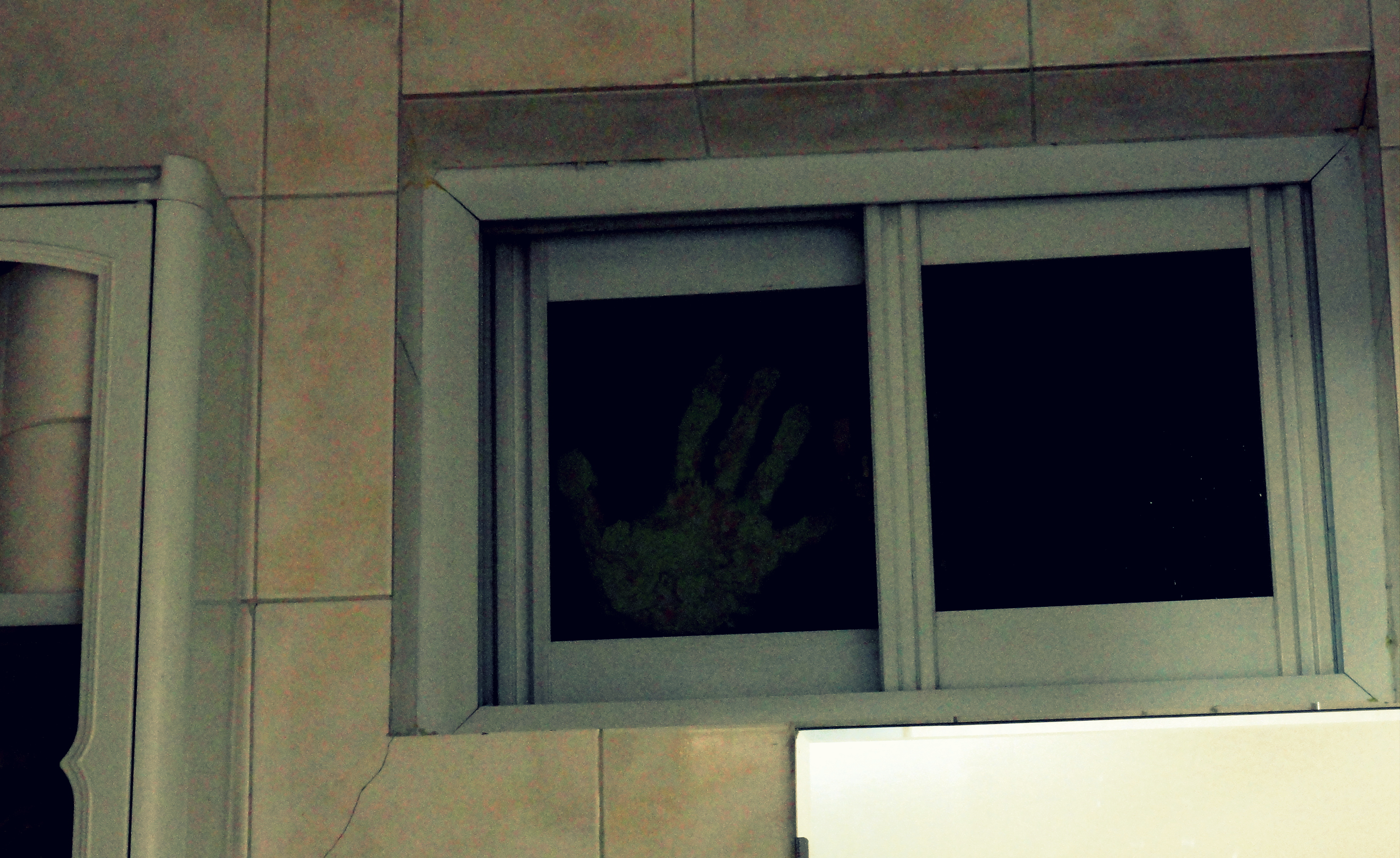
The motion-sensor light in the hall came on—one of my neighbors coming in late, most likely drunk. I didn’t hear any doors open and a few seconds later, the light went off. I was just washing my hands when I glanced up at the window and saw a hand pressed against the glass.

The fingers were long and thin and the whole hand had a greenish-grey tinge to it. It was pulsing slightly—stroking at the frosted glass window with its fingertips and wherever it touched, it left greenish smudges on the glass.

My heart started to pound and I backed out of the bathroom. I wanted to look away, but I couldn’t. The hand slowly slid down the glass and out of sight until all that was left were five long smears.

I was not near the living room light switch but I reached into the bedroom and turned on the light there. At the same time, the motion-sensor light in my small entranceway came on.

I was starting to seriously freak out. Maybe it’s just a short in the wires, I thought. I knew my outer door had been locked. The entranceway light went off, but then a second later it came back on. I saw a shadow of something come across the light through the frosted glass windows in the closed entranceway door. The knob began to turn, silently.

I thought I was going to pass out from panic. I had nothing close by to use as a weapon. In a second, the entranceway door would open.

“Go away!” I shouted, although my voice cracked absurdly. “Go away now . . . in Jesus’ name!”

I wasn’t a Christian at that time, and I had no idea where that came from. It just came into my head, suddenly.

At that moment, the light in the entranceway went off again, which made things worse. I backed a little further into the lighted bedroom, waiting for movement to turn the entranceway light back on.

But it never came back on. The waiting became unbearable. I had no idea if the person was gone or if they were lurking there in my entranceway, not moving and not triggering the light. An hour went by before I got up the nerve to venture out and turn the living room light on. From its light, I could tell that the entranceway was empty. I opened the door and saw that my front door was open too.

There were many things I could not explain. I swear that I had locked my front door—I did so automatically whenever I came home. The outer door was big and creaky, but I never heard a sound. The entranceway was covered with bits of dust and tiny clots of greenish-grey dirt. The strangest thing—and what made me shiver in terror—was the sight of one of my steel-toed boots, crushed almost flat and covered with green dust. I could not imagine what could have done that, and silently too.

I have never seen anything like that since, but once was enough. I could not sleep in that apartment again. I slept in a hotel for two weeks until my school arranged for a new apartment for me, one with a pass code to get into the building. I would have thought it was all a horrible dream except for the dirt and the filthy smears on the window that were still there the next day.

Since that time, I have never had an apartment on the ground floor or one where the windows were at all accessible from outside. Still, whenever it is dark and I catch a glimpse of a window, I shudder to think of another hand pressed again it, smearing it with green-grey filth, or even worse…

…a face.


The Elephant's Trunk

🐘 Nancy is a storyteller, music blogger, humorist, poet, curveballer, noir dreamer 🐘

Thru Violet's Lentz

My view, tho' somewhat askew...

The New, Unofficial, On-line Writer's Guild

Aooga, Aooga - here there be prompts, so dive right in

Just Joyfulness

Celebrating joy

Tao Talk

You have reached a quiet bamboo grove, where you will find an eclectic mix of nature, music, writing, and other creative arts. Tao-Talk is curated by a philosophical daoist who has thrown the net away.

H J Musk

On reading, writing and everything in between ...

Clare Graith

Author, Near Future Sci-Fi

Dirty Sci-Fi Buddha

Musings and books from a grunty overthinker

Rolling Boxcars

Where Gaming Comes at you like a Freight Train

Lady Jabberwocky

Write with Heart

Fatima Fakier

Wayward Thoughts of a Relentless Morning Person

Life in Japan and Beyond

stories and insights from Japan

The Green-Walled Treehouse

Explore . Imagine . Create

One Minute Office Magic

Learning new Microsoft Office tricks in "just a minute"

lightsleeperbutheavydreamer

Just grin and bear it awhile

Linda's Bible Study

Come study God's Word with me!

Haden Clark

Philosophy. Theology. Everything else.

Citizen Tom

Welcome to Conservative commentary and Christian prayers from Mount Vernon, Ohio.

The Green-Walled Chapel

Writings on Faith, Religion and Philosophy

To Be A Magician

Creative writing and short stories

My music canvas

you + me + music

Eve In Korea

My Adventures As An ESL Teacher In South Korea

Luna's Writing Journal

A Place for my Fiction

Upper Iowa University

Center for International Education

Here's To Being Human

Living life as a human

jenacidebybibliophile

Book Reviewer and Blogger

yuxianadventure

kitten loves the world

Strolling South America

10 countries, 675 days, 38,540km

It's All in Finding the Right Words

The Eternal Search to Find One's Self: Flash Fiction and Beyond

Reflections Of Life's Journey

Lessons, Joys, Blessings, Friendships, Heartaches, Hardships , Special Moments

Ryan Lanz

Fantasy Author

Chris Green Stories

Original Short Fiction

Finding Myself Through Writing

Writing Habits of Elle Knowles - Author

BEAUTIFUL WORDS

Inspiring mental health through creative arts and friendly interactions. (Award free blog)

TALES FROM THE MOTHERLAND

Straight up with a twist– Because life is too short to be subtle!

Unmapped Country within Us

Emily Livingstone, Author

Silkpurseproductions's Blog

The art of making a silk purse out of a sow's ear.