Mech Babies

Inspired by the article How Baby-Driven Robots Could Help Disabled Children. I think it’s a great idea.


Roger Preston was dropping his son Phillip off at daycare when he was attacked from behind by a robotic spider.

“Bye bye, Phillip. Daddy’s going to go now,” he had been saying. “Have a great time here with the other—oof!” He fell forward as something hard hit him in the back and he narrowly missed falling on his son. Phillip clapped and giggled at silly daddy.

Roger scrambled away from grasping metal legs and looked back to see a 3-foot wide robotic spider with a toddler sitting in its midst. The way the child sat motionless with its head lolled to one side, while the robot moved around it, produced a very odd picture.

Roger found the teacher right away.

“I guess I should have said something to you about Warren,” the teacher, Mrs. Fredericks said. “We just don’t want to judge or make any child feel different. Warren has a muscle disease and can’t move on his own, so he has his little Creep Around to help with that. Now he can keep up with the other children at playtime.”

“How exactly does he drive it?” Roger asked. “I didn’t see any controls.”

“It’s connected to his brainwaves, so he can drive it just by thinking,” Mrs. Fredericks said, as proudly as if she had invented it herself. “Now, Mr. Preston, I guess I’ll see you this afternoon?”

“I think I’m going to stay and watch a bit today,” Roger said.

There were hard plastic chairs at the back of the room where parents could wait if they came early or just wanted to observe. Roger called his work to tell them he would be late and then settled in to watch Warren in action.

It soon became clear that the robot more than made up for Warren’s disability, at least in movement. At playtime, the children all rushed for the toy chests. Warren, on the other hand, took a flying leap, six feet over their heads and grabbed a toy first. He picked up a teddy bear with two steel pincers and stroked it lovingly with a third. Only once did he become too greedy and tipped over after trying to grab toys with the legs he was standing on. It only took a moment to right himself and scuttle back into the fray.

Roger was impressed, although he wasn’t sure about the brainwave-driven aspect of it. During nap-time, Warren’s robot’s legs suddenly spasmed and he leapt six feet in the air and clung to a wall. Night terrors, Mrs. Fredericks explained. Roger ended up spending the whole day at the daycare, watching Warren with a sort of macabre fascination. Phillip didn’t seem to mind the cybernetically-enhanced boy and played with him just the same.

Roger told his wife Maggie about it when he got home. She was outraged.

“That’s not fair in the least,” she said. “Here this other boy is getting an unfair advantage over the other children. There is no way Phillip can compete with a kid who’s half robot.”

“Well, he’s not really a robot,” Roger said. “Plus, he wouldn’t be able to move otherwise. Phillip didn’t seem to mind him at all.”

“I know, but what about later in life? This is probably the way of the future anyway, so this Warren kid will already be used to the technology when Phillip is just be learning it. I want you get Phillip one of those robots.”

“Yes, honey,” Roger said, and then realized what she had said. “What? No way Phillip is getting one of those!”

“He doesn’t have to use it all day, but he’s getting one. I won’t have my Phillip being upstaged by a robot kid.” She stalked off before he could argue.

Roger looked into it and finally bought the thing. It was easier than arguing and he secretly though it was pretty cool that his 3-year-old son could drive a robot. He bought a smaller version of Warren’s spider walker, but one with a large battery pack that promised higher speeds and a longer jump. This one had manual controls too.

Phillip took to his robot walker as if his mother had been a Borg. He never wanted to get out of it, so Roger rigged up a strap to put the whole thing into the back seat of the SUV. When he dropped Phillip off at daycare, however, Mrs. Fredericks approached with an awkward smile on her face.

“I’m not sure we can allow Phillip to have one of these as well,” she said.

“Well, Warren has one. What’s the difference?”

“Well, Warren is, uh, differently abled. These robot walkers are more for people in his unique life situation.”

“I know how much you don’t want people to feel differently,” Roger said. “That’s one reason we got this. Warren must feel so alone and outside things, beings the only one in a special walker. We wanted him to feel included by getting Phillip one too. At home, we call it the ‘sympathy machine’.”

“Oh, well I see what you mean,” Mrs. Fredericks said. “I guess it’s okay then.”

Roger called Maggie on his way out. “I won her over. It’s all good.”

It was all good too, for a while. Then Roger noticed that other kids were showing up to daycare with movement-assistance robots. In two months, two thirds of the kids had them and the ones without could never keep up. They either stopped coming or got ones of their own.

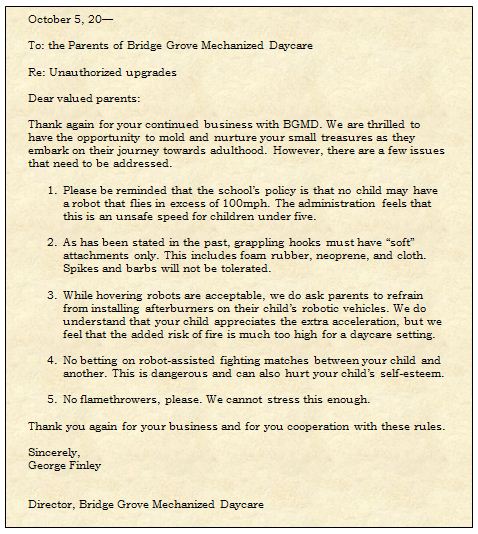
Warren didn’t seem too happy either now that he could not always get the first toy or jump over everyone to get to the lunch line first. One day, when his parents dropped him off, he was sitting in a new hover chair that floated a foot off the ground. After that, it was total war. The daycare finally capitulated and changed its name to Bridge Grove Mechanized Daycare.

A memo from a year later:

Droog’s Story

(An Edward Morrison chapter)

The first story: Saturday, 4am

If I cannot speak, then I am nothing more than a machine, Droog thought. He could speak of course, but only in Russian, a language spoken by no one he had ever known. Androids are already half machines and people think of us as less valuable than themselves. He understood the idea of value, but had no way of determining it himself. I, who cannot speak, might as well be an E-device or a door-opening motor.

Droog was standing by the door of a crumbling police station. His new owner, Edward Morrison was sleeping just inside. He had ordered Droog to keep watch and so Droog stood looking into the darkness, scanning for life and movement every few seconds. As he did every day, Droog thought back and replayed his entire life, reliving memories as clear now as they had been when the events occurred.

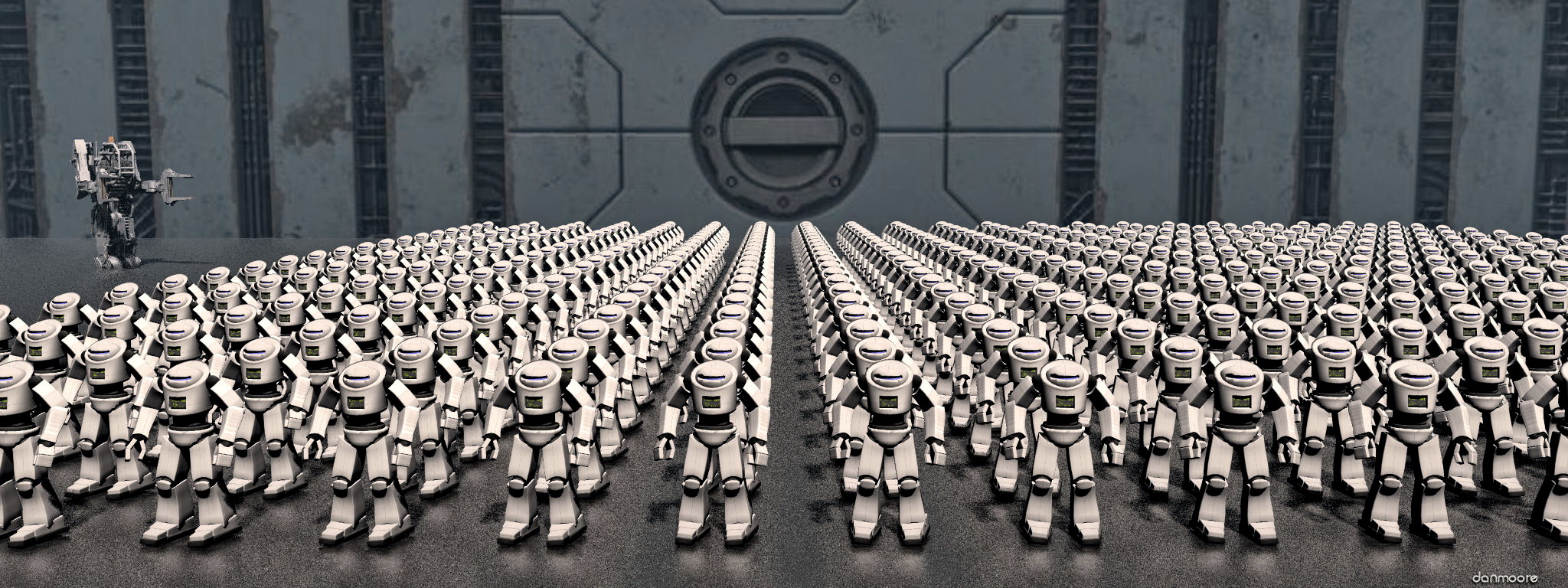
Droog was activated on March 9, 2083. His first thought was 132 since that was the number of rivets he could see on the ceiling above him as his eyes circuits turned on. Technicians directed him to a line of other ‘Munculus Bots where he stood, activated but unneeded for several days. He did not speak, but he took in his surroundings and thought about them, remembering everything.

Three days later, two men walked by. “The London shipment is ready, except because of the lang-pack glitch, we’re one short,” one of them said.

“Here, just take one of the others. By the time they figure it out, it’ll be too late. What are these, Russian? That’ll do.” Droog kept this conversation perfectly preserved in his brain for years until he learned English enough to understand what had been said. Then he knew that he was Russian.

The man directed Droog to a crate where he stood with 99 other ‘Munculus Bots in foam stabilizers. They had all been deactivated for the voyage, but the man had forgotten to deactivate Droog and so he stood for weeks in the dark, listening and thinking. He kept every thought and sensation in his memory and later, when he learned more about the world, he knew that they had been loaded onto a truck, and then onto a ship. The ship had sailed for 18 days and then they had been unloaded again and put onto another truck, and then finally, brought to a warehouse.

The men in England were not happy to find that Droog did not know English. He stood motionless, listening and recording their incomprehensible words while they shouted at him and then shouted into the phone. He stood in the back corner of the warehouse, while other bots came and went by the thousands, staying no more than a few days each. He talked to them all, since all bots can communicate without having to use human language. They were friendly, but they were all babies and knew nothing more about the world than he did.

Then came the day that crushed the world.

In the warehouse, Droog heard a roar so loud that it overloaded his circuits. When he restored his programming, most of the warehouse was gone, crushed into oblivion by another building that had collapsed on it. Through a hole in the wall, he saw daylight for the first time in his life. The light was chalky with dust and was tinged blood-red. He went outside—his first action done on his own inclination—and saw the world for the first time.

Destruction and chaos were everywhere. Fires raged and he heard screams coming from all around. Droog had never heard the sound before and went to investigate.

With the help of his scans, he soon came across a boy curled up by the side of a car. He was whimpering and seemed to be having trouble breathing. Droog could not tell what was wrong with him.

Droog touched the boy’s arm. “Ya tvoi Droog,” he said. I am your friend.

“Droog?” the boy said, looking up at him uncertainly.

“Droog,” Droog said. “I will go get help for you and come back. Do not worry.” The boy nodded blankly at the Russian words and Droog left to find help.

There was none. The only people he saw were either injured or fleeing and none would stop for him. A building collapsed behind him and the road back to the boy was blocked. It took him almost a whole day to pick his way through the rubble to get back to where the boy had been, but when he got there, the boy was gone.

Days and nights came and the fires eventually went out, leaving a deadly calm. People left but did not return and Droog was left alone. For months, he searched for the boy by the car, but never found him. Finally, having nowhere else to go, he went back to languish in the warehouse where he had been stored. There were thirty other bots that had survived. They were deactivated, though, and never replied when he spoke to them.

Years passed, then more years.

Droog waited and thought and walked around outside, searching for the boy. He learned about weather and matched experiences with the words stored in his programming. Then one day, a man came to the warehouse and got very excited when he saw Droog and the other bots. His name was Blake, Droog learned later, and he took Droog with him to a place with other humans and for the first time in his existence, Droog became useful.

Droog helped to find things. He was a scanner, although he could not report what he had found. There were other bots there, and sometimes they tried to translate for him. In this way, Blake rigged up lights on Droog’s shoulders to show the results of his scans. He lived in the community for a long time and during all that time, he kept searching for the Boy-by-Car, as he called him now, that first injured boy he had seen. He never found him, but he scanned every male of the approximately right age. He knew the boy’s bio-rhythmic signature and would know him, if he ever found him again.

Then Blake traded him to a man named Joseph Watson. By this time, Droog could understand English, but still could not speak it. He tried to force himself to speak but the knowledge of what he heard was stored in Russian and came out that way. He did not have a speaker that could have played the recorded bits of conversations he had heard over the years. And so, he heard and understood and languished in silence.

Joseph Watson lived alone and rarely saw other people. He mostly ignored Droog, treating him as just another machine. Droog would not have thought this was strange, but he saw how the other bots had been treated, those who could speak English. They had been companions, not tools. He tried every day to make English sounds, but the only things that come out were nonsense sounds or Russian.

Then came the night when Edward “the Squid” Morrison barged in at 4am and Joseph gave him Droog to save a disc of music. Droog went as he was ordered, exiting the cellar to wander with Edward out in the cold, hard world. Droog did not have emotions or preferences, but he understand, on some level, the idea of liking things. To the point that Droog could like anything, he liked traveling with Edward. Edward had a mission, although Droog did not know what it was. Droog had a mission too. He still searched for the Boy-by-Car. He had said he would come back with help and he still intended to.


Isabelle’s Island

Louis Grillon woke up to find himself on an island roughly half the size of the now-shipwrecked frigate that had placed him there. It was a barren slip of black rock devoid of any life, save a few barnacles.

What was worse, in a way, was the huge lush island that lay next to his sea-splashed rock, a mere fifty feet of swirling white water away. The trees there were tall and shady and he could see little streams of water trickling down to the shore from the high interior. It looked like a paradise.

It was late afternoon and the sun sat just above the highest peak of the island. Louis lay down and closed his eyes, listening to the crash of the waves and smelling the distinctive brine and sea-rot smell of the shoreline.

“Hello? Who are you?” Louis heard a tremulous female voice calling in English. He looked across the narrow channel and saw a young girl kneeling on the rocks on the far side, leaning towards him.

“Who are you?” Louis asked in French, and he heard a muffled gasp and a sob.

“Oh, thank God! Thank the Lord you’ve come. I’ve been so lonely and scared here. You’ve come to rescue me at last,” the girl said, switching to French.

“I am afraid I am not in the position to rescue anyone. I have been shipwrecked here myself,” Louis said.

“It is no matter,” the girl said. “You are here, at least, and can protect me and keep me company. What is your name, sir?”

“I am Louis Grillon, a sailor in the French navy. I was shipwrecked last night and floated for hours before I found myself here. And who are you, little girl?”

“My name is Isabelle. I—” She suddenly broke down in tears and could not continue speaking for several minutes.

Through scattered words forced out between sobs, Louis learned that Isabelle had been shipwrecked with her family some time ago, but they had all disappeared and she had been left on her own. She had no idea how long ago it had been. Louis could see that she was wearing an old-fashioned style of dress; when he asked about it, Isabelle thought that she had gotten it from her mother.

“I am so glad you have come, Louis,” Isabelle said some time later, when she had composed herself. “You have no idea what it is like, to be young and alone on a wild island like this. But why do you stay over there, on that little piece of rock? Will you come over here, with me?”

Louis looked at the water crashing on the barely-submerged rocks in the channel. It would be suicide to cross it at that time, in his condition. “I cannot now,” he said. “Perhaps at low tide.”

Isabelle nodded vaguely. “You know, there is a monster on this island,” she said. “It stalks me every night. I usually sleep in the trees where it cannot find me, but once I could not find a tree before sunset and I ran all night, hearing its heavy footprints right behind me. If you came over here, could you defend me against the monster? You are so much stronger than me.”

Louis’ throat was burning from thirst and the dehydration was beginning to creep into his brain, making it hard to think. “Yes, yes of course I would defend you from anything, if I could,” he said. “How can I get there though?”

“You must swim,” she said. “Look, the sun has just gone down behind the top ridge of the island. It will be dark very soon and then the monster will come out to hunt. You must hurry.”

“Water . . . I need water before I can try. I floated for so long.” His head was beginning to swim.

“There is plenty of water over here, Louis. Once you are here, you can have as much as you want. Look, it is not far. A minute of work and you will be here and can relax.”

Louis nodded. He knew she was right. A small struggle and he would be there. Still, he sat there as the light continued to fade, unable to force his aching muscles to move.

“Louis, you must hurry,” Isabelle said. “Please, come quickly. I need you here; I am so lonely, with no one to talk to and no one to play with. Come to me, Louis. Please, come.”

“I—I am coming,” he said. He slid a foot into the water, grimacing at the cold shock. He felt a rock below the surface and used it as a foothold. Internally, he prepared himself for the ordeal and frantic swim.

“Louis?” Isabelle asked. He looked up. “You won’t leave me, right? You’ll stay with me?”

“Yes, I’ll stay with you, Isabelle. Don’t worry,” he said.

“Do you promise?”

He nodded. “I promise. It will be okay.” The sound of the rushing water was filling his ears and he looked at the swirling water. I can’t do this, he told himself. I will be killed. I can’t do this, but I have to.

Twilight had fallen and the upper ridges and treetops of the island glowed pink with the last rays of the setting sun. Suddenly, Isabelle screamed.

Louis looked up and saw a large shape coming towards them down the beach. It was a large as a horse, with what looked like long fur and horns. It walked with a shambling gait.

“Louis, please! It’s the monster. Louis, help me. Help!”

Louis threw himself into the water. He did not know how he was going to defend this girl against a huge beast like that, but he did not wait to contemplate it. The water closed around him and he flailed his weak limbs, trying to move forward and stay above the surface.

The water took him, spun him with its terrible strength, and sent him slamming against the rocks. There was no pain, just a sickening concussion that shook his whole body. Even as he was pulled down by the undertow, he kept swimming feebly, like a mouse batting at a tornado with its paws.

The monster on the beach stopped walking and then, slowly faded from view. Isabelle sat staring at the place where Louis had disappeared, a look of anger and disbelief on her face. Then, slowly, she too faded from sight.

*         *         *

It was 1996 and Tom Nedimyer was sailing his yacht solo through French Polynesia. It was about noon when he saw an island appear on the horizon, off to the right. The chart showed it as uninhabited, so he steered towards it and took the inflatable in to the beach. It would be good to get on land again and maybe hunt some wild game.

He was pulling the boat up onto the beach when he saw movement among the trees. It was a little girl wearing an old-fashioned dress. He waved at her and she took a step towards him.

“Où est Louis? Est-ce que vous le connaissez?” she asked.

“Sorry, miss. My French isn’t too good,” Tom said. “Do you know English?”

“Where is Louis? Do you know him?” she asked again.

“I don’t know any Louis, sorry. I’m alone and I haven’t seen any other ships today.”

“He promised he would come be with me and protect me,” she said. “He promised and then he just left. Will you stay with me? I’m so lonely and afraid.”

Tom put up a hand. “I can’t stay more than a couple hours, I’m afraid. I’m expected in Fiji in a week or so. I can send out a radio bulletin to look for him, if you’d like.”

“There is a monster on this island, you know,” she said. “It stalks me at night if I don’t climb up into the trees. Can you please stay with me and defend me. I’m so afraid here by myself.”

“I’m sorry, I need to get back to my boat,” Tom said, moving back towards the inflatable. “I’ll be sure to put out a bulletin to look for your friend Louis and I’ll get someone to send a rescue vessel to pick you up.”

From behind him, he heard a sudden cracking noise and whirled around. Something large and hairy had risen out of the sea and was clinging to the side of his small yacht. As he watched in horror, it grasped the gunwale with a clawed limb and tore a huge section from the hull. It did this again and again until the ship listed and capsized.

“I told you there was a monster,” the girl said. “It broke your ship. But now you can stay with me here and keep me company. I’m so lonely here by myself. What’s your name? My name is Isabelle.”


Let the Cast Assemble

If you read my blog regularly, you know that I tend to write a wide variety of stories with many different characters. However, if you were really paying attention, you know that a few characters have come up more than once.

The first of these is Klista. She first appeared in the story See the World Through a Cardboard Tube! and then recently in The Recruitment of Bruce Riansson.

Klista is a mysterious character. She is a woman who apparently has no trouble traveling between worlds or even quickly in space. Where she comes from is unknown. She often wears a red cloak and carries a bag of strange, possibly magical, items. As for what she does, she tells Bruce Riansson to “think of me as a type of guide. I show secrets to people who need them and who are worthy.” What this actually means, will be explored in later stories.

Joining her is Bruce Riansson, a former innkeeper who was exiled from his home country of Indrake for harboring a fleeing traitor. Because The Recruitment of Bruce Riansson occurred first, Bruce is actually the unnamed male assistant in See the World Through a Cardboard Tube!

The second recurring character is Horus Vere. He was the main character in The Mermaid’s Kiss and I Was on Trial Once… He come from the same world as Bruce Riansson and is a professional traveler, who seeks adventure and whatever profit he can make along the way.

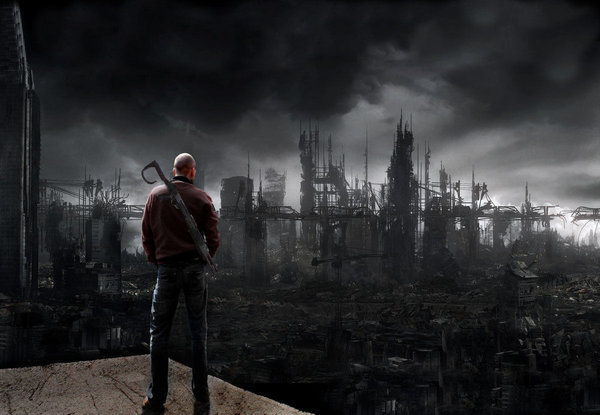
A third character who will become a recurring character is Edward “The Squid” Morrison, who appeared in the recent story Saturday, 4am. He is an extortionist and scavenger in post-apocalyptic England who is out to find what he calls “hidden pearls” of the old world, the time Before. He is accompanied by his recently-acquired android follower, Droog.

I will still write unrelated stories, but I will write more stories to expand these three story arcs. Let me know if there is one character whose stories you particularly enjoy and I will try to do more with them.


Saturday, 4am

This is the second story in the Open Prompts series. Because of the length constraint, it is not a full story, on the beginning. More will come, I promise. Here were the story elements suggested:

1. Title: “Saturday, 4am” (suggested by me)
2. Length: about 700 words (suggested by Reality of Christ)
3. vinyl records (suggested by Alastair)
4. A character named Edward “the Squid” Morrison (suggested by Christopher De Voss)
5. Genre: post-apocalyptic sci-fi (suggested by jomiddleton)
6. an android sidekick (suggested by Exit Fresh)

Edward Morrison was the unofficial king of the decaying residential area known as Free Frall. He worked alone, by night, collecting and gathering and making his influence felt among the ragged collection of survivors that haunted the rotting suburb. They would pay him a share of what they found by virtue of what he called “personality”. They called him the Squid, and he liked it.

Free Frall was in the wrong place for revival. It was too close to the bomb-blasted epicenter that had been London, but too far from the enclave of Cambridge, where a determined remnant tried to piece a civilization back together.

Edward checked his device screen. It was Saturday, 4 am. It was funny—five billion people dead and most of the rest living like trolls, but they still knew the day and the time, thanks to Cambridge. Technology galore, but no food.

He was in an area he rarely went to—the rusted sign named the cul-de-sac Brighton Circle. The last stop of the night. There was a house he had his eye on.

***

It was 4am and Joseph Watson was just getting ready to go to bed when he heard a creak from the stairs leading down to his cellar home. Droog, a dwarf-sized robot, whirred over to the door and did a scan. The light on his shoulder went red. Joseph was just reaching for his gun when the door flew open and Edward “the Squid” Morrison stepped in.

“What do you want, Squid?” Joseph said, trying to sound unconcerned.

“Joseph, so this is where you’ve been hiding!” Edward said, with a big smile. “I heard you were dead, but then I kept hearing rumors. I’m glad to see you.”

“Yeah, I’ll bet you are. You always took whatever you wanted from me,” Joseph said. “What—what can I get for you?” he added quickly, as Edward started to walk around the cluttered room with an appraising eye.

“Just seeing what you’ve found—you always did get the best junk. Where did you find this thing?” He toed Droog, who was following him around, still scanning him.

“It’s a ‘Munculus Bot. A guy in Cambridge found a bunch and is fixing them up and trading them. His name is Droog. He doesn’t know English.”

“I wouldn’t think you’d be too attached to it then,” Edward said. “Hey, what do you got here?” He picked up a thin, black disc and was rewarded when Joseph jumped up, fear plain on his face.

“You don’t want that, Squid. Here, take Droog if you’d like. Please, just—put it down.” Edward raised his eyebrows and started to twirl the disc in his fingers.

“Okay, I’ll tell you,” Joseph said. “Just—be careful. It’s music.”

“Music? Like hum-tunes? Why would I want that?”

“This is music from Before. There are tiny grooves that hold the music. No, not like that,” he said quickly as Edward held up the vinyl record to his ear. “I wrote an instruct for the scanner on my device to read them. Here.”

Joseph set the record down on the desk and placed his E-device in a wire frame that suspended it above the record. Then he turned it on and a tiny laser flashed rapidly around the black disc.

A sound unlike anything Edward had ever heard started to pour from the device’s speaker. It was a woman singing strong and clear in a strange language. It had such tragic and haunting tones that Edward involuntarily closed his eyes. It was as if a window had been opened out onto another world, but it was too dark to see more than an inch beyond the frame. And he so desperately wanted to see. The music soared and dipped and finally, faded away.

“What is she saying, in the music?” Edward asked.

“It’s another language,” Joseph said, with a shrug. “They say there were hundreds of them, Before. Maybe there still are, somewhere.”

“Where did you get this?” Edward asked. “Tell me, please.”

“I traded the four I have from a wanderer named Ryan. He makes runs from here to Cambridge and around. I’ve asked for more, but he hasn’t gotten me any. Please, take Droog if you want, but not the discs.”

“Fine, I’ll take Droog instead, but only if you give me the instruct for playing the music.”

“Okay, I guess. You’re going to go find more?”

Edward was, but that wasn’t all. Hearing that song at 4 am on Saturday was like uncovering a pearl in a mound of filth. It was something that for years had remained unsullied by the decay around it. There must be more, and he was going to find it.

(Mireille Mathieu – “Exodus”)


Innocence of the Swarm

(This is not a metaphor for anything. It simply is what it is.)

Jeremy reached up and plucked a locust out of the air and held it between two fingers. The swarm was coming, the news said. The main body was only a mile off, maybe less. It was consuming everything in its path, destroying the food of thousands in a single day. It was unstoppable.

He looked at the single locust he held between his fingers. It was struggling to get free. Of course, what creature wouldn’t try to free itself? This single locust knew nothing about the swarm. It had hatched and now it was hungry, so it was eating. It ate so little that the amount would never even be noticed, if it were by itself.

It was innocent, he realized. It had no malicious instincts, no evil plans for the misery of others. It wanted what every other creature wanted: to eat and to reproduce. To live.

Even killing it would make no difference. The absence of this single insect would not help anything one whit. It was insignificant and innocent, and yet . . .

“Jeremy, come help me get the barn closed up,” his wife called.

“Coming.” He crushed the locust between his fingers and threw its body on the ground.


Open Prompts #2

This is the second call for story elements in a series I’m calling Open Prompts (I’m not entirely sure I like that name though, so if you have a better suggestion, let me know). The result of the first Open Prompts was my story “Klutz” and originolS’s story “$0.99 Only”.

If you have a suggestion for a story element, post it in the comments. It’s pretty open, but here are some examples:

– the title

– the genre (fantasy, mystery, horror, etc.)

– the tone (dark, humorous , serious, absurd, etc.)

– a character’s name or other details about them (just one character at a time, though)

– plot elements (e.g. a silver dagger, a rainstorm, identical twins, etc.)

– the length (something between 50 and 1500 words)

– anything else you feel like.

I’m going to use six story elements, suggesting the first one myself to get the ball rolling. I know everyone has their own blogging/writing schedule, but if you’d like to join me, I’d be thrilled to read your story based on the same story elements.

Story elements:

  1. The title is: “Saturday, 4am”

Have fun! Be creative! I’ll post the story this Friday.


The Poetry of War

Lonely birds in skies of ash

Soar over isles of rock and heath

Sudden sprouts of wispy drab

Burst forth and float to ground beneath.

Barking shouts from hidden nests

Scream forth to greet these assailing seeds

The first of the raptors meets its prey

And in midair begins to feed.

“Fire!”

The chatter of anti-aircraft fire filled the air and the first of the 40mm flak guns had just begun to hurl shells into the air. Captain Rost watched the sky fill with more and more tiny olive-drab parachutes, the enemy soldiers beneath almost invisible against the overcast sky. He saw a flak round hit one of the closer ones with a jerk and a small spray, but most found only empty air and the invaders drifted ever closer to the ground. A staff officer hurried up to him.

“Captain, you are ordered to roll out your platoon to the landing zone to repulse the invaders. The defense of the fort is the first priority.” The major hurried away, talking on his walkie-talkie. Captain Rost looked back to the paratroopers. Now that they were lower, the anti-aircraft guns were finding more marks, ripping through parachutes and men and sending them hurtling to the earth. It was not enough though. Within minutes, a thousand or more shock troops would be on the ground. He ran towards his tank, shouting for the crews to saddle up, load up, get rolling. Minutes later, the gates of the fort opened and a column of tanks and APCs with mounted machine guns rolled out to defend their sovereign territory.

š ›The trees rushed up

And through I fell

Fingering branches and whispered doom

A savage jerk and then

Dangling

Cut here, cut there

A crashing thud

Silence

The fear rushed in

I watched and waited

Cries of pain and victory all around

A burst of fire

Chaos

Duck here, dodge there

Running scared

Terror

A man loomed up

I aimed and fired

A single shot sped through the air

A bloom of red

Hit

Screaming loud, tumbling down

First kill

Sick

Private First Class John Haviland’s hands shook as he lowered his rifle. The enemy soldier lay dead ten yards ahead of him. He reached up, past his parachute harness and reached for a fresh magazine. Then he remembered he had only fired one shot and let it be.

All around him, the woods echoed with the staccato of machine gun and rifle fire and with the cries of men. He could not tell what side they came from—probably both. He stood for a moment looking around in confusion. He had killed a man, but he was alone in the woods. Which way was he supposed to go? Their orders were to take the fort in the center of the island, but what direction was that in?

“Hey, soldier! What the hell do you think you’re doing?” PFC Haviland turned to see a lieutenant crouched behind a bush. “Get your ass down! Do you want to get shot?” Haviland dropped to the ground and crawled over to the lieutenant. He felt better. Getting shouted at was familiar ground.

“Which way, sir?”

“Follow me and keep down. We’re going straight up, you cover the flank.” The lieutenant darted forward and Haviland lurched after him, swinging the barrel of his rifle back and forth.

A bullet whistled by him from the right. He fell flat and fired a burst without aiming. The bullets tore up the bark of a tree twenty yards away. Then he was up and scrambling to the hollow where the lieutenant had taken shelter.

This was the routine for the next few minutes. Duck, wait, fire, sprint, drop, crawl, wait. The lieutenant shot two enemy soldiers before Haviland even saw them. He felt scared and useless, but it was better than being alone. Five minutes later, they came across a squad of their own men, including a captain. There were bazookas in this group and the officers started ordering attack formations. Haviland was handed a bazooka and then they were off again.

They came out of the trees to rocky ground covered with scrub grass and low bushes. Private Haviland heard a squeaking rumble and a tank appeared ahead of them, then two more off to the right. It stopped as soon as it was in sight, and the turret rotated towards them.

Haviland wished they hadn’t given him a bazooka. He was breathing hard as he thumbed the safety switch and sighted it on the space between the tank’s turret and main body. He had a mental image of himself vomiting just as he pulled the trigger, firing into the ground and killing them all. He pulled the trigger and with a roar of flame, the rocket was away.

Iron dragon green

Explodes like blooming orchid

Burning men inside

Even from within his tank, Captain Rost felt the concussion as the tank near him exploded. He shouted orders to return fire, but the gunner was already moving the main gun, sighting in on the low depression where the rocket had come from. The tank rocked back as the gun fired, and the low hillock 60 yards away fountained up in a shower of rock and splintered vegetation. Rost opened the top hatch and got behind the .50 caliber machine gun. There was a sporadic crackle of rifle fire, some of it pinging off the armor of the tank. He returned fire, strafing the edge of the woods wherever he saw movement.

The tank was moving again, turning and prowling along the edge of the trees. Rost kept the machine gun pointed at the trees, letting out short bursts. An anti-tank rocket flew over his hand. He fired at the direction it had come from. He paused for a moment, but there was only silence.

A tiny pool of red

Fed from a small but steady stream

That issues from a tiny gash

In a jacket of olive green

Pumped from the labored heart

Of mother’s son both young and loyal

Whose life leaks out on foreign leaves

Absorbed in foreign soil

Private Haviland had lost his rifle. He lay with his back to a spiky tree, holding the wound in his side. He tried not breathe—every rise and fall of his chest made more blood spill out and soak his uniform. He gritted his teeth, trying to think.

Most of the rest of the squad was dead. A few must have survived, but if they had, they had already advanced. Was he going to die? How would he ever find a medic like this? He felt a wave of lightheadedness come over him. It had to be shock, unless it was the first signs of the final unconsciousness that he would never wake up from. He fought it, blinking his eyes furiously and pressing on the wound as tight as he could.

There was another rumbling of a tank approaching. More bursts from a machine gun. Haviland saw a group of four enemy tanks come into view in the field ahead of him. They were patrolling, turning this way and that as if not sure of where to attack next. Haviland was in plain sight from where they sat; he could only hope that if they did see him, they would consider a wounded soldier not even worth a bullet.

The commander of the lead tank pointed in his direction and swiveled the machine gun around. Haviland was bracing for the shots when he heard a high pitched whistle and a line of fire balls enveloped the far two tanks in a sudden conflagration. The remaining two tanks hurried to gain cover. Just before he lost consciousness, Haviland could see allied bombers flying overhead, like tiny specks of black against the grey sky. He felt happy, although he was not sure why, considering he was about to die.

Night falls and the tigers sheath their claws

And with stealthy paws

Search the carnage they have caused

Despite the air support, the attack had failed. The invasion force had been crushed and either destroyed or captured as prisoners. Captain Rost escorted a medical and recovery team as they searched by flashlight for survivors on both sides.

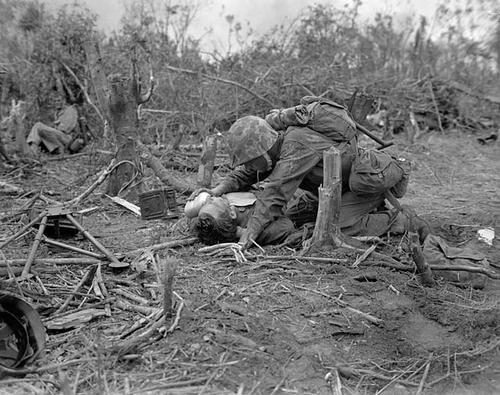
He came across a group of bodies lying near where his tank column had been attacked. His soldiers went around collecting the corpses and weapons, piling them to be picked up later. He was searching one body for intelligence when it moved slightly and gave a small moan.

“Medic!” he shouted and waited as men with a stretcher approached. They lifted the wounded man onto it and carried him away.

An hour later, Captain Rost returned to the fort and went to the medical corps where he was shown into a guarded area for wounded prisoners of war. The wounded enemy soldier he had found had been bandaged and lay on a low cot. He opened his eyes when Rost approached.

“What is your name, soldier?” Rost asked. The boy looked muzzily at him.

“Private First Class John Haviland,” he said finally, his voice barely more than a croak. “Am I a prisoner?”

“Yes, your attack failed,” Rost said. “You are in recovery now. The doctors believe it is a miracle that you are alive at all. You had more than a foot on death’s threshold when we found you.”

“Why did you save me then?” Haviland asked. “I am the enemy. Out there we tried to kill each other.”

Captain Rost shrugged. “It is soldiers who must fight, but wars are fought between nations, not between men. Does your side not see it that way?”

“We were told that you tortured prisoners and used them in barbaric ways.”

Captain Rost smiled. “We are told the same about you, but those things are told by nations, not by men. Get better soon.”

Like arm-wrestlers locked in struggle

The war raged back and forth

Swaying to one side, then the other

Until one fell

They laid down their arms

Dusted off their uniforms

And shook hands

Treaties were signed

Prisoners released

Men returned home

And the war was added as one line

In the grand history of humankind


The Recruitment of Bruce Riansson

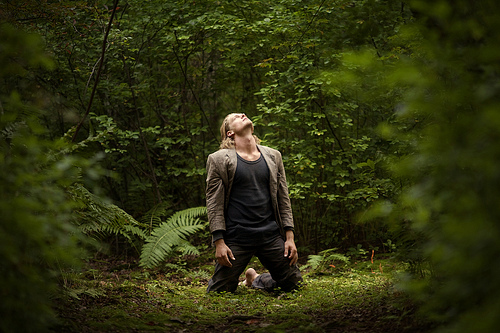
The leaves were what first spoke to Bruce Riansson and told him that maybe there was still some hope in life.

He sat on the damp, pungent leaf mould of the clearing just where the squad of soldiers had left him, with all that he now owned in the world: a satchel with enough food for two meals, a small knife and three copper coins. He had been exiled to the wilderness and they had left him three copper coins. It was a mockery of charity.

He wished they had just killed him. He had been sentenced to death, but the king, with a wicked glint in his eyes, had so graciously, so magnanimously commuted his sentence to exile. Now he would die a longer, more painful death than any executioner’s axe could give.

He had been sitting that way for some time when he heard the leaves rustling and whispering above him as the wind played them back and forth restlessly. There were no words in their message, but as he listened, he felt better. He was still alive and he was free now. There was still hope.

Bruce stood up and with a start, noticed a woman looking at him from across the clearing. She had black hair and was wearing a dark red cloak of a style he had never seen before. She smiled at him. “I was wondering when you would stand up. Those leaves are quite persuasive, I see.”

Bruce looked at her warily. “Was it you who made them shake like that?”

“No, that was only the wind,” she said, walking towards him. “But I had a feeling they would have that effect on you. My name is Klista. Remember it, please. And you are?”

“Bruce Riansson,” he said, with a feeling that she already knew.

“How is it that you are sitting out here alone, Bruce Riansson?” Klista asked, putting a hand on her hip. It was a gesture both familiar and imperious.

“I was exiled from Indrake,” he said. “The traitor and former pirate, Sir Denvé, came through our village as he was fleeing capture. I let him stay at my inn.”

“And you knew that it was him?”

“I have never turned away anyone from my inn. I have always considered hospitality to be a matter of humanity, not politics.”

Klista nodded. “That’s a very mature attitude. Very rare indeed, actually. Now, Bruce Riansson, I have a proposition for you. I knew you would be coming here and I was waiting for you. If you wish, you may work for me, work with me even. The work is not what you are used to, but I’m sure you will be suited to it, nevertheless.”

“Who are you?” Bruce asked, his apprehension rising again. “Why would I want to work for you?”

“I have already told you my name,” Klista said. “I did ask you to remember it, you recall. Besides that, think of me as a type of guide. I show secrets to people who need them and who are worthy. Does that not sound intriguing? As for why you should work for me, you are exiled in the wilderness in late summer with almost no supplies.” She gave him a look as if the choice were obvious.

“What would I have to do?” he asked.

“Ah, we’ll get to that in time. First, I have a test for you. I have to be completely sure about you first.” She took a leather bag off her shoulder and rummaged through it. Bruce caught a glimpse of a jumble of strange objects: a purple conch shell, a white tube with blue stars on it, and a key shaped like a spreading tree. Finally, she pulled out a box with a glass window in it and handed it to him.

“This is a compass,” she said and then saw his blank expression. “It has lodestone in it and always points in the same direction. What you have to do is follow the direction of the needle. Several miles away there is a high pass between two mountains. Reach that pass by sunset and look over the other side and you have passed the test.”

“That is all? It sounds too simple.”

“You have not seen the way yet. Remember, you must follow the needle exactly. There will be an easier way up, but do not take it. Sometimes the journey taken is more important than the destination reached. Sometimes the destination depends on the path taken there. Now go and I will see you at sunset.”

Klista walked off briskly. Bruce picked up his pack and looked at the box. The needle pointed into the trees, away from where Klista had gone. He started walking.

At first, the way was easy. There was little underbrush and the ground was level. After half an hour, the ground got steeper and soon the way was choked with brambles that tore at him with thorny claws.

He had just climbed over a pile of rocks when he saw a well-defined trail off to the right. He ignored it and kept fighting his way through the underbrush. The trail crossed his path and for a moment, he was tempted to follow it for a little ways, until he remembered and re-entered the tangle of bushes.

The mountain trail zigzagged back and forth up the slope and by the time Bruce had crossed and re-crossed it four times, he was torn and bleeding in multiple places and his clothes were shredded to rags. Already the light was decreasing, softening to the peaceful glow of dusk. He pressed on.

He crossed the mountain trail for the last time and it disappeared off to the left, going straight and following the ridge of the mountains. Above him were two steep peaks like horns, their summits tinged with red from the approaching sunset. Between them, he saw the high pass, only several hundred feet above him.

The final climb was the worst. He scrambled recklessly up as the sky darkened above him, ignoring the sharp bite of razor-like granite edges cutting into his hands. Finally, he pulled himself up to the pass and looked over.

The valley below him was a mass of trees, like a vast carpet of greenery. Bruce looked farther and in the orange glow of the day’s end, he saw strange structures rising out of the trees. They were like huge blocks of stone, a hundred feet high or more, but he could see the light glinting off rows of windows. It was a vision of some alien city.


“You pass,” Klista said from behind him. He turned quickly.

“How did you get here?”

“I take my own paths,” she said. “What do you think that is?” She pointed to the distant structures.

“I do not know, but it looks like a city of some sort.”

“It is a city, although not one of this world. This is what I wanted to show you, a tiny taste of what is hidden behind real life. The world you were living in yesterday was infinitely smaller than the world you will be living in tomorrow.”

“Is it really over there or is it only a vision?” Bruce asked.

“It is really where it is,” Klista said. “You will find that a word like ‘there’ has very little meaning. If you mean, could you reach it by walking, then yes. You were able to see it by following the compass and you could follow it to the actual place too. But that is a long, hard road and I travel by quicker ones. Now, do you still want to join me?”

“I do not know what I can do, but yes, I am willing,” Bruce said. He offered her the compass, but she shook her head.

“You keep it. It will be very useful to you in the future, I think. This is the not the end of your journey by far, Bruce Riansson: this is only the beginning.”


Old Moon, Young Moon

(Inspired by a comment thread with RoSy)

The Man on the Moon felt old. He had looked down on the Earth constantly for thousands of years and had witnessed all of human history. He had risen and set over countless nations and rulers, and the comings and goings of billions of human lives. And still he looked down, his weathered face more ancient by far than the oldest thing that moved or grew on the surface of the Earth.

The Boy on the Moon, obscured on the far side, felt young. He looked out into the vastness of space and laughed with delight. Compared with the shining stars and whirling galaxies that he saw, he was nothing more than a newborn baby, mere seconds out of its celestial womb.


The Elephant's Trunk

🐘 Nancy is a storyteller, music blogger, humorist, poet, curveballer, noir dreamer 🐘

Thru Violet's Lentz

My view, tho' somewhat askew...

The New, Unofficial, On-line Writer's Guild

Aooga, Aooga - here there be prompts, so dive right in

Just Joyfulness

Celebrating joy

Tao-Talk

You have reached a quiet bamboo grove, where you will find an eclectic mix of nature, music, writing, and other creative arts. Tao-Talk is curated by a philosophical daoist who has thrown the net away.

H J Musk

On reading, writing and everything in between ...

Clare Graith

Author, Near Future Sci-Fi, Dystopian, Apocalypse

Kent Wayne

Epic fantasy & military sci-fi author.

Rolling Boxcars

Where Gaming Comes at you like a Freight Train

Lady Jabberwocky

Write with Heart

Fatima Fakier

Wayward Thoughts of a Relentless Morning Person

Life in Japan and Beyond

stories and insights from Japan

The Green-Walled Treehouse

Explore . Imagine . Create

One Minute Office Magic

Learning new Microsoft Office tricks in "just a minute"

lightsleeperbutheavydreamer

Just grin and bear it awhile

Linda's Bible Study

Come study God's Word with me!

Haden Clark

Philosophy. Theology. Everything else.

Citizen Tom

Welcome to Conservative commentary and Christian prayers from Mount Vernon, Ohio.

The Green-Walled Chapel

Writings on Faith, Religion and Philosophy

To Be A Magician

Creative writing and short stories

My music canvas

you + me + music

Eve In Korea

My Adventures As An ESL Teacher In South Korea

Luna's Writing Journal

A Place for my Fiction

Upper Iowa University

Center for International Education

Here's To Being Human

Living life as a human

jenacidebybibliophile

Book Reviewer and Blogger

yuxianadventure

kitten loves the world

Strolling South America

10 countries, 675 days, 38,540km

It's All in Finding the Right Words

The Eternal Search to Find One's Self: Flash Fiction and Beyond

Reflections Of Life's Journey

Lessons, Joys, Blessings, Friendships, Heartaches, Hardships , Special Moments

Ryan Lanz

Fantasy Author

Chris Green Stories

Original Short Fiction

Finding Myself Through Writing

Writing Habits of Elle Knowles - Author

BEAUTIFUL WORDS

Inspiring mental health through creative arts and friendly interactions. (Award free blog)

TALES FROM THE MOTHERLAND

Straight up with a twist– Because life is too short to be subtle!

Unmapped Country within Us

Emily Livingstone, Author

Silkpurseproductions's Blog

The art of making a silk purse out of a sow's ear.

BJ Writes

My online repository for works in progress